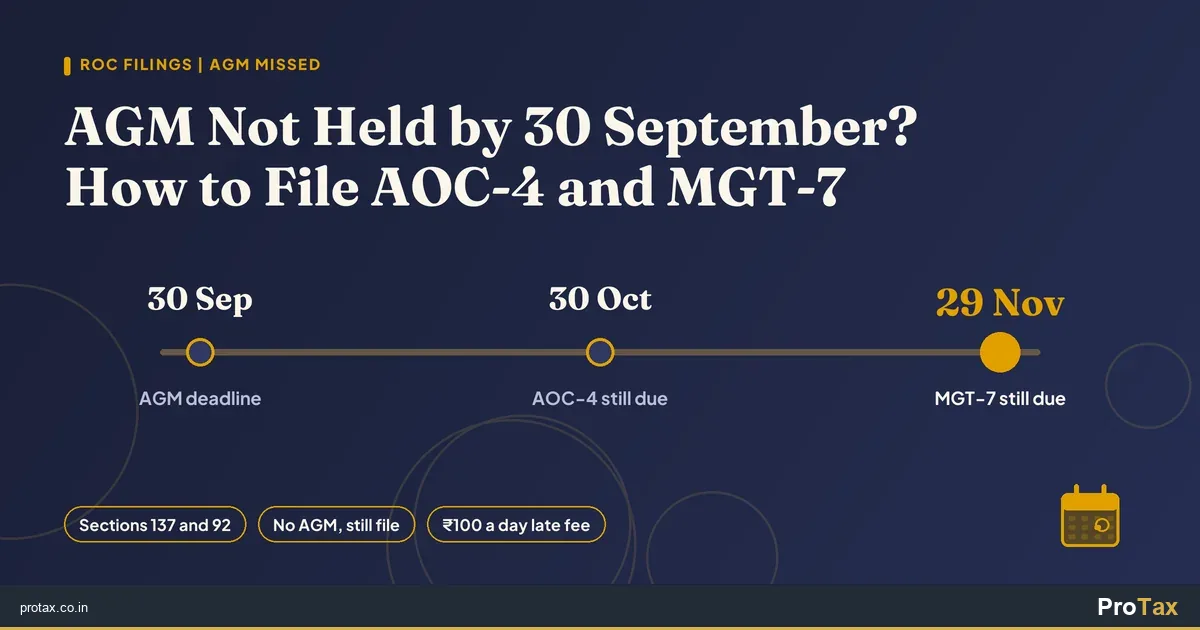
If your company did not hold its AGM by 30 September 2026, the annual filing clock has not stopped. It has simply switched tracks. Under Section 137(2) and Section 92(4) of the Companies Act, 2013, you still file AOC-4 by 30 October 2026 and MGT-7 or MGT-7A by 29 November 2026, counted from the last date the AGM should have been held. Both forms go in with a signed statement of facts and reasons for not holding the meeting. Filed inside those windows, they attract only the normal MCA fee of ₹200 to ₹600 per form. Miss them, and ₹100 per day per form starts adding up with no cap. The missed AGM itself is a separate problem under Section 99, with a fine of up to ₹1 lakh. Here is how each piece works, and what to do this month.
- AOC-4 due 30 October 2026 and MGT-7/MGT-7A due 29 November 2026 for FY 2025-26 when the AGM was not held and no extension was granted.
- Both forms need a statement of facts and reasons for not holding the AGM, approved by the board.
- On-time filing costs only the ₹200 to ₹600 normal fee per form; the ₹100 per day additional fee applies only after the deadline.
- Filing does not cure the AGM default. Section 99 allows a fine of up to ₹1,00,000 plus ₹5,000 per day, which can be compounded under Section 441.
- A GNL-1 extension of up to 3 months works only if filed before 30 September, and never for a company's first AGM.
The rules below cover private and public companies with a 31 March financial year end that missed the FY 2025-26 AGM. It does not cover LLPs, which have no AGM requirement, or listed company obligations under SEBI regulations.
What Happens When an AGM Is Not Held by 30 September 2026?
An Annual General Meeting (AGM) is the yearly meeting of a company's members, required under Section 96 of the Companies Act, 2013, at which shareholders adopt the audited financial statements, appoint or ratify auditors and transact ordinary business. Every company except a One Person Company must hold one.
Section 96 sets two clocks. The first AGM must be held within 9 months from the close of the first financial year. Every later AGM must be held within 6 months of the year end, with no more than 15 months between two AGMs. For a 31 March year end, that puts the FY 2025-26 AGM deadline at 30 September 2026.
When that date passes without a meeting, three things happen at once. The company is in default under Section 96. The deadlines for AOC-4 and MGT-7 start running from 30 September instead of from an actual AGM date. And the financial statements still have to reach the Registrar of Companies (ROC), because the law treats annual disclosure as separate from the meeting itself. Think of the AGM as the train and the filings as the cargo: the train missed its slot, but the cargo still has to be delivered on schedule.
The rules come from the Companies Act, 2013: Section 96 (AGM timing), Section 97 (NCLT power to call an AGM), Section 99 (penalty for AGM default), Section 137 (filing financial statements in AOC-4) and Section 92 (annual return in MGT-7 or MGT-7A). Filings are made on the MCA V3 portal administered by the Ministry of Corporate Affairs.
AOC-4 and MGT-7 Due Dates When the AGM Is Not Held
The single most useful fact here: when the AGM is not held, the filing deadline is calculated from the last date on which the AGM should have been held, not from the date you eventually hold it. The table below maps the common FY 2025-26 situations.
| Situation (FY 2025-26, 31 March year end) | AGM Deadline | AOC-4 Due | MGT-7 / MGT-7A Due |
|---|---|---|---|
| AGM held on 30 September 2026 | 30 September 2026 | 30 October 2026 | 29 November 2026 |
| AGM held earlier, on 15 September 2026 | 30 September 2026 | 15 October 2026 | 14 November 2026 |
| AGM not held, no extension | 30 September 2026 (missed) | 30 October 2026 | 29 November 2026 |
| GNL-1 extension to 31 December 2026, AGM held that day | 31 December 2026 | 30 January 2027 | 1 March 2027 |
| GNL-1 extension to 31 December 2026, AGM still not held | 31 December 2026 (missed) | 30 January 2027 | 1 March 2027 |
| First AGM (first financial year ended 31 March 2026) | 31 December 2026 | 30 January 2027 | 1 March 2027 |
| One Person Company (no AGM required) | Not applicable | 27 September 2026 (180 days) | 29 November 2026 |
Notice the second row. A company that holds its AGM early gets an earlier deadline, while a company that skips the AGM gets the maximum window. That is not a loophole worth chasing, because the Section 99 exposure more than wipes out any extra days. For the full sequence of deadlines, our ROC compliance calendar for 2026-27 lists each date in order.
For most companies with a 31 March year end, the GNL-1 window closed on 30 September 2026. The live deadlines now are 30 October 2026 for AOC-4 and 29 November 2026 for MGT-7. Every day after those dates adds ₹100 per form.
Section 137(2) and Section 92(4): The Law Behind the Rule
Two provisions do the heavy lifting here. Read them once and the rest of this topic falls into place.
Section 137(2): Financial Statements in AOC-4
Form AOC-4 is the MCA e-form used to file a company's audited financial statements, board's report and auditor's report with the ROC under Section 137 of the Companies Act, 2013. Companies covered by the XBRL rules file AOC-4 XBRL instead.
Section 137(1) normally requires filing within 30 days of the AGM. Section 137(2) covers the gap: where the AGM for any year has not been held, the financial statements, along with the required documents, duly signed, together with the statement of facts and reasons for not holding the AGM, must be filed within 30 days of the last date before which the AGM should have been held. The statements are those approved by the board under Section 134 and carry the auditor's report.
Section 92(4): Annual Return in MGT-7 or MGT-7A
Form MGT-7 is the annual return under Section 92, disclosing shareholding pattern, directors, meetings held, remuneration and indebtedness as on the year end. Small companies and OPCs file the abridged MGT-7A. Section 92(4) gives 60 days from the AGM, or where no AGM is held, 60 days from the date on which the AGM should have been held, with a statement specifying the reasons for not holding it.
Both sections require a reason. Both start their clocks from the deemed AGM date. And both carry their own penalty provision, separate from the AGM default. Our detailed explainer on AOC-4 and MGT-7 annual return filing covers the regular, AGM-held process in full.
Statement of Facts and Reasons: What to Write
This is the one document that separates an AGM-not-held filing from a normal one, and most competitor articles mention it in a single line. The Act does not prescribe a format, so the content matters more than the layout. A statement of facts and reasons is a board-approved declaration explaining why the AGM was not held by its statutory due date, attached to AOC-4 and MGT-7 filed under Sections 137(2) and 92(4).
A well-drafted statement covers six points:
- Company identity: name, CIN and registered office address.
- The financial year and deadline: FY 2025-26, AGM due on or before 30 September 2026 under Section 96(1).
- The factual reason: for example, statutory audit not completed because the auditor resigned on a stated date, or a member dispute pending before a court. Be specific, with dates.
- Steps taken: new auditor appointed through ADT-1, board meetings held, notices issued.
- Proposed AGM date: the date the company intends to hold the meeting.
- Authority and signature: reference to the board resolution approving the statement, signed by a director with DIN.
"The Annual General Meeting of ABC Private Limited for FY 2025-26, due on or before 30 September 2026, could not be held because the statutory audit remained incomplete following the resignation of the auditor on 12 August 2026. A new auditor was appointed by the board on 25 August 2026 under Section 139(8). The company proposes to hold the AGM on 15 November 2026. This statement was approved by the Board of Directors at its meeting held on 20 October 2026."
Vague reasons such as "due to unavoidable circumstances" invite ROC queries. A precise, dated explanation reads as a company that knows its obligations and is fixing a specific problem, which also helps if the matter later reaches compounding.
How to File AOC-4 and MGT-7 on MCA V3 Without an AGM
The MCA V3 portal handles AOC-4 and MGT-7 as web forms with an SRN generated before the signed PDF is uploaded. The process for a company that missed its AGM runs in eight steps.
- Complete the statutory audit: AOC-4 requires the auditor's report, so the audit must be signed first. If the auditor changed, confirm that ADT-1 for the auditor appointment is on record.
- Hold a board meeting: approve the financial statements and board's report under Section 134, and approve the statement of facts and reasons. Record both in the minutes.
- Prepare the financial statements in the right format: PDF for most private companies, or XBRL for companies covered by the Companies (Filing of Documents and Forms in XBRL) Rules, 2015, such as those with turnover of ₹100 crore or more.
- Open AOC-4 on the MCA V3 portal: log in as a business user, enter the CIN and financial year, and answer the AGM questions to show that the AGM was not held, with the due date and reason.
- Attach documents: financial statements, board's report, auditor's report, and the statement of facts and reasons for not holding the AGM.
- Sign and submit AOC-4: affix the DSC of a director, pay the normal fee (plus additional fee if late) and note the SRN. Submit on or before 30 October 2026 to avoid the additional fee.
- File MGT-7 or MGT-7A: complete the shareholding, director and meeting details, show the AGM as not held, attach the statement and the list of shareholders, and submit by 29 November 2026.
- Hold the AGM and plan compounding: convene the AGM as soon as practicable, then evaluate a compounding application for the Section 96 default.
Based on our experience assisting companies with ROC annual filings, the most common error in AGM-not-held filings is entering the intended future AGM date as if the meeting had already taken place. The form then shows a held AGM that never happened, which creates a mismatch with the minutes book and a second problem for later. Harith - Compliance Expert recommends answering the AGM questions exactly as the facts stand on the filing date.
Get Expert Assistance with AOC-4 and MGT-7
Our team prepares the statement of reasons, financial statement attachments and both MCA filings for companies that missed their AGM. Professional charges start at ₹2,499. Government filing fees are paid separately to MCA at actuals.
Not Held vs Unadopted vs Adjourned: Three Different Situations
These three terms get mixed up in forums, and the filing route differs for each. Pick the wrong one and the form tells the ROC a story that does not match your minutes.
| Point | AGM Not Held | AGM Held, Accounts Not Adopted | AGM Adjourned |
|---|---|---|---|
| Governing provision | Section 137(2), Section 92(4) | First proviso to Section 137(1) | Second proviso to Section 137(1) |
| Did a meeting take place? | No | Yes, but members did not adopt the accounts | Yes, but business was postponed to a later date |
| AOC-4 clock starts from | Last date the AGM should have been held | Date of the AGM | Date of the adjourned AGM, for the adopted statements |
| Special attachment | Statement of facts and reasons | Unadopted statements, later followed by adopted ones | Adopted statements after the adjourned meeting |
| ROC treatment | Taken on record with the reason | Taken on record as provisional | Final once adopted and filed |
| Section 96 default? | Yes, Section 99 fine applies | No, the AGM was held on time | No, if the original AGM was within time |
| Number of AOC-4 filings | One (plus a fresh filing if accounts change at the AGM) | Two: provisional and final | One, within 30 days of the adjourned AGM |
Here is the practical takeaway. If there is any chance of holding a short AGM before the deadline, even one where the accounts end up unadopted, the company avoids the Section 96 default entirely. The unadopted route exists exactly for situations where members disagree but the meeting still happens.
Fees and Penalties: What a Missed AGM Actually Costs
A missed AGM creates up to four separate cost lines. Founders often assume they are one charge. They are not.
| Cost Line | Provision | Amount | Who Pays |
|---|---|---|---|
| Normal filing fee (per form) | Companies (Registration Offices and Fees) Rules, 2014 | ₹200 (capital below ₹1 lakh) to ₹600 (capital ₹1 crore or more) | Company |
| Additional fee for late AOC-4 or MGT-7 | Same Rules, as amended in 2018 | ₹100 per day per form, no upper limit | Company |
| Failure to hold AGM | Section 99 | Fine up to ₹1,00,000, plus up to ₹5,000 per day of continuing default | Company and every officer in default |
| Failure to file financial statements | Section 137(3) | ₹10,000 plus ₹100 per day, up to ₹2,00,000 (company); ₹10,000 plus ₹100 per day, up to ₹50,000 (officers) | Company, MD, CFO or director in charge |
| Failure to file annual return | Section 92(5) | ₹10,000 plus ₹100 per day, up to ₹2,00,000 (company) and ₹50,000 (officers) | Company and every officer in default |
The normal fee slabs are: below ₹1 lakh capital ₹200; ₹1 lakh to ₹4,99,999 ₹300; ₹5 lakh to ₹24,99,999 ₹400; ₹25 lakh to ₹99,99,999 ₹500; and ₹1 crore or more ₹600. The MCA fee calculator confirms the normal fee for your capital.
Worked Example: Two Companies, Same Missed AGM
Company A and Company B each have authorised capital of ₹10 lakh and both missed the 30 September 2026 AGM. Company A files AOC-4 on 28 October 2026 and MGT-7A on 25 November 2026. It pays ₹400 per form, ₹800 in total. Company B files AOC-4 on 30 November 2026 (31 days late) and MGT-7A on 31 December 2026 (32 days late). It pays ₹400 plus ₹3,100 for AOC-4 and ₹400 plus ₹3,200 for MGT-7A, which is ₹7,100 in total. Both still face the same Section 99 exposure, but Company B has added ₹6,300 in avoidable fees and has also opened itself to adjudication under Sections 137(3) and 92(5). The lesson is simple: the AGM default is already done, so the filing deadlines are the part you can still control.
The Companies Compliance Facilitation Scheme, 2026 (CCFS-2026), which waived 90% of additional fees on older pending filings, closed on 15 September 2026. FY 2025-26 filings made after 30 October and 29 November 2026 pay the full ₹100 per day.
GNL-1 AGM Extension: The Fix That Only Works Before the Deadline
The proviso to Section 96(1) lets the ROC extend a subsequent AGM by up to 3 months for a special reason. The application is made in Form GNL-1, supported by a board resolution and evidence of the reason, with a fee on the same ₹200 to ₹600 slab. It is a discretionary relief, not a right.
Three rules decide whether GNL-1 helps you:
- Timing: it must be filed before the AGM due date. After 30 September 2026, the default has already occurred and the ROC has nothing left to extend.
- First AGM excluded: the extension power does not apply to a company's first AGM, whose 9-month limit is absolute.
- Approval matters: filing GNL-1 is not the same as getting the extension. Until the ROC approves it, plan your filings around 30 September.
For FY 2025-26, GNL-1 is therefore relevant mainly to companies whose AGM due date has not yet arrived, such as companies with a different financial year end or first-year companies planning their December AGM. Put it on next year's calendar for July, when there is still time to act. Our article on AGM and board meeting rules for private companies covers notice periods and quorum if you are planning the meeting now.
Does Filing AOC-4 and MGT-7 Cure the AGM Default?
What Filing Fixes and What It Does Not
Filing on time does not cure the AGM default, and this is where many companies get a false sense of relief. Filing on time satisfies Sections 137 and 92. The failure to convene the AGM under Section 96 is a separate default with its own consequence under Section 99. Here is how the remaining exposure is usually closed:
- Hold the AGM late: convene it with 21 clear days' notice (or shorter notice with member consent) and adopt the accounts. A late AGM does not erase the default, but it stops the per-day fine from running.
- Compounding under Section 441: because Section 99 is punishable with fine only, the company and officers can apply to compound the offence before the Regional Director or NCLT, depending on the amount involved.
- Respond to ROC notices promptly: if a show-cause notice arrives, reply with the statement of facts, evidence and the date of the late AGM. Our guide on how to respond to an ROC notice for non-compliance walks through the reply format.
Separately, any member can approach the NCLT under Section 97 to have the AGM called. That route usually appears when shareholders disagree with management, and the Tribunal can direct how the meeting is held, including deeming one member present to be a valid quorum.
Long-Term Risks: Disqualification and Strike-Off
One missed AGM is a fixable event. A pattern of missed AGMs and missing filings is what creates lasting damage, and the numbers here are worth knowing.
Director disqualification under Section 164(2)(a) applies when a company has not filed its financial statements or annual returns for 3 continuous financial years. Every director of that company becomes ineligible to be reappointed or appointed in any other company for 5 years. Filing AOC-4 and MGT-7 every year, even without an AGM, keeps directors clear of this rule.
Strike-off under Section 248 can be initiated where a company has not carried on business for 2 immediately preceding financial years and has not applied for dormant status. A company that has stopped filing looks inactive on the MCA record, which is exactly the profile that attracts a strike-off notice in Form STK-1. Regular filings are the simplest evidence that the company is alive.
So what is the real cost of skipping AOC-4 because the AGM was missed? Not the ₹100 per day. It is the risk that three years later, every director finds their DIN flagged.
Common Reasons AGMs Get Missed, and the Right Fix for Each
Every missed AGM has a reason, and the reason decides the fastest repair. These are the patterns that come up most often in practice.
| Reason the AGM Was Missed | What to Do Now | Watch Out For |
|---|---|---|
| Statutory audit not finished | Complete the audit, then file AOC-4 with the statement of reasons | Do not file unaudited accounts to beat the date |
| Auditor resigned mid-year | Appoint a new auditor under Section 139(8) and file ADT-1 | The outgoing auditor must file ADT-3 |
| Founder dispute or deadlock | Hold the AGM even if accounts are not adopted, or a member approaches NCLT under Section 97 | Unadopted statements need a second AOC-4 later |
| Company had no business in the year | Prepare NIL or minimal financial statements, get them audited and file | No business does not mean no filing |
| Directors unaware of the deadline | File AOC-4 and MGT-7 within the Section 137(2) and 92(4) windows | Calendar the next AGM for July 2027 |
| Accounts not finalised by the bookkeeper | Close the books, finalise and audit, then file | Each day after 30 October 2026 adds ₹100 per form |
A company with no operations is a common case. Our explainer on annual filing for a company with no business covers NIL financial statements in detail.
Common Mistakes in AGM-Not-Held Filings
- Waiting for the AGM before filing: the deadline runs from the deemed date, so delaying AOC-4 until the late AGM adds ₹100 per day for no reason.
- Showing a future AGM date as held: the form must reflect facts as on the filing date.
- Skipping the statement of reasons: the ROC can mark the filing defective or issue a query.
- Filing unaudited accounts: AOC-4 needs the auditor's report, and unaudited figures create a fresh compliance problem.
- Forgetting MGT-7 after filing AOC-4: the annual return has its own deadline and its own ₹100 per day fee.
- Assuming GNL-1 can be filed late: an extension request after 30 September cannot cure a past default.
- Ignoring the AGM after filing: the meeting still has to happen, and compounding is cleaner once it has.
If you are unsure how many of these apply to your company, a structured compliance health check reviews the MCA record, registers and pending filings in one pass.
Small Companies, OPCs and First-Year Companies
The basic rules apply to all companies, but three categories have differences worth noting.
Small Companies
A small company is a private company with paid-up capital up to ₹10 crore and turnover up to ₹100 crore, under Section 2(85) as amended by the MCA notification effective 1 December 2025. Small companies follow the same Section 96 AGM deadline but file MGT-7A instead of MGT-7. Our comparison of MGT-7 vs MGT-7A explains which form applies.
One Person Companies
An OPC is exempt from holding an AGM. It files AOC-4 within 180 days of the year end, which was 27 September 2026 for FY 2025-26, and MGT-7A within 60 days of the date on which its AGM would have been due. An OPC that missed 27 September is already paying ₹100 per day on AOC-4.
First-Year Companies
A company incorporated during FY 2025-26 with its first financial year ending 31 March 2026 must hold its first AGM by 31 December 2026. No extension is possible. If that deadline is missed, AOC-4 falls due on 30 January 2027 and MGT-7 on 1 March 2027. Before the first AGM, also confirm the INC-20A commencement declaration is on record.
Summary
When the AGM is not held, AOC-4 and MGT-7 filing does not wait. For FY 2025-26, file AOC-4 by 30 October 2026 and MGT-7 or MGT-7A by 29 November 2026, each with a board-approved statement of facts and reasons, and you pay only the normal ₹200 to ₹600 fee per form. Then hold the AGM, and close the Section 99 exposure through compounding. The default that already happened cannot be undone, but every rupee of late fees from here is avoidable. For ongoing support with the full yearly cycle, see our private limited company compliance page.
Professional Assistance for AOC-4 and MGT-7 Filing
ProTax helps you prepare the statement of reasons, financial statement attachments and both annual filings with the ROC, starting at ₹2,499 in professional charges. Government and additional fees are payable separately to MCA at actuals.
Frequently Asked Questions
Can a company file AOC-4 if the AGM was not held?
A company can and must file AOC-4 even when the AGM was not held. Section 137(2) of the Companies Act, 2013 requires the financial statements, signed and attached with a statement of facts and reasons for not holding the AGM, to be filed within 30 days of the last date on which the AGM should have been held.
What is the AOC-4 due date for FY 2025-26 if the AGM was not held?
For a company with a 31 March year end, the AGM deadline for FY 2025-26 was 30 September 2026. If no AGM was held and no extension was granted, AOC-4 is due by 30 October 2026, which is 30 days from that last permitted AGM date under Section 137(2).
What is the MGT-7 due date when the AGM is not held?
Under Section 92(4), the annual return is due within 60 days from the date on which the AGM should have been held. For FY 2025-26, that makes MGT-7 or MGT-7A due by 29 November 2026, filed with a statement explaining why the AGM did not take place.
What is the penalty for not holding an AGM?
Section 99 of the Companies Act, 2013 makes the company and every officer in default liable to a fine of up to ₹1,00,000, plus up to ₹5,000 per day while the default continues. This is a court fine, separate from ROC filing fees, and it can be compounded under Section 441.
Does filing AOC-4 without an AGM cure the Section 96 default?
Filing AOC-4 and MGT-7 on time only satisfies Sections 137 and 92. The failure to hold the AGM under Section 96 remains a separate default exposed to the Section 99 fine. Companies usually hold the AGM late, then apply for compounding under Section 441 to close the matter.
What is a statement of facts and reasons for not holding the AGM?
It is a signed declaration, usually approved at a board meeting, that records the AGM due date, the exact reason the meeting was not held, the steps taken and the expected date of the AGM. It is attached to both AOC-4 and MGT-7 when filed under Sections 137(2) and 92(4).
Are additional fees payable if the AGM is not held but AOC-4 is filed by 30 October?
No additional fee arises on AOC-4 filed within 30 days of the deemed AGM date, so a filing by 30 October 2026 pays only the normal fee of ₹200 to ₹600 based on share capital. The ₹100 per day additional fee starts only after the Section 137(2) window ends.
How much is the late fee for AOC-4 and MGT-7 in 2026?
The additional fee under the Companies (Registration Offices and Fees) Rules, 2014 is ₹100 per day of delay for each form, with no upper cap. A company filing AOC-4 31 days late pays ₹3,100 plus the normal fee, and the same applies separately to MGT-7.
Can the AGM deadline be extended after 30 September?
The ROC can extend a subsequent AGM by up to 3 months under the proviso to Section 96(1), but the application in Form GNL-1 must be filed before the due date. Once 30 September 2026 has passed without an application, there is nothing left for the ROC to extend.
Can the first AGM of a company be extended?
The first AGM cannot be extended. Section 96(1) requires it within 9 months from the close of the first financial year, and the ROC's 3-month extension power expressly excludes the first AGM. A company whose first financial year ended on 31 March 2026 must hold it by 31 December 2026.
What happens to AOC-4 and MGT-7 deadlines if the ROC granted an AGM extension?
When a GNL-1 extension is approved and the AGM is held on or before the extended date, the 30-day AOC-4 and 60-day MGT-7 clocks run from the actual AGM date. With an extension to 31 December 2026 and no AGM held, AOC-4 falls due on 30 January 2027.
Are unadopted financial statements the same as an AGM not held?
They are different situations. Unadopted statements arise when the AGM was held but members did not adopt the accounts; the first proviso to Section 137(1) lets the ROC take them on record as provisional. An AGM not held at all is covered by Section 137(2) and needs the statement of facts and reasons.
Do OPCs need to worry about the AGM deadline for AOC-4?
One Person Companies are exempt from holding an AGM under Section 96(1). An OPC files AOC-4 within 180 days of the financial year end, which was 27 September 2026 for FY 2025-26, and files MGT-7A within 60 days of the date its AGM would have been due.
Can audited accounts be filed in AOC-4 if the audit is not finished?
AOC-4 requires the auditor's report and board-approved financial statements under Section 134, so the form cannot be completed with unaudited figures for a company. If the audit delay caused the missed AGM, finish the audit first and accept the ₹100 per day fee rather than filing incomplete accounts.
What are the steps to file AOC-4 when the AGM was not held?
The usual sequence is:
- Hold a board meeting to approve the audited accounts and the statement of reasons
- Prepare the XBRL or PDF financial statements
- Select 'AGM not held' details in the MCA V3 form
- Attach the statement and auditor's report
- Sign with a director's DSC and pay the fee
Who can apply to the NCLT if a company does not hold its AGM?
Under Section 97 of the Companies Act, 2013, any member of the company can apply to the National Company Law Tribunal after a Section 96 default. The NCLT can order the AGM to be called and give directions, including that one member present in person or by proxy forms a valid quorum.
Can directors be disqualified for missing AGMs?
Missing a single AGM does not disqualify directors. Disqualification under Section 164(2)(a) applies when a company fails to file its financial statements or annual returns for 3 continuous financial years. Filing AOC-4 and MGT-7 every year, even without an AGM, keeps directors outside that rule.
Is the AGM deadline different for small companies?
Small companies follow the same Section 96 AGM deadline of 6 months from year end. Since 1 December 2025, a private company with paid-up capital up to ₹10 crore and turnover up to ₹100 crore qualifies as small and files the shorter MGT-7A instead of MGT-7.
Was there an MCA extension for AGMs or AOC-4 in 2026?
No general extension was announced for FY 2025-26. MCA General Circular 03/2025 allowed AGMs through video conferencing until further orders but stated it does not extend statutory timelines. The CCFS-2026 fee waiver scheme closed on 15 September 2026 and does not cover FY 2025-26 delays.
How much does professional help for AOC-4 and MGT-7 cost?
ProTax assistance for ROC annual filing starts at ₹2,499 in professional charges. Government filing fees of ₹200 to ₹600 per form, plus any ₹100 per day additional fee, are paid separately to MCA at actuals and depend on the company's share capital and delay.
What is the difference between AOC-4 and MGT-7?
AOC-4 carries the company's audited financial statements, board's report and auditor's report under Section 137, due within 30 days of the AGM. MGT-7 is the annual return under Section 92 covering shareholding, directors, meetings and indebtedness, due within 60 days of the AGM.
Where can I check the AOC-4 and MGT-7 filing status of a company?
Filing status is visible on the MCA V3 portal at mca.gov.in through the View Company or LLP Master Data service and the company's filed documents. Each submission also generates an SRN that can be tracked under Track SRN Status until the ROC approves the form.
Frequently Asked Questions
Can a company file AOC-4 if the AGM was not held?
A company can and must file AOC-4 even when the AGM was not held. Section 137(2) of the Companies Act, 2013 requires the financial statements, signed and attached with a statement of facts and reasons for not holding the AGM, to be filed within 30 days of the last date on which the AGM should have been held.
What is the AOC-4 due date for FY 2025-26 if the AGM was not held?
For a company with a 31 March year end, the AGM deadline for FY 2025-26 was 30 September 2026. If no AGM was held and no extension was granted, AOC-4 is due by 30 October 2026, which is 30 days from that last permitted AGM date under Section 137(2).
What is the MGT-7 due date when the AGM is not held?
Under Section 92(4), the annual return is due within 60 days from the date on which the AGM should have been held. For FY 2025-26, that makes MGT-7 or MGT-7A due by 29 November 2026, filed with a statement explaining why the AGM did not take place.
What is the penalty for not holding an AGM?
Section 99 of the Companies Act, 2013 makes the company and every officer in default liable to a fine of up to ₹1,00,000, plus up to ₹5,000 per day while the default continues. This is a court fine, separate from ROC filing fees, and it can be compounded under Section 441.
Does filing AOC-4 without an AGM cure the Section 96 default?
Filing AOC-4 and MGT-7 on time only satisfies Sections 137 and 92. The failure to hold the AGM under Section 96 remains a separate default exposed to the Section 99 fine. Companies usually hold the AGM late, then apply for compounding under Section 441 to close the matter.
What is a statement of facts and reasons for not holding the AGM?
It is a signed declaration, usually approved at a board meeting, that records the AGM due date, the exact reason the meeting was not held, the steps taken and the expected date of the AGM. It is attached to both AOC-4 and MGT-7 when filed under Sections 137(2) and 92(4).
Are additional fees payable if the AGM is not held but AOC-4 is filed by 30 October?
No additional fee arises on AOC-4 filed within 30 days of the deemed AGM date, so a filing by 30 October 2026 pays only the normal fee of ₹200 to ₹600 based on share capital. The ₹100 per day additional fee starts only after the Section 137(2) window ends.
How much is the late fee for AOC-4 and MGT-7 in 2026?
The additional fee under the Companies (Registration Offices and Fees) Rules, 2014 is ₹100 per day of delay for each form, with no upper cap. A company filing AOC-4 31 days late pays ₹3,100 plus the normal fee, and the same applies separately to MGT-7.
Can the AGM deadline be extended after 30 September?
The ROC can extend a subsequent AGM by up to 3 months under the proviso to Section 96(1), but the application in Form GNL-1 must be filed before the due date. Once 30 September 2026 has passed without an application, there is nothing left for the ROC to extend.
Can the first AGM of a company be extended?
The first AGM cannot be extended. Section 96(1) requires it within 9 months from the close of the first financial year, and the ROC's 3-month extension power expressly excludes the first AGM. A company whose first financial year ended on 31 March 2026 must hold it by 31 December 2026.
What happens to AOC-4 and MGT-7 deadlines if the ROC granted an AGM extension?
When a GNL-1 extension is approved and the AGM is held on or before the extended date, the 30-day AOC-4 and 60-day MGT-7 clocks run from the actual AGM date. With an extension to 31 December 2026 and no AGM held, AOC-4 falls due on 30 January 2027.
Are unadopted financial statements the same as an AGM not held?
They are different situations. Unadopted statements arise when the AGM was held but members did not adopt the accounts; the first proviso to Section 137(1) lets the ROC take them on record as provisional. An AGM not held at all is covered by Section 137(2) and needs the statement of facts and reasons.
Do OPCs need to worry about the AGM deadline for AOC-4?
One Person Companies are exempt from holding an AGM under Section 96(1). An OPC files AOC-4 within 180 days of the financial year end, which was 27 September 2026 for FY 2025-26, and files MGT-7A within 60 days of the date its AGM would have been due.
Can audited accounts be filed in AOC-4 if the audit is not finished?
AOC-4 requires the auditor's report and board-approved financial statements under Section 134, so the form cannot be completed with unaudited figures for a company. If the audit delay caused the missed AGM, finish the audit first and accept the ₹100 per day fee rather than filing incomplete accounts.
What are the steps to file AOC-4 when the AGM was not held?
The usual sequence is:
- Hold a board meeting to approve the audited accounts and the statement of reasons
- Prepare the XBRL or PDF financial statements
- Select 'AGM not held' details in the MCA V3 form
- Attach the statement and auditor's report
- Sign with a director's DSC and pay the fee
Who can apply to the NCLT if a company does not hold its AGM?
Under Section 97 of the Companies Act, 2013, any member of the company can apply to the National Company Law Tribunal after a Section 96 default. The NCLT can order the AGM to be called and give directions, including that one member present in person or by proxy forms a valid quorum.
Can directors be disqualified for missing AGMs?
Missing a single AGM does not disqualify directors. Disqualification under Section 164(2)(a) applies when a company fails to file its financial statements or annual returns for 3 continuous financial years. Filing AOC-4 and MGT-7 every year, even without an AGM, keeps directors outside that rule.
Is the AGM deadline different for small companies?
Small companies follow the same Section 96 AGM deadline of 6 months from year end. Since 1 December 2025, a private company with paid-up capital up to ₹10 crore and turnover up to ₹100 crore qualifies as small and files the shorter MGT-7A instead of MGT-7.
Was there an MCA extension for AGMs or AOC-4 in 2026?
No general extension was announced for FY 2025-26. MCA General Circular 03/2025 allowed AGMs through video conferencing until further orders but stated it does not extend statutory timelines. The CCFS-2026 fee waiver scheme closed on 15 September 2026 and does not cover FY 2025-26 delays.
How much does professional help for AOC-4 and MGT-7 cost?
ProTax assistance for ROC annual filing starts at ₹2,499 in professional charges. Government filing fees of ₹200 to ₹600 per form, plus any ₹100 per day additional fee, are paid separately to MCA at actuals and depend on the company's share capital and delay.
What is the difference between AOC-4 and MGT-7?
AOC-4 carries the company's audited financial statements, board's report and auditor's report under Section 137, due within 30 days of the AGM. MGT-7 is the annual return under Section 92 covering shareholding, directors, meetings and indebtedness, due within 60 days of the AGM.
Where can I check the AOC-4 and MGT-7 filing status of a company?
Filing status is visible on the MCA V3 portal at mca.gov.in through the View Company or LLP Master Data service and the company's filed documents. Each submission also generates an SRN that can be tracked under Track SRN Status until the ROC approves the form.














