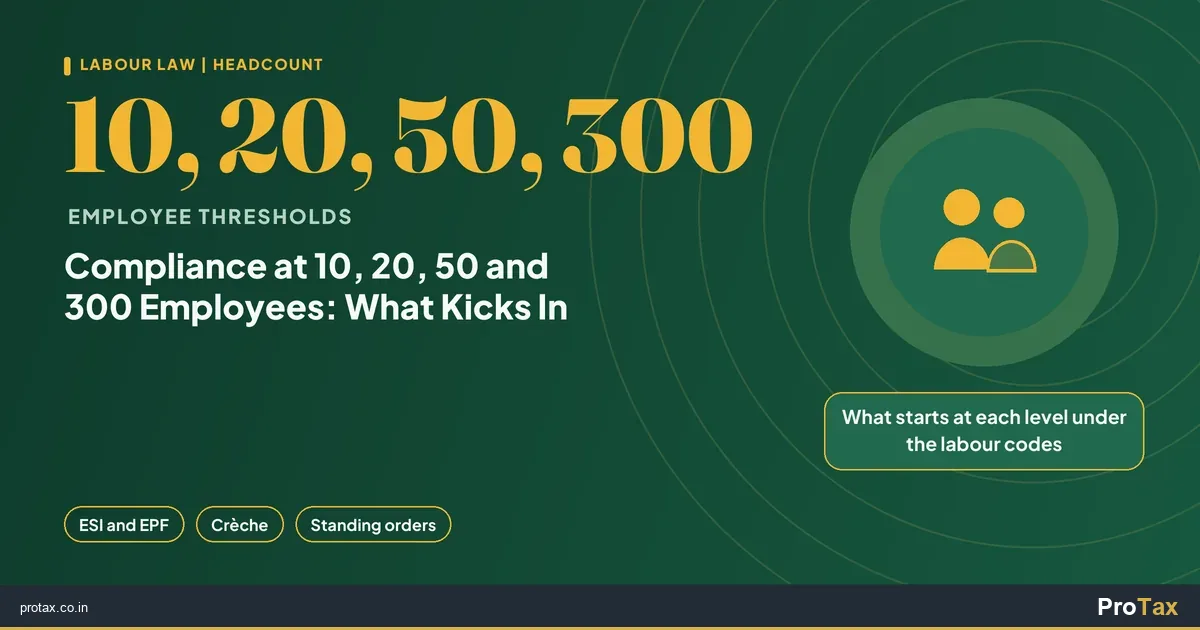
EPF registration for startups becomes mandatory the moment your headcount hits 20 employees, as per the Code on Social Security, 2020, which subsumed the EPF Act, 1952. Both the employer and each employee contribute 12% of basic wages plus dearness allowance. The registration process is online through the EPFO Unified Portal, takes 3 to 7 working days, and the monthly compliance (ECR filing, payment by the 15th of the next month) is straightforward once set up. Missing the deadline is not: damages (14B) of up to 1% of arrears per month apply, and interest (7Q) at 12% a year must be paid with the contribution. If your startup is DPIIT-recognised, the government reimburses the employer's 12% EPF contribution for new employees for up to 3 years. Here is the complete breakdown of when EPF applies, what it costs, how to register, and what to watch out for.
- EPF registration is mandatory for every establishment with 20 or more employees under the Code on Social Security, 2020
- Employer cost: 12% of basic wages + 0.50% EPF admin + 0.50% EDLIS admin per employee per month
- Monthly ECR return first, then challan payment, due by the 15th of the following month on the EPFO Unified Portal
- DPIIT-recognised startups get the employer's 12% EPF contribution reimbursed for new employees for 3 years
- Late payment attracts damages capped at 1% of arrears per month (14B) plus 12% annual interest (7Q)
What Is EPF? The Employee Provident Fund Explained
The Employee Provident Fund (EPF) is a government-backed retirement savings scheme governed by the Code on Social Security, 2020 and the EPF Scheme, 2026. It is administered by the Employees' Provident Fund Organisation (EPFO) under the Ministry of Labour and Employment, Government of India. Every eligible employee and their employer contribute a percentage of the employee's basic wages plus dearness allowance into a fund that accumulates with interest over the employee's working life.
For startups, EPF is not a tax or a penalty. It is a structured savings programme that your employees will eventually thank you for. Think of it as a forced retirement piggy bank where both sides put in money, the government adds interest (8.25% in FY 2024-25), and the employee withdraws the corpus upon retirement, resignation, or under specific conditions like home purchase or medical emergencies. The scheme also includes life insurance (EDLIS) and a pension component (EPS), making it a three-in-one social security package.
Governed by the Code on Social Security, 2020, which subsumed the 1952 Act, with the EPF Scheme, 2026, EPS 2026 and EDLI Scheme 2026. Administered by the Employees' Provident Fund Organisation (EPFO) through www.epfindia.gov.in. The portal still labels interest as 7Q and damages as 14B, after the sections of the 1952 Act.
When Is EPF Mandatory for Startups? The 20-Employee Threshold
EPF applies to every establishment that employs 20 or more persons on any day during a financial year. This threshold now comes from the Code on Social Security, 2020. The moment your startup's payroll headcount touches 20, you have 30 days to register with the EPFO. There is no revenue threshold, no industry exemption, and no grace period beyond those 30 days.
What counts as "20 persons" is where details matter. The number includes full-time employees, part-time employees, contract workers on your payroll, and temporary staff engaged in or in connection with the work of the establishment. It does not include genuine independent contractors (who invoice your company under their own GST registration), apprentices under the Apprentices Act, 1961, or workers employed by a contractor who has separate EPF registration for them.
Scenarios That Trigger EPF Registration
| Scenario | Employee Count | EPF Required? | Action |
|---|---|---|---|
| Startup with 15 full-time employees | 15 | No (unless voluntary) | Optional registration under Section 1(4) |
| Startup with 18 employees + 3 contract workers on payroll | 21 | Yes | Register within 30 days |
| Startup with 22 employees, 4 resign, count drops to 18 | 18 | Yes (continues) | EPF coverage does not lapse once triggered |
| Remote startup with 25 employees across India | 25 | Yes | All remote employees are counted; register centrally |
| Startup with 12 employees + 10 with a contractor's EPF | 12 (own payroll) | No | Contractor's workers counted under contractor's EPF |
Many startups miscalculate their headcount by excluding contract workers or part-time staff. The EPFO counts all persons employed in or in connection with the work of the establishment. If a compliance audit reveals the threshold was crossed earlier, the startup faces backdated contributions plus damages (14B).
One point that founders often overlook: the trigger is "on any day," not an average. If you hired 5 people for a project in November and your headcount touched 20 for just one week before 3 people left, EPF still applies. Once the Act covers your establishment, it stays covered regardless of future headcount fluctuations. The EPFO Regional Commissioner must issue a formal de-coverage order under Section 17 for the Act to stop applying, and that order is rare outside permanent closure.
Voluntary EPF Registration: Why Some Startups Register Early
The Code on Social Security, 2020 allows establishments with fewer than 20 employees to register voluntarily. This requires a joint application signed by the employer and a majority of employees. The contribution rate for voluntary establishments with fewer than 20 employees is 10% (instead of the standard 12%), though employers can choose to contribute at 12% voluntarily.
Why would a startup take on a compliance obligation before it has to? Three practical reasons:
- Talent acquisition: Candidates coming from established companies (who had EPF) prefer employers that continue their PF contributions. Offering EPF as a benefit makes your offer letter competitive against larger firms.
- Investor readiness: VCs and angel investors check labour law compliance during due diligence. A startup already registered with EPF signals operational maturity and reduces perceived compliance risk.
- Smooth scaling: If you plan to hire rapidly, crossing the 20-employee mark can happen overnight. Having EPF infrastructure (Unified Portal access, DSC setup, payroll integration) already in place avoids a 30-day scramble.
Based on our experience assisting 200+ startups with PF registration, startups that register voluntarily at 10 to 15 employees experience significantly smoother fundraising rounds. Investor due diligence on labour compliance goes from a multi-week exercise to a checkbox.
Get EPF Registration Done Right
ProTax handles end-to-end PF registration for startups: document preparation, Unified Portal setup, DSC coordination, and first ECR filing. Starting at ₹2,999.
EPF Contribution Rates: Complete Breakdown for Startups
The EPF contribution structure has multiple components, and the employer pays more than just 12%. Here is the exact breakdown for a startup employer.
Employer Contribution Components
| Component | Rate | Paid By | Calculation Base |
|---|---|---|---|
| EPF (Provident Fund) | 3.67% | Employer | Basic wages + DA |
| EPS (Employee Pension Scheme) | 8.33% | Employer | Basic wages + DA (max ₹15,000) |
| EDLIS (Deposit Linked Insurance) | 0.50% | Employer | Basic wages + DA |
| EPF Admin Charges | 0.50% | Employer | Basic wages + DA (min ₹75/month) |
| EDLIS Admin Charges | 0.50% | Employer | Basic wages + DA (min ₹75/month) |
| Total Employer Cost | 13.50% | Employer |
Employee Contribution
| Component | Rate | Paid By | Calculation Base |
|---|---|---|---|
| EPF (Provident Fund) | 12% | Employee | Basic wages + DA |
The employee's entire 12% goes directly to the EPF account. The employer's 12% is split between EPF (3.67%) and EPS (8.33%). The admin charges and EDLIS are additional costs borne entirely by the employer.
Salary Breakdown Example: ₹15,000 Basic Wages
For an employee with basic wages of ₹15,000 per month, here is the exact calculation:
| Component | Rate | Monthly Amount (₹) | Who Pays |
|---|---|---|---|
| Employee EPF Contribution | 12% | ₹1,800 | Employee (deducted from salary) |
| Employer EPF Contribution | 3.67% | ₹550 | Employer |
| Employer EPS Contribution | 8.33% | ₹1,250 | Employer |
| Employer EDLIS Contribution | 0.50% | ₹75 | Employer |
| EPF Admin Charges | 0.50% | ₹75 | Employer |
| EDLIS Admin Charges | 0.50% | ₹75 | Employer |
| Total Employer Cost Per Employee | 13.50% | ₹2,025 | Employer |
| Total Monthly Deposit to EPFO | ₹3,825 | Employer + Employee |
Multiply this by your headcount and you have your monthly EPF budget. For a startup with 20 employees at ₹15,000 basic wages each, the employer's monthly EPF cost is ₹40,500 (20 x ₹2,025), and the total deposit to EPFO is ₹76,500 (20 x ₹3,825). That is real money for an early-stage company, which is exactly why the Startup India reimbursement scheme exists (more on that below).
Cost of EPF for Startups: Budget Planning
Let us put the numbers in perspective. EPF is not just 12%; the employer's true cost is 13.50% of basic wages when you include admin charges and EDLIS. Here is a quick reference for different salary levels:
| Monthly Basic Wages | Employee EPF (12%) | Employer Total (13.50%) | Total EPFO Deposit | Annual Employer Cost |
|---|---|---|---|---|
| ₹10,000 | ₹1,200 | ₹1,350 | ₹2,550 | ₹16,200 |
| ₹15,000 | ₹1,800 | ₹2,025 | ₹3,825 | ₹24,300 |
| ₹20,000 | ₹2,400 | ₹2,700 | ₹5,100 | ₹32,400 |
| ₹25,000 | ₹3,000 | ₹3,375 | ₹6,375 | ₹40,500 |
| ₹30,000 | ₹3,600 | ₹4,050 | ₹7,650 | ₹48,600 |
Structure salaries with a 40:60 or 50:50 split between basic wages and other allowances (HRA, special allowance). EPF is calculated only on basic wages + DA, not on the entire CTC. A ₹50,000 CTC with ₹20,000 basic has an employer EPF cost of ₹2,700/month. The same CTC with ₹30,000 basic costs ₹4,050/month in EPF. Your salary structure directly impacts your EPF outflow.
For a 25-person startup with an average basic wage of ₹20,000, the annual EPF cost to the employer is ₹8,10,000 (25 employees x ₹32,400 annual cost). That is roughly ₹67,500 per month. Factor this into your burn rate calculations from day one.
Need Help With Payroll and PF Compliance?
ProTax's HR and payroll services handle EPF calculations, monthly ECR filing, and EPFO compliance for startups. Focus on building your product; we handle the paperwork.
Step-by-Step EPF Registration Process Online
EPF registration is done entirely online through the EPFO Unified Portal. No physical visit to the EPFO office is required. Here is the exact process:
- Get a Digital Signature Certificate (DSC): The authorised signatory (director, partner, or proprietor) needs a Class 2 or Class 3 DSC. If you do not have one, apply through a Certifying Authority like eMudhra or Sify. Processing takes 1 to 3 working days. Cost: ₹500 to ₹1,500.
- Visit the EPFO Unified Portal: Go to unifiedportal-emp.epfindia.gov.in and click on "Establishment Registration." Select "Employer" as the user type.
- Fill the Registration Form: Enter establishment details including: name as per PAN, date of setup, PAN of the establishment, nature of business (select the appropriate NIC code), address, and details of the authorised signatory. The form also asks for bank account details for challan payments.
- Upload Documents: Attach scanned copies of: PAN card, Certificate of Incorporation or Partnership Deed, address proof, cancelled cheque, DSC of the signatory, and details of employees (Aadhaar, PAN, bank account). All documents must be in PDF format, under 2 MB each.
- Submit and Sign with DSC: Review all entries, then submit the application using the DSC. The portal generates a reference number for tracking.
- EPFO Verification: The EPFO regional office verifies the submitted documents. This typically takes 3 to 7 working days. If the EPFO needs additional information, they communicate through the portal.
- Receive Establishment Code Number: Upon approval, the EPFO issues a unique Establishment Code Number (ECN). This is your EPF registration number, used for all future filings. The format is: [State Code]/[Regional Office Code]/[Establishment Serial Number]/[DB Extension].
- Add Employees by UAN: After receiving the ECN, log in to the Unified Portal and add all eligible employees using their Universal Account Number (UAN). Since 1 August 2025, employees without one generate a new UAN through Aadhaar face authentication in the UMANG app and share it with you.
Complete the employee onboarding (Step 8) immediately after receiving the ECN. Do not wait until the first ECR filing date. Adding employees early gives time to resolve any Aadhaar-KYC mismatches, which are the most common cause of ECR rejection.
Documents Required for EPF Registration: Startup Checklist
The document requirements vary slightly depending on your entity type. Here is the complete checklist:
For Private Limited Companies and LLPs
| Document | Details | Format |
|---|---|---|
| Certificate of Incorporation | Issued by MCA (Registrar of Companies) | PDF, under 2 MB |
| PAN Card of Company/LLP | PAN in the name of the establishment | |
| Address Proof | Rent agreement with landlord's consent or property deed + utility bill | |
| Cancelled Cheque | From the business current account (must show entity name) | Image or PDF |
| Director/Partner DSC | Class 2 or Class 3 DSC of the authorised signatory | USB token |
| Director/Partner Aadhaar + PAN | KYC of all directors or designated partners | |
| Employee List | Name, Aadhaar, PAN, date of joining, basic wages, bank account | Excel or CSV |
| Salary Register/Payslips | Showing basic wages, DA, and total wages payable | PDF or Excel |
For Partnerships and Proprietorships
Partnership firms need the registered Partnership Deed instead of the Certificate of Incorporation. Proprietorships require the proprietor's PAN, Aadhaar, and a declaration of business commencement. GST registration certificate is additional proof of business activity for both entity types.
Ensure the establishment name on PAN exactly matches the name on the Certificate of Incorporation. Even minor discrepancies (punctuation, abbreviations) cause rejection. The EPFO system validates PAN details against the NSDL database in real time.
Starting a Company? Get All Registrations Together
ProTax bundles company incorporation with GST, EPF, ESI, and professional tax registration. Save time and get compliant from day one.
Monthly EPF Compliance: ECR Filing and Payment
EPF registration is a one-time process. The ongoing obligation is monthly: file the ECR and pay the contribution by the 15th of the following month. Miss this, and penalties start accumulating automatically.
Monthly Compliance Calendar
| Task | Due Date | Portal | Penalty for Delay |
|---|---|---|---|
| ECR Filing + Payment | 15th of next month | EPFO Unified Portal | Damages (up to 1% per month) + Interest (12% p.a.) |
| International Worker Return | 15th of next month | EPFO Unified Portal | Same as ECR |
| Annual Return (Form 3A/6A) | April 30 | EPFO Unified Portal | Prosecution under the Code |
| KYC Update for New Employees | Within 15 days of joining | EPFO Unified Portal | ECR rejection if KYC incomplete |
How to File ECR
The Electronic Challan cum Return (ECR) is the core monthly filing. Since the wage month of September 2025, the revamped ECR separates the return from payment:
- Log in to the EPFO Unified Portal with your establishment credentials
- Go to "Payments" > "Return Filing" and search the wage month on the Return Monthly Dashboard
- Upload the ECR text file as a Regular Return and choose the 12% or 10% rate
- Fix any error file the system generates (common issues: unlinked UAN, exited member, EPS wages above ₹15,000)
- Review the return statement and approve it
- On the Due Deposit Balance Summary, choose Full Payment (any 7Q interest is included and must be paid)
- Prepare the challan, note its TRRN (Temporary Return Reference Number), and pay through an authorised bank
- Download the payment receipt; file months in chronological order, using supplementary or revised returns for later changes
Most payroll software (Zoho Payroll, GreytHR, RazorpayX Payroll) generates ECR files automatically. If your startup uses payroll software, the monthly filing takes 15 to 20 minutes. If you are filing manually, budget 30 to 45 minutes per month.
Penalties for EPF Non-Compliance
EPF law has some of the strictest penalty provisions among Indian labour laws. The EPFO does not send friendly reminders; it sends demand notices with calculated damages. Here is what you are liable for if you miss the mark.
Damages for Late Payment (14B)
| Item | Rule |
|---|---|
| Basis | Percentage of arrears per month of default |
| Cap | 1% of arrears per month since June 2024 |
| Before June 2024 | 5% to 25% a year by length of delay |
| Calculation | Worked out by the revamped ECR with the return |
Interest on Delayed Payment (7Q)
In addition to damages, the EPFO charges simple interest at 12% per annum on the unpaid amount from the due date until the date of actual payment. Under the revamped ECR, this interest is calculated with the return and must be paid with the contribution.
Criminal Prosecution
For wilful non-compliance (including failure to register, deducting employee's share but not depositing it, or filing false returns), the Code on Social Security, 2020 prescribes:
- Imprisonment: For wilful default, with longer terms for repeat offences
- Fine: In addition to or instead of imprisonment
- Both: Imprisonment and fine together
Deducting EPF from employee salaries but not depositing it with EPFO is treated as a criminal offence under Section 405/406 of the Indian Penal Code (criminal breach of trust). This attracts arrest without bail in extreme cases. Always deposit the deducted amount before the 15th, even if the employer's share payment is delayed.
A practical example: suppose your startup had 22 employees from April 2025 but did not register for EPF. The EPFO discovers this during a routine inspection in December 2025. You now owe 8 months of backdated contributions for 22 employees, plus damages capped at 1% of arrears per month, plus 12% annual interest. On a ₹15,000 basic wage per employee, the backdated contribution alone is ₹6,73,200 (22 x ₹3,825 x 8 months). Damages at the 1% monthly cap add up to ₹30,294 (36 month-units of delay on ₹84,150 a month), and interest at 12% a year adds the same again. The total hit: over ₹7,30,000. That is enough to dent a seed-stage startup's runway.
Worried About Labour Law Compliance?
ProTax's compliance health check covers EPF, ESI, professional tax, and all labour law obligations. Identify gaps before the EPFO does.
EPF vs ESI: Key Differences for Startups
EPF and ESI are the two primary social security obligations for startups. They are governed by different Acts, have different thresholds, and serve different purposes. Here is a side-by-side comparison:
| Parameter | EPF (Employee Provident Fund) | ESI (Employee State Insurance) |
|---|---|---|
| Governing Act | Code on Social Security, 2020 | Code on Social Security, 2020 |
| Administering Body | EPFO | ESIC |
| Purpose | Retirement savings + pension + life insurance | Health insurance + medical benefits |
| Employee Threshold | 20 or more employees | 10 or more employees |
| Wage Ceiling | ₹15,000/month (for exemption from coverage) | ₹21,000/month (employees above this are not covered) |
| Employer Contribution | 12% of basic wages + DA | 3.25% of gross wages |
| Employee Contribution | 12% of basic wages + DA | 0.75% of gross wages |
| Total Contribution | 24% of basic wages | 4% of gross wages |
| Payment Due Date | 15th of next month | 15th of next month |
| Online Portal | unifiedportal-emp.epfindia.gov.in | esic.gov.in |
| Registration Service | PF Registration | ESI Registration |
A startup reaching 10 employees hits the ESI threshold first. At 20 employees, both EPF and ESI apply. Most startups end up registering for both within their first 2 years of hiring. If you are approaching 10 employees, budget for ESI registration alongside your EPF planning.
Startup India EPF Reimbursement Scheme
The Government of India, through the Startup India initiative, offers reimbursement of the employer's EPF contribution for DPIIT-recognised startups. This is a significant cost offset for early-stage startups building their teams.
Eligibility Criteria
- The startup must be recognised by the Department for Promotion of Industry and Internal Trade (DPIIT) under the Startup India programme
- The employees must be new hires with a fresh Universal Account Number (UAN); employees who were previously EPF members are not eligible
- The employees must earn basic wages up to ₹15,000 per month
- The startup must have been incorporated after April 1, 2016
What Gets Reimbursed
The government reimburses the employer's full 12% EPF contribution (not the admin charges or EDLIS) for eligible employees for a period of 3 years from the date of EPF registration. The startup pays the contribution upfront each month via ECR and then claims reimbursement through the EPFO portal.
How to Claim
- Ensure your startup has a valid DPIIT recognition certificate
- Register for EPF through the normal process and obtain the ECN
- File monthly ECR and pay contributions on time (this is non-negotiable; late payments disqualify the claim)
- Apply for reimbursement on the EPFO Unified Portal under the Startup India scheme section
- The EPFO verifies eligibility and processes the reimbursement to the startup's bank account
If your startup is not yet DPIIT-recognised, apply for Startup India recognition before registering for EPF. The recognition process takes 2 to 5 working days and is free. The EPF reimbursement alone can save a 20-person startup over ₹4 lakh per year.
EPF for Contract Workers and Interns
This is where many startups trip up. EPF coverage extends beyond your full-time payroll, and getting this wrong creates backdated liability.
Contract Workers
If your startup engages workers through a contractor (manpower agency, staffing company), the EPF liability depends on who pays them:
- Contractor has separate EPF registration: The contractor is responsible for EPF compliance. These workers count toward the contractor's headcount, not yours.
- Workers are on your payroll: Even if engaged through a contractor, if the startup directly pays their wages, they count toward your 20-employee threshold and must be covered under your EPF registration.
- Principal employer liability: Under Section 12A of the Contract Labour (Regulation and Abolition) Act, 1970, the principal employer (your startup) is ultimately responsible for ensuring that the contractor complies with EPF obligations. If the contractor defaults, the EPFO can recover the amount from the startup.
Interns
The Code does not mention "interns" specifically. The classification depends on the nature of the engagement:
- Stipend-based interns (college internship, no employment contract): Generally not covered. The stipend is treated as a training allowance, not wages.
- Paid interns with employment terms (fixed hours, regular salary, supervisory control): Treated as employees. EPF applies if the other conditions (headcount, wages) are met.
- Apprentices under the Apprentices Act, 1961: Explicitly excluded from EPF coverage under the Code on Social Security, 2020.
The safe approach: if an intern works regular hours, reports to a manager, and receives a fixed monthly payment that looks like a salary, treat them as an employee for EPF purposes. The EPFO applies a substance-over-form test; calling someone an "intern" does not override the reality of an employer-employee relationship.
Common Mistakes Startups Make with EPF
After helping hundreds of startups with EPF registration and compliance, here are the mistakes we see repeatedly. Each one is preventable.
1. Delaying Registration After Crossing 20 Employees
The 30-day window is strict. Every month of delay adds to the backdated contribution liability. Some founders assume they can register later and start contributing from that date. The EPFO calculates backdated liability from the date the 20th employee joined, not from the registration date.
2. Incorrect Salary Structure Leading to Higher EPF Outflow
EPF is calculated on basic wages + DA only. If your salary structure allocates 70% to basic wages and 30% to allowances, your EPF cost is higher than if the split is 40% basic and 60% allowances. Review your salary structure with your HR team before registering for EPF.
3. Not Depositing the Employee's Deducted Share
This is the most dangerous mistake. Some cash-strapped startups deduct EPF from employee salaries but hold the funds to manage cash flow. This is a criminal offence under Section 405/406 IPC. The employee's share must be deposited with EPFO by the 15th of the next month, without exception.
4. Ignoring KYC Seeding for Employees
Each employee's UAN must be linked with Aadhaar. If Aadhaar-KYC is not completed, the ECR gets rejected for that employee, leading to partial filing and potential penalty. Complete KYC verification before the first ECR filing date.
5. Treating Freelancers as Employees (or Vice Versa)
If a "freelancer" works exclusively for your startup, uses your tools, follows your schedule, and receives a monthly payment, the EPFO will classify them as an employee. Conversely, treating genuine employees as freelancers to avoid EPF is a compliance risk that surfaces during audits or employee disputes.
6. Not Updating Employee Exit on the Portal
When an employee leaves, update their exit date on the Unified Portal immediately. Failing to do this means the employee continues to appear in your ECR, requiring you to show zero wages (which triggers verification queries from EPFO) or, worse, continuing to contribute for a person who no longer works for you.
Get Expert Help with PF Compliance
From registration to monthly ECR filing, ProTax manages your startup's EPF obligations so you do not have to. Avoid penalties, stay compliant.
EPF Exemptions and Special Provisions
While EPF law casts a wide net, there are specific exemptions and relaxations that startups should be aware of:
Section 17 Exemption
Under the Code on Social Security, 2020 (earlier Section 17 of the EPF Act), the Central Government can exempt any establishment from all or any provisions of the EPF Scheme if the employees are already receiving benefits that are, on the whole, not less favourable than those provided under the Code. This is typically used by large corporations that run their own provident fund trusts (exempted establishments). For startups, Section 17 exemption is rarely practical due to the administrative overhead of running a private PF trust.
Establishments Covered Under Special Categories
Certain industries have modified EPF applicability. Beedi manufacturing, coir industry, and some plantation establishments have different threshold and contribution rules. Most tech startups, service companies, and D2C brands fall under the general category and follow the standard 20-employee threshold.
Startup India and Aatmanirbhar Bharat Benefits
- DPIIT Startups: Employer's 12% EPF reimbursement for new employees (earning up to ₹15,000 basic) for 3 years
- Aatmanirbhar Bharat Rojgar Yojana (ABRY): The government contributed both employer and employee EPF shares (24%) for new employees joining establishments between October 2020 and March 2022, earning up to ₹15,000 per month. While ABRY's enrollment window has closed, the benefits continue for the 2-year period from the date of each employee's registration. Check for any successor schemes announced in the Union Budget.
EPF Registration for Different Entity Types
The registration process is largely the same regardless of your business structure, but the supporting documents differ. Here is a quick reference:
| Entity Type | Establishment Document | Signatory | EPF Applicable? |
|---|---|---|---|
| Private Limited Company | Certificate of Incorporation from MCA | Director with DSC | Yes (at 20+ employees) |
| LLP | LLP Incorporation Certificate from MCA | Designated Partner with DSC | Yes (at 20+ employees) |
| Partnership Firm | Registered Partnership Deed | Managing Partner | Yes (at 20+ employees) |
| Proprietorship | PAN + GST Certificate + Declaration | Proprietor | Yes (at 20+ employees) |
| Section 8 Company (NGO) | Certificate of Incorporation | Director with DSC | Yes (at 20+ employees) |
If you have not yet incorporated your startup, choosing the right entity type affects everything from EPF to fundraising to taxation. A Private Limited Company is the most common choice for startups planning to hire and raise funding, while an LLP works well for professional services firms with lower headcount.
EPF and Your Startup's Hiring Plan: Practical Advice
Here is the approach we recommend to startup founders who are about to cross the 20-employee mark or are planning a hiring spree:
Before You Hit 20 Employees
- Review your salary structure: Optimise the basic-to-CTC ratio. This is the single biggest lever for controlling EPF costs.
- Apply for DPIIT recognition: The Startup India recognition takes 2 to 5 working days and makes you eligible for the EPF reimbursement scheme.
- Budget for EPF: Add 13.50% of basic wages to your per-employee cost model. Update your burn rate projections.
- Prepare documents early: Get your DSC, bank details, and employee data ready. Registration is faster when documents are pre-assembled.
When You Cross 20 Employees
- Register within 30 days: Not 31. Not next month. Within 30 days of crossing the threshold.
- Complete KYC for all employees: Aadhaar seeding is mandatory. Start collecting employee Aadhaar details before registration.
- Set up payroll integration: Connect your payroll software to the EPFO Unified Portal for automated ECR generation.
- Register for ESI simultaneously: If you have 10+ employees, ESI registration is already overdue. Do both together.
Ongoing Best Practices
- Set a calendar reminder for the 10th of each month to prepare and file ECR (the 15th is the deadline; file 5 days early as a buffer)
- Maintain a compliance tracker for all labour law obligations: EPF, ESI, professional tax, gratuity, labour welfare fund
- Review EPF contributions quarterly against payroll data to catch discrepancies early
- Update employee exits on the portal promptly to avoid phantom entries in ECR
Based on our experience processing PF registrations for startups across India, the average startup takes 2 to 3 months longer than necessary to register for EPF because of document gaps (expired DSC, mismatched PAN). Start your document preparation the month before you expect to hit 20 employees, not after.
Summary
EPF registration for startups is mandatory once the headcount reaches 20 employees under the Code on Social Security, 2020. The employer's true cost is 13.50% of basic wages per employee per month (12% contribution + admin charges). Registration is done online through the EPFO Unified Portal in 3 to 7 working days. Monthly compliance requires filing the ECR return and then paying the challan by the 15th of the following month. Penalties for delay include damages capped at 1% of arrears per month (14B) and interest at 12% per annum (7Q). DPIIT-recognised startups can recover the employer's 12% contribution through the Startup India reimbursement scheme. Register early, structure salaries wisely, and treat monthly EPF filing as a non-negotiable calendar item. If you need help with PF registration or ongoing compliance, get professional assistance before the EPFO comes knocking.
Register for EPF With Zero Compliance Gaps
ProTax handles PF registration, ESI registration, and monthly compliance for startups. From document preparation to the first ECR filing, we set up your labour law compliance end-to-end.
Frequently Asked Questions
What is EPF registration for startups?
EPF registration is the process of enrolling an establishment with the Employees' Provident Fund Organisation (EPFO) under the Code on Social Security, 2020, which subsumed the Employees' Provident Funds and Miscellaneous Provisions Act, 1952. Once registered, both the employer and employee contribute 12% of the employee's basic salary plus dearness allowance to the provident fund. Registration is done online through the EPFO Unified Portal at unifiedportal-emp.epfindia.gov.in.
When is EPF registration mandatory for startups?
EPF registration becomes mandatory when a startup employs 20 or more employees on any day during a financial year, as per the Code on Social Security, 2020 (earlier Section 1(3) of the EPF Act, 1952). This includes full-time employees, contract workers on the startup's payroll, and employees drawing basic wages up to ₹15,000 per month. Once the 20-employee threshold is crossed, the establishment must register within 30 days.
Can a startup register for EPF voluntarily before reaching 20 employees?
Yes. Startups with fewer than 20 employees can apply for voluntary EPF registration under the Code on Social Security, 2020. This requires the consent of both the employer and the majority of employees. Voluntary registration helps attract better talent, builds employer credibility with investors, and makes the transition to mandatory compliance easier when the headcount reaches 20.
What is the EPF contribution rate for employers and employees?
Both the employer and employee contribute 12% of basic wages plus dearness allowance. The employer's 12% is split into: EPF (3.67%), EPS (8.33%, capped at ₹15,000 basic), and EDLIS (0.50%). The employer also pays admin charges of 0.50% for EPF and 0.50% for EDLIS. The employee's entire 12% goes to the EPF account. For startups with fewer than 20 employees opting for voluntary registration, the contribution rate is 10%.
How much does EPF cost a startup per employee?
For an employee with a basic salary of ₹15,000 per month, the employer's total EPF cost is approximately ₹2,475 per month. This includes: EPF contribution (₹550.50), EPS (₹1,249.50), EDLIS (₹75), EPF admin charges (₹75), and EDLIS admin charges (₹75). The employee contributes ₹1,800. For 20 employees at ₹15,000 basic salary, the startup's monthly EPF cost is approximately ₹49,500.
What documents are required for EPF registration?
Key documents include:
- PAN card of the establishment
- Certificate of Incorporation or Partnership Deed
- Address proof of the registered office (rent agreement or utility bill)
- Digital Signature Certificate (DSC) of the authorised signatory
- Cancelled cheque or bank statement of the business bank account
- Aadhaar card and PAN of directors or partners
- List of employees with Aadhaar, PAN, and bank details
- Salary register showing basic wages and DA
How long does EPF registration take?
EPF registration through the EPFO Unified Portal takes 3 to 7 working days after submission of all documents. The EPFO issues a unique Establishment Code Number (ECN) upon approval. In practice, if documents are complete and the DSC is valid, most registrations are processed within 5 working days. The process is entirely online; no physical visits to the EPFO office are required.
What is the penalty for not registering for EPF?
Under the Code on Social Security, 2020, wilful failure to pay EPF contributions attracts fine and imprisonment. Damages for late payment (shown as 14B on the portal) are a percentage of arrears per month, capped at 1% per month since June 2024. Interest (7Q) at 12% per annum is calculated with the ECR and must be paid with the contribution. Non-registration when mandatory is treated as non-payment from the date the threshold was crossed.
What is the difference between EPF and ESI?
EPF (Employee Provident Fund) is a retirement savings scheme under the Code on Social Security, 2020, applicable to establishments with 20+ employees. ESI (Employee State Insurance) is a health insurance scheme under the same Code, applicable to establishments with 10+ employees and covering workers earning up to ₹21,000 per month. EPF contribution is 12% + 12%; ESI contribution is 3.25% (employer) + 0.75% (employee). Both are mandatory once their respective thresholds are met.
Do contract workers count towards the 20-employee EPF threshold?
Yes. Contract workers employed through the principal employer's establishment count towards the 20-employee threshold for EPF. If the contract workers are on the contractor's payroll and the contractor has a separate EPF registration, they are counted under the contractor's establishment. However, if the startup directly pays the contract workers, they count towards the startup's headcount. The EPFO considers the total number of workers engaged in or in connection with the work of the establishment.
Is EPF applicable to interns and apprentices?
Generally, interns receiving a stipend (not wages) are not covered under EPF. However, if the internship arrangement constitutes an employer-employee relationship (regular hours, supervisory control, fixed monthly payment), the EPFO may classify the intern as an employee. Apprentices engaged under the Apprentices Act, 1961 are explicitly excluded from EPF coverage under the Code on Social Security, 2020. Paid interns who function like regular employees should be covered to avoid compliance risk.
What is the EPFO Unified Portal?
The EPFO Unified Portal (unifiedportal-emp.epfindia.gov.in) is the online platform for all EPF-related employer activities. Through this portal, employers register their establishment, file monthly Electronic Challan cum Return (ECR), add or remove employees, generate payment challans, and download compliance reports. The portal requires a valid Digital Signature Certificate (DSC) for registration and monthly filings.
What is ECR filing and when is it due?
ECR (Electronic Challan cum Return) is the monthly return that employers file on the EPFO Unified Portal. It contains employee-wise contribution details including UAN, name, wages, and EPF/EPS contributions. Since the wage month of September 2025, the ECR is filed and approved first and the challan is then paid, both by the 15th of the following month. For example, March 2026 contributions are due by April 15, 2026. Months must be filed in order, and late filing attracts damages (14B) and interest (7Q).
Can a startup get EPF reimbursement under Startup India?
Yes. The Government of India reimburses the employer's EPF contribution (12%) for new employees hired by DPIIT-recognised startups under the Startup India EPF reimbursement scheme. This applies to employees earning up to ₹15,000 per month, for a period of 3 years from the date of registration. The startup must be registered with DPIIT and the new employees must have a new UAN (not previously employed under EPF). Claims are processed through the EPFO portal.
What is the EPF wage ceiling of ₹15,000?
The EPF wage ceiling is ₹15,000 per month for basic wages plus dearness allowance. Employees earning basic wages above ₹15,000 can opt out of EPF coverage at the time of joining (if they have never been an EPF member before). However, the EPS contribution (8.33%) is calculated only on a maximum of ₹15,000 regardless of actual wages. For employees earning above ₹15,000, the employer can choose to contribute on the higher actual wages or on the statutory limit.
How does PF work for employees with salary above ₹15,000?
For employees with basic wages above ₹15,000, the EPS contribution remains capped at 8.33% of ₹15,000 (₹1,250 per month). The remaining employer contribution goes to the EPF account. For example, if basic wages are ₹25,000: employee EPF contribution is ₹3,000 (12%), employer's EPS is ₹1,250 (capped), employer's EPF is ₹1,750 (₹3,000 minus ₹1,250), and EDLIS is 0.50% of ₹25,000 (₹125). Both employer and employee may agree to contribute on actual wages or restrict to the statutory ceiling.
What happens if a startup crosses 20 employees and then goes below?
Once an establishment is registered for EPF, the registration does not lapse if the employee count drops below 20. Coverage continues once triggered. The startup must continue making EPF contributions for all covered employees regardless of the current headcount. De-registration is possible only if the establishment is permanently closed or the Regional PF Commissioner grants an order of exemption under the Code on Social Security, 2020.
Is EPF applicable to a Private Limited Company from day one?
No. EPF registration for a Private Limited Company becomes mandatory only when the company employs 20 or more persons. A newly incorporated Pvt Ltd with 5 employees is not required to register for EPF. However, the company can opt for voluntary registration under Section 1(4). For startups planning rapid hiring, registering early avoids the scramble to comply when the 20th employee joins.
What is the EPF interest rate for 2025-26?
The EPFO declared an interest rate of 8.25% per annum on EPF deposits for the financial year 2024-25. The rate for 2025-26 is typically announced by the Central Board of Trustees in its annual meeting (usually held in February-March). EPF interest is calculated monthly but credited to the member's account at the end of the financial year. The rate has ranged between 8.10% and 8.65% over the past five years.
Can an LLP register for EPF?
Yes. An LLP (Limited Liability Partnership) must register for EPF once it employs 20 or more persons. The process is identical to that for a company. The LLP agreement and Certificate of Incorporation from MCA serve as the establishment documents. The designated partner signs the EPF registration application using a valid DSC. LLPs with fewer than 20 employees can opt for voluntary registration.
What is Form 5A in EPF registration?
Form 5A is the return of ownership submitted to the EPFO at the time of registration. It contains details about the establishment including: name and address, nature of business, date of setup, details of the employer and directors, number of employees, and wage structure. Form 5A is submitted along with Form 9 (declaration by the employer) during the online registration process on the Unified Portal.
How does EPF registration affect startup fundraising?
EPF compliance is a standard item in investor due diligence checklists. Venture capital firms and angel investors verify that a startup is compliant with all applicable labour laws, including EPF and ESI, before investing. Non-compliance creates contingent liabilities that reduce the startup's valuation. Maintaining clean EPF records from the start avoids last-minute scrambles during fundraising rounds and signals operational maturity to investors.
What are the EPF admin charges for employers?
Employers pay two types of admin charges: EPF admin charges at 0.50% of basic wages (minimum ₹75 per month if total wages are below ₹15,000), and EDLIS admin charges at 0.50% of basic wages. These are over and above the 12% employer contribution. For a startup with 20 employees at ₹15,000 basic wages each, the total monthly admin charges are approximately ₹3,000 (₹1,500 for EPF admin + ₹1,500 for EDLIS admin).
Is there any EPF exemption for small startups?
No blanket exemption exists for small startups. However, startups with fewer than 20 employees are simply not covered for EPF (unless they opt for voluntary registration). The Startup India EPF reimbursement scheme offsets the cost by reimbursing the employer's 12% contribution for new employees for 3 years. Under the Aatmanirbhar Bharat package (extended periodically), the government has also contributed both the employer and employee share (24%) for new low-wage employees.
What is the due date for EPF payment each month?
EPF contributions must be deposited by the 15th of the month following the wage month. For wages paid in March, the EPF payment is due by April 15. The payment is made online through the EPFO Unified Portal after the ECR return is filed and approved. If the 15th falls on a public holiday, the payment must be made on the preceding working day. The annual EPF return (Form 3A and Form 6A) is due by April 30 of the following financial year.
Can a startup switch from voluntary to mandatory EPF coverage?
If a startup registers voluntarily under Section 1(4) and later crosses the 20-employee threshold, the coverage automatically shifts to mandatory under Section 1(3). The contribution rate changes from 10% (applicable for voluntary establishments with fewer than 20 employees) to 12%. No separate application is needed for this transition; the EPFO updates the establishment's status based on the employee count reported in the monthly ECR.