FCRA auto-cessation is the automatic termination of an NGO's foreign contribution registration when the organisation fails to renew its certificate before the 5-year validity expires. Under Section 12 of the Foreign Contribution (Regulation) Act, 2010, there is no reminder, no show-cause notice, and no second chance once the deadline passes: the registration simply stops existing. Every certificate carries a fixed expiry date 5 years after grant, so every registered NGO meets this deadline once in each cycle, and organisations registered between 2020 and 2022 face their first renewal between 2025 and 2027. This article explains what auto-cessation means, how it differs from cancellation and suspension, what triggers it, and the 7 concrete steps an NGO can take to keep its FCRA status intact.
- FCRA registration is valid for 5 years; failure to renew causes automatic cessation with no government order needed.
- Renewal must be filed at least 6 months before expiry (proposed: 9 months under the 2026 Bill) using Form FC-3C.
- Auto-cessation is different from cancellation (Section 14) and suspension (Section 13): it involves no investigation, just a missed deadline.
- After cessation, the NGO cannot receive, transfer, or use any foreign contribution and must apply afresh under Section 11.
- The proposed 2026 Bill discusses a 180-day late-filing window with an additional fee, but this is not yet enacted.
- Filing all FC-4 annual returns on time and maintaining clean bank records are prerequisites for a smooth renewal.
What is FCRA Auto-Cessation of Registration?
FCRA auto-cessation is the automatic lapse of an organisation's registration under the Foreign Contribution (Regulation) Act, 2010, when the 5-year validity period expires without a timely renewal application. It is governed by the registration and renewal framework under Sections 12 and 16 of the FCRA, 2010, administered by the Ministry of Home Affairs through fcraonline.nic.in.
The word "auto" is the critical part. Unlike cancellation, where the government actively investigates and issues an order, and unlike suspension, where the MHA temporarily freezes operations for up to 180 days (extendable by a further 180), auto-cessation requires no government action at all. The clock runs out, the registration expires, and the NGO loses its legal authority to receive foreign donations. No letter arrives. No portal notification pops up (though the proposed 2026 framework plans to add one). The organisation simply moves from "registered" to "unregistered" on the MHA database. That silence is what makes auto-cessation dangerous. Cancellation at least comes with a fight; cessation comes with a calendar page turning.
Governed by the Foreign Contribution (Regulation) Act, 2010, specifically Sections 12, 13, 14, 15, and 16. Administered by the Ministry of Home Affairs (MHA) through the FCRA Online Portal. Section 12(6) has fixed a 5-year validity since the Act took effect on 1 May 2011, and Rule 12 of the FCRA Rules, 2011 sets the renewal procedure. The proposed 2026 Bill modifies the renewal and cessation timeline further.
FCRA Registration Validity: The 5-Year Cycle Since 2011
Under the repealed Foreign Contribution (Regulation) Act, 1976, a registration carried no expiry date. The FCRA, 2010, in force from 1 May 2011, changed that: under Section 12(6) every certificate is valid for 5 years, and Section 16 requires renewal within 6 months before expiry, filed in Form FC-3C with a ₹5,000 fee. Registrations carried over from the 1976 Act were deemed valid for 5 years from 1 May 2011, up to 30 April 2016, so the first renewals under the current law fell due in 2016.
The 2020 amendment did not create the 5-year cycle. It added other conditions: the designated FCRA account at SBI, New Delhi Main Branch, a 20% cap on administrative expenses, a ban on transferring foreign contribution to other persons, and Aadhaar for office bearers. Under Rule 12(6) of the FCRA Rules, 2011, if no renewal application with the requisite fee is received before expiry, the certificate is deemed to have ceased on completion of 5 years from grant. The MHA has issued public notices extending the validity of certificates whose renewal applications were filed in time and are still pending, but those extensions do not help an NGO that never applied: every FCRA-registered NGO in India operates on a fixed renewal calendar. That calendar is the single most important compliance date on the board's radar, more important than FC-4 filing, more important than bank reconciliation, because missing it does not just attract a penalty. It ends the registration.
How the 5-Year Renewal Cycle Works
- Registration Granted: MHA issues the FCRA certificate with a specific validity end date printed on the document.
- Year 1 to Year 4: NGO files FC-4 annual returns by 31 December each year, maintains the designated SBI FCRA account, and uses foreign contribution per approved objectives.
- Year 4 (6 Months Before Expiry): NGO files Form FC-3C renewal application on the FCRA portal with all supporting documents and audited accounts.
- Year 5 (Certificate Expiry Date): If renewal is approved, a new 5-year certificate is issued. If the application is pending, the current certificate typically remains valid until a decision is communicated. If no application was filed, auto-cessation takes effect.
The 6-month pre-expiry filing window is not optional guidance. It is the statutory timeline under current rules. NGOs that wait until the last month often face portal glitches, document gaps, or processing delays that push them past the expiry date. File early. Filing 9 months ahead, as the proposed 2026 Bill suggests, is even safer.
Auto-Cessation vs Cancellation vs Suspension: A Clear Comparison
One of the biggest sources of confusion for NGO administrators is the difference between auto-cessation, cancellation, and suspension. All three result in an NGO losing the ability to use foreign contribution, but they arise from very different triggers, follow different procedures, and carry different consequences. Here is the comparison that every FCRA-registered board should understand.
| Parameter | Auto-Cessation | Cancellation (Section 14) | Suspension (Section 13) |
|---|---|---|---|
| Trigger | Failure to file renewal before certificate expiry | MHA order after finding specific violations | MHA order during investigation of suspected violations |
| Government Action Needed | None; automatic by operation of law | Yes; show-cause notice, inquiry, and formal order | Yes; notice and order with stated reasons |
| Duration | Permanent until fresh registration is obtained | Permanent; entity must re-apply after a cooling period | Temporary; up to 180 days, extendable by a further 180 days |
| Typical Grounds | Administrative oversight, missed deadline | Fund diversion, misreporting, violation of FCRA conditions | Pending inquiry into irregularities |
| Show-Cause Notice | No | Yes; mandatory under Section 14(1) | Yes; issued with suspension order |
| Appeal / Revision | No formal appeal; only fresh application possible | Revision under Section 32 within 1 year; High Court writ | Revision under Section 32; High Court writ |
| Effect on Foreign Funds | All foreign contribution frozen; no new receipts allowed | All foreign contribution frozen; assets under Section 15 custody | Restricted use; only essential spending with MHA permission |
| Path to Restoration | Fresh application under Section 11 (3-year track record needed) | Fresh application after meeting conditions and cooling period | Restoration when the suspension ends without cancellation |
| Impact on Ongoing Projects | All foreign-funded activities must stop immediately | All foreign-funded activities must stop; assets may be seized | Limited spending allowed for beneficiary protection |
The practical takeaway is straightforward. Cancellation is something the government does to you. Suspension is something the government does while deciding what to do. Auto-cessation is something you do to yourself by not filing on time. That is why prevention is entirely within the NGO's control, which makes it both the easiest to avoid and the most frustrating when it happens.
What Triggers FCRA Auto-Cessation?
Auto-cessation is driven by one root cause: failure to renew before the certificate expires. But the reasons behind that failure usually fall into predictable patterns. Understanding these triggers helps boards identify their own risk before the deadline arrives.
1. Missing the Renewal Filing Deadline
The most direct trigger. The NGO does not file Form FC-3C within the required window (currently 6 months before expiry). This may happen because the compliance officer left the organisation, the expiry date was not tracked, or the board assumed the government would send a reminder. Under the current FCRA framework, the MHA does not send expiry reminders as a matter of course.
2. Incomplete Documentation at Filing
Filing Form FC-3C is not enough if the application is incomplete. Missing audited accounts, unfiled FC-4 returns, or unsigned board resolutions can cause the portal to reject the submission. If the NGO only discovers the gap close to the deadline, there may not be enough time to gather documents and re-submit before expiry.
3. Outstanding FC-4 Annual Returns
If an NGO has not filed one or more FC-4 annual returns (due by 31 December each year), the renewal application cannot be processed. The FC-4 is a prerequisite, not just a parallel obligation. An organisation that ignored annual filing for 2 or 3 years and then rushes to renew in year 5 will find the path blocked.
4. Designated Bank Account Issues
The 2020 amendment mandated that all foreign contribution must flow through the designated SBI FCRA account at Sansad Marg, New Delhi. If the account was never opened, was closed, or has discrepancies, the renewal application hits a dead end. Bank compliance is not a separate task. It is embedded in the renewal pathway.
5. Leadership Transition Without Compliance Handover
When a founding trustee passes away, a managing committee changes after elections, or a new board takes over a Section 8 company, FCRA compliance knowledge often walks out the door. The new leadership may not even know the expiry date until a donor asks for the valid certificate.
Based on our experience assisting NGOs with FCRA compliance, the most common auto-cessation scenario is not deliberate neglect. It is a leadership change in year 3 or 4 where the outgoing team did not hand over the renewal calendar. By the time the new board discovers the gap, the 6-month window has already closed or is too narrow for proper document assembly.
Consequences of FCRA Auto-Cessation for NGOs
The effects of auto-cessation extend far beyond losing a registration number. Here is what happens the day after your FCRA certificate expires without renewal.
Immediate Legal Consequences
- No New Foreign Contribution: The NGO cannot legally accept any foreign donation, grant, or transfer. Donors sending funds to a ceased entity risk their own compliance exposure.
- Frozen Foreign-Funded Accounts: Unutilised balances in the designated SBI FCRA account and utilisation accounts, and assets created from foreign contribution, vest with the prescribed authority under Rule 12(6A) of the FCRA Rules, 2011 until renewal or fresh registration.
- Criminal Liability Risk: Knowingly receiving foreign contribution after cessation is a contravention punishable with imprisonment up to 5 years and a monetary penalty up to ₹5 lakh under Section 35.
- Loss of Donor Relationships: International donors and grant-making foundations require a valid FCRA certificate as a prerequisite. Cessation immediately disqualifies the NGO from ongoing and pipeline grant applications.
Operational Impact
- Project Shutdown: Foreign-funded projects, including staff on foreign-funded payroll, must stop using those funds immediately. Beneficiary programmes face disruption.
- Vendor and Partner Contracts: Implementation agreements funded by foreign contribution cannot be honoured from those funds. The NGO may face contractual liability.
- Reputational Damage: A lapsed FCRA status is visible on the MHA portal. Peer organisations, government partners, and media can verify it. The credibility impact is harder to repair than the legal gap.
Financial Consequences
| Consequence | Current Law | Proposed 2026 Bill |
|---|---|---|
| Foreign funds in designated account | Vest with the prescribed authority under Rule 12(6A) | Same, with digital asset register requirement |
| Penalty for receiving funds post-cessation | Up to ₹5 lakh and/or 5 years imprisonment | Same base, with enhanced daily penalty proposed |
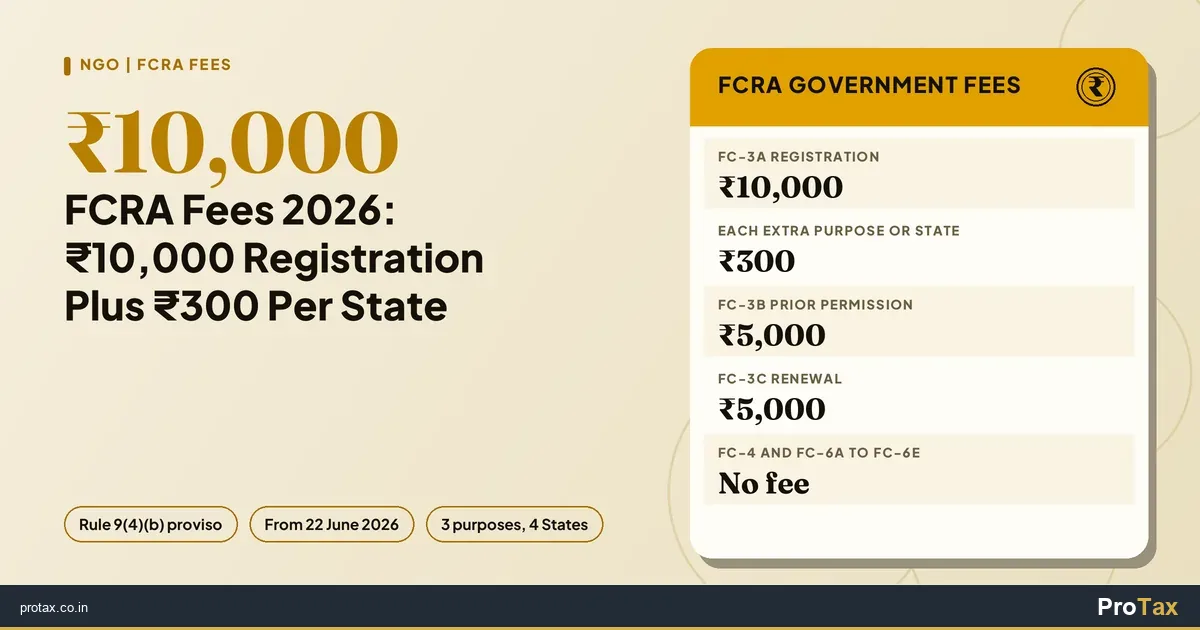
| Cost of fresh registration | ₹10,000 government fee (Form FC-3A) + professional charges | ₹10,000 fee (unchanged) + stricter eligibility review |
| Time to regain FCRA status | 6 to 12 months for fresh application processing | Expected similar timeline with digital fast-track proposals |
| Gap period funding loss | No foreign funding during the gap | No change; gap period remains unfunded from foreign sources |
International grant cycles typically run 12 to 18 months from proposal to disbursement. If an NGO's FCRA status lapses, it loses not just current funding but the entire pipeline of proposals under review. Rebuilding that pipeline after regaining registration takes another 1 to 2 years. The true cost of auto-cessation is measured in years, not just penalties.
The Proposed 2026 Changes to FCRA Auto-Cessation
The FCRA Amendment Bill 2026, discussed as a proposal for Parliament, introduces meaningful changes to the auto-cessation framework. These are not yet law, but understanding them helps NGOs prepare for stricter compliance. For the full analysis of all proposed changes, see the FCRA Amendment Bill 2026 breakdown.
Key Proposed Changes
- 180-Day Late-Filing Window: The proposal discusses a transitional period after expiry during which an NGO could file a late renewal application with an additional fee of ₹10,000 (proposed). This is not a grace period for continued operations; the entity would still be unable to receive foreign funds during this window. It is a procedural lifeline for filing the renewal, not for receiving donations.
- Early Renewal Trigger at 9 Months: The current 6-month window would extend to 9 months before expiry, giving MHA more review time and giving NGOs a larger safety buffer. This is one of the most practical changes under discussion.
- Mid-Cycle Compliance Statement: In year 3 of the 5-year cycle, the NGO would file a compliance self-assessment through the portal. This mid-cycle checkpoint would flag issues early, giving the board 2 years to fix problems before the renewal deadline.
- Digital Expiry Alerts: The proposal includes automated portal-based alerts starting 12 months before expiry, with escalating reminders at 9, 6, and 3 months. If enacted, this would directly address the "we did not know" problem that causes most cessation cases.
- Linked Cessation and Designated Authority: Under the proposed framework, auto-cessation would trigger the same designated authority asset control framework that applies to cancellation. This means a lapsed registration would not just freeze funds but could lead to active government supervision of NGO assets.
The FCRA Amendment Bill 2026 discussed here is a proposal. The law currently in force remains the FCRA, 2010 as amended in 2020. NGOs should comply with current rules while preparing for proposed changes. Do not rely on the 180-day cure window until it is enacted and notified.
7 Prevention Strategies to Avoid FCRA Auto-Cessation
Auto-cessation is entirely preventable. Every single case happens because of missed deadlines, poor documentation, or lack of institutional memory. Here are 7 strategies that work, based on real compliance patterns observed across trusts, societies, and Section 8 companies.
Strategy 1: Create a Board-Level Renewal Calendar
Do not leave renewal tracking to one person or one spreadsheet. Pass a board resolution that creates a standing compliance calendar with the following milestones:
- 24 months before expiry: Begin collecting audited accounts and verifying FC-4 filing history
- 12 months before expiry: Confirm SBI FCRA account status and utilisation account declarations
- 9 months before expiry: Start assembling Form FC-3C with all annexures
- 6 months before expiry: File the renewal application on the MHA portal
- 3 months before expiry: Follow up on application status; respond to any clarification queries
Strategy 2: Appoint a Dedicated FCRA Compliance Officer
Assign one named individual, whether a trustee, director, or paid compliance professional, as the FCRA compliance officer. This person's job includes tracking the renewal date, ensuring FC-4 filings are on time, maintaining the bank reconciliation, and serving as the single point of contact for the MHA portal. If that person leaves, the handover protocol must include FCRA credentials and the compliance calendar.
Strategy 3: File FC-4 Annual Returns by 30 November
The statutory deadline for FC-4 is 31 December, but filing by 30 November gives a full month's buffer for portal issues, auditor delays, or signatory unavailability. More importantly, timely FC-4 filing keeps the renewal pathway clean. An application with missing annual returns will be delayed or rejected, which increases cessation risk.
Strategy 4: Maintain a Live Bank Reconciliation
Reconcile the designated SBI FCRA account and all declared utilisation accounts quarterly, not just at year-end. Match every inward remittance to a donor, every outward payment to a project head, and flag any unexplained transaction immediately. Clean bank records speed up both FC-4 filing and renewal processing.
Strategy 5: Conduct a Renewal Readiness Audit in Year 3
Do not wait until year 5 to discover that 2 years of audited accounts are missing or that the designated bank account has unresolved entries. Engage your auditor or a compliance professional to run a readiness check in year 3, covering:
- All FC-4 returns filed and acknowledged
- Audited accounts available for the full certificate period
- No outstanding MHA notices or queries
- All utilisation accounts properly tagged on the portal
- Office bearer details up to date on the MHA portal
Strategy 6: Keep Entity Registration Active and Current
FCRA renewal requires the underlying entity to be in good standing. A trust must have a valid trust deed and updated trustee records. A society must have filed its annual returns with the state Registrar. A Section 8 company must be compliant with MCA filings including AOC-4 and MGT-7. If the entity's own registration has lapsed or is under strike-off proceedings, FCRA renewal cannot proceed. Ensure your NGO registration foundation is solid before layering FCRA on top.
Strategy 7: Engage Professional Support Early
If your organisation does not have in-house compliance expertise, engage a professional service provider at least 12 months before the FCRA expiry date. Professional support for FCRA renewal assistance covers document compilation, Form FC-3C preparation, portal filing, and response to MHA queries. The cost of professional assistance (starting at ₹1,999, with government fees charged separately at actuals) is a fraction of the cost of losing FCRA status and rebuilding from scratch.
FCRA Renewal Compliance Timeline: Month-by-Month Checklist
Here is a practical compliance timeline that maps every action an NGO should take from the midpoint of the FCRA certificate through renewal. Pin this to the board room wall (or your compliance dashboard).
| Timeline | Action Item | Responsible Party | Document / Form |
|---|---|---|---|
| Year 3 (Mid-Cycle) | Conduct renewal readiness audit; fix gaps in FC-4 history and bank records | Compliance Officer + Auditor | Internal audit report |
| 24 Months Before Expiry | Verify all audited accounts are prepared for the full certificate period | Finance Team | Audited financials |
| 18 Months Before Expiry | Update office bearer details on FCRA portal; renew DSC if expiring | Compliance Officer | Portal update + DSC renewal |
| 12 Months Before Expiry | Confirm SBI FCRA account status; reconcile all utilisation accounts | Finance Team | Bank statements + reconciliation |
| 9 Months Before Expiry | Begin Form FC-3C preparation; compile all annexures and activity report | Compliance Officer | Form FC-3C draft |
| 6 Months Before Expiry | File Form FC-3C on MHA portal; retain acknowledgement receipt | Authorised Signatory | Form FC-3C (filed) |
| 3 Months Before Expiry | Check application status; respond to MHA queries within 7 days | Compliance Officer | Portal status + response letters |
| 1 Month Before Expiry | Escalate if no response received; prepare backup contingency plan | Board Chairperson | Escalation letter to MHA |
| Expiry Date | If renewal approved, receive new certificate. If pending, monitor daily | Board | New FCRA certificate |
Who is Most at Risk? Identifying Vulnerable NGOs
Not every FCRA-registered organisation faces the same level of auto-cessation risk. Here are the profiles of NGOs most likely to miss their renewal deadline.
Small Trusts with Volunteer Administration
Many charitable trusts in India operate with volunteer trustees who handle FCRA compliance as a side responsibility. When the founding trustee retires, falls ill, or passes away, compliance knowledge often disappears. These trusts may not even have a trust registration reminder system in place, let alone an FCRA renewal calendar.
NGOs That Stopped Receiving Foreign Funds
Organisations that received foreign contribution 3 or 4 years ago but shifted to domestic funding sometimes assume they no longer need FCRA registration. That assumption is wrong. The registration remains active and the renewal obligation persists. Filing a nil FC-4 return is still mandatory. Ignoring the renewal because "we don't use FCRA anymore" is one of the most common paths to cessation.
First-Time Registrants
NGOs that obtained FCRA registration in 2020, 2021 or 2022 reach their first-ever renewal between 2025 and 2027. They have no institutional memory of the renewal process because they have never done it before. For these organisations, everything from Form FC-3C to the activity report format is a first-time exercise.
Societies with Rotating Managing Committees
Registered societies under the Societies Registration Act often elect new managing committees every 2 to 3 years. Each transition risks losing continuity on FCRA compliance. The outgoing committee may not brief the incoming one about the renewal deadline, DSC handover, or portal credentials.
If your NGO matches any of these profiles, run the renewal readiness audit described in Strategy 5 immediately. It costs far less to fix gaps proactively than to apply for fresh registration after cessation.
What to Do If FCRA Registration Has Already Lapsed
If auto-cessation has already occurred, the situation is serious but not hopeless. Here is the recovery roadmap.
Step 1: Stop All Foreign-Funded Activities Immediately
Do not receive, transfer, or spend any foreign contribution. Inform donors, partners, and banking contacts that FCRA status has lapsed. Continuing to accept foreign funds after cessation is a criminal offence under Section 35 of FCRA, 2010.
Step 2: Secure and Report Existing Foreign Contribution Balances
Prepare a statement of all foreign contribution balances in the designated SBI account and utilisation accounts. Notify the MHA about the status. Under Rule 12(6A), unutilised foreign contribution and assets created from it vest with the prescribed authority until the certificate is renewed or a fresh registration is granted, so follow its directions on the funds.
Step 3: Apply for Fresh Registration Under Section 11
File a fresh application for FCRA registration using Form FC-3A on the MHA portal. The application will be treated as new registration, not a continuation. The NGO must demonstrate:
- 3 years of operational history in its chosen field
- Clean financial records and audited accounts
- No pending adverse orders from MHA or enforcement agencies
- Active entity registration (trust deed, society registration, or Section 8 certificate in good standing)
- A valid designated bank account
The government fee for fresh registration is ₹10,000. Processing time is typically 6 to 12 months.
Step 4: Bridge the Gap with Domestic Funding
During the gap period, the NGO must sustain operations entirely through domestic donations, CSR grants, and government funding. Ensure 12A and 80G registration is current so domestic donors can claim tax deductions. This keeps the organisation operational while the fresh FCRA application is processed.
Step 5: Rebuild Donor Confidence
Once fresh registration is obtained, proactively share the new FCRA certificate with existing and prospective donors. Include a compliance summary showing the steps taken to prevent future lapses. Transparent communication about the gap period builds more trust than silence.
FCRA Cessation and Entity-Type-Specific Compliance
The auto-cessation trigger and consequences are identical across entity types, but the internal governance steps differ. Here is how each entity type should approach FCRA renewal compliance.
| Compliance Area | Trust | Society | Section 8 Company |
|---|---|---|---|
| Governing Document | Trust Deed | Memorandum + Bye-laws | MoA + AoA + MCA Charter |
| Renewal Authority | Trustees (via resolution) | Managing Committee (via resolution) | Board of Directors (via board resolution) |
| Annual Entity Filing | State Charity Commissioner (varies by state) | State Registrar of Societies | MCA (AOC-4, MGT-7, DIR-3 KYC) |
| Common Renewal Blocker | Missing trustee KYC; outdated trust deed | Expired managing committee; unfiled annual returns with state Registrar | Director DIN lapsed; outstanding Section 8 compliance filings |
| Leadership Continuity Risk | High (trustee death or incapacity) | High (election-cycle transitions) | Medium (formal resignation and appointment process) |
| Typical Compliance Support Need | Trust deed alignment, trustee KYC, annual audit | Bye-law compliance, committee filings, state returns | MCA filings, board minutes, statutory registers |
Regardless of entity type, the bottom line is the same: if your FCRA certificate has an expiry date and you do not file Form FC-3C in time, the registration ceases. Corporate governance quality affects how prepared you are, but the deadline itself is blind to your entity structure.
Common Myths About FCRA Auto-Cessation
Misinformation about FCRA cessation is widespread, especially among smaller NGOs that rely on informal advice. Here are the myths that need correcting.
Myth 1: "The Government Will Send a Reminder Before Cessation"
Reality: Under the current FCRA framework, MHA does not send mandatory renewal reminders. The proposed 2026 Bill discusses digital alerts, but until it is enacted, tracking the expiry date is entirely the NGO's responsibility. Do not wait for a letter that may never arrive.
Myth 2: "Filing a Nil FC-4 Means We Don't Need to Renew"
Reality: Filing a nil annual return (reporting zero foreign contribution received) does not remove the renewal obligation. As long as the FCRA registration exists, it must be renewed every 5 years. The only way to end the obligation without renewal is to voluntarily surrender the registration by writing to MHA.
Myth 3: "Auto-Cessation Has a Grace Period"
Reality: There is no statutory grace period under the current law. The proposed 2026 Bill discusses a 180-day late-filing window, but this is not enacted. Under existing rules, the registration ceases on the expiry date if no renewal application is pending. Operating during a mythical "grace period" while receiving foreign funds is a criminal offence.
Myth 4: "We Can Simply Renew After Cessation"
Reality: Renewal is only possible while the registration is still active. Once cessation occurs, the NGO must file a completely fresh application under Section 11 of FCRA, meeting all first-time eligibility criteria including the 3-year operational track record. The process takes 6 to 12 months, and there is no guarantee of approval.
Myth 5: "12A/80G Registration Covers Foreign Donations Too"
Reality: 12A and 80G registration under the Income-tax Act deals with domestic tax exemptions and deductions. It has no bearing on the right to receive foreign contribution, which requires separate FCRA registration under the MHA. An NGO with valid 12A/80G but lapsed FCRA cannot accept foreign funds.
FCRA Auto-Cessation and Related Compliance Obligations
FCRA registration does not exist in isolation. It sits inside a web of compliance obligations that affect whether renewal proceeds smoothly or hits roadblocks. Here is how FCRA connects to other critical registrations.
FCRA and 12A/80G Registration
12A registration exempts the NGO's income from tax, while 80G registration allows domestic donors to claim deductions. Since 1 April 2026 they are registration under section 332 and approval under section 354 of the Income-tax Act, 2025, each with its own renewal cycle, generally 5 years. An NGO should align both renewal calendars to avoid a situation where one registration lapses while the other is current. For details on the process, see the 12A and 80G registration assistance page.
FCRA and DARPAN Registration
DARPAN registration on the NITI Aayog NGO portal is required for receiving government grants and CSR funding. While DARPAN does not affect FCRA status directly, maintaining a valid DARPAN registration is important for the domestic funding bridge strategy if FCRA status is ever at risk.
FCRA and Entity-Level Compliance
A Section 8 company must file annual returns with MCA. A society must file with the state Registrar. A trust must comply with the state Charity Commissioner's requirements. If the entity itself is not in good standing, meaning if its own annual filings are overdue or its registration is challenged, the FCRA renewal application will face scrutiny. The Section 8 compliance filing guide covers the company-law side of this obligation. For more on entity selection, see the Section 8 vs Trust vs Society comparison.
For comprehensive compliance support covering FCRA renewal, 12A and 80G filing, and entity-level compliance, professional assistance is available through the NGO registration assistance page. Professional charges vary by scope; government fees are always separate.
Compliance Readiness Checklist for FCRA-Registered NGOs
Use this checklist to assess your current compliance position. Every "No" answer is a gap that must be closed before the renewal window opens.
| Compliance Area | Question | Yes / No | Action If "No" |
|---|---|---|---|
| Certificate Tracking | Do you know your exact FCRA expiry date? | Check the FCRA certificate or the MHA portal immediately | |
| FC-4 Filing | Have all FC-4 returns been filed for every year since registration? | File outstanding returns before starting Form FC-3C | |
| Bank Account | Is the designated SBI FCRA account active and reconciled? | Contact SBI Sansad Marg branch; update portal records | |
| Utilisation Accounts | Are all utilisation accounts declared on the portal? | Tag undeclared accounts within 15 days per current rules | |
| Audited Accounts | Are audited financials available for the full 5-year period? | Engage auditor to complete outstanding years | |
| Office Bearer Details | Are office bearer details current on the MHA portal? | Update within 30 days of any change per FCRA rules | |
| DSC Validity | Is the authorised signatory's DSC valid for at least 12 months? | Renew DSC before it expires; portal rejection is common for expired DSCs | |
| Entity Registration | Is the underlying trust/society/Section 8 registration in good standing? | File overdue entity returns; resolve pending compliance issues | |
| Compliance Calendar | Does a board-approved compliance calendar exist? | Create one and pass a board resolution adopting it | |
| Handover Protocol | Is there a documented handover process for compliance responsibilities? | Create SOP; include FCRA portal credentials and renewal dates |
Summary
FCRA auto-cessation is the quietest way to lose one of the most valuable registrations an Indian NGO can hold. There is no hearing, no appeal, and no grace period under the current law. The registration simply expires when the 5-year clock runs out without a timely Form FC-3C renewal application. The consequences extend beyond legal status: frozen bank accounts, disrupted beneficiary programmes, lost donor pipelines, and potential criminal liability if foreign funds are received after cessation. Every prevention strategy described in this article, from the board-level renewal calendar to the year-3 readiness audit, costs a fraction of what rebuilding from a fresh Section 11 application would demand. For NGOs approaching their first renewal cycle, the time to act is not 6 months before expiry. It is now.
Professional Assistance for FCRA Renewal and Compliance
ProTax assists NGOs, trusts, and Section 8 companies with FCRA renewal, FC-4 filing, and compliance readiness. Professional charges start at ₹1,999; government fees are separate and paid at actuals.
Frequently Asked Questions
What is FCRA auto-cessation of registration?
FCRA auto-cessation is the automatic lapse of an NGO's FCRA registration when the entity fails to apply for renewal before its certificate expires. Under the Foreign Contribution (Regulation) Act, 2010, registration is valid for 5 years and must be renewed through Form FC-3C on the MHA portal. If the renewal window closes without an application, the registration ceases to exist by operation of law.
How is FCRA auto-cessation different from cancellation?
Auto-cessation is a passive, time-triggered lapse that occurs without a government order when renewal is not filed on time. Cancellation under Section 14 of FCRA, 2010 is an active enforcement action where the Ministry of Home Affairs revokes registration after finding specific violations such as fund diversion, misreporting, or non-filing of FC-4 returns. Cancellation involves a show-cause notice and hearing; auto-cessation does not.
What is the validity period of FCRA registration in India?
FCRA registration granted under Section 12 of the Foreign Contribution (Regulation) Act, 2010 is valid for 5 years from the date of issue. This 5-year term has applied since the Act took effect on 1 May 2011. Only registrations under the repealed FCRA, 1976 carried no expiry, and those were deemed valid until 30 April 2016. Renewal is filed in Form FC-3C on the FCRA online portal.
When should an NGO apply for FCRA renewal to avoid auto-cessation?
Under current rules, an NGO must apply for renewal at least 6 months before the certificate expiry date using Form FC-3C on the MHA portal. The proposed FCRA Amendment Bill 2026 discusses extending this window to 9 months before expiry. Filing early is the single most effective prevention strategy against auto-cessation.
What happens to foreign funds if FCRA registration auto-ceases?
Once registration ceases, the NGO cannot receive, transfer, or use any foreign contribution. Under Rule 12(6A) of the FCRA Rules, 2011, unutilised foreign contribution and assets created from it vest with the prescribed authority until the certificate is renewed or a fresh registration is granted. The organisation must stop all foreign-funded activities and report existing balances. Domestic donations remain unaffected by FCRA cessation.
Can an NGO restore its FCRA registration after auto-cessation?
There is no automatic restoration. The NGO must file a fresh application under Section 11 of FCRA, 2010, meeting all eligibility criteria including the 3-year operational track record requirement. The fresh application is treated as new registration, not a continuation. During the gap period, the NGO cannot legally receive or use any foreign contribution.
What is the 180-day cure window under the proposed 2026 FCRA changes?
The proposed FCRA Amendment Bill 2026 discusses a 180-day transitional period after expiry during which an NGO could file a late renewal with an additional fee. This is not yet law. Under the current framework, missing the renewal deadline triggers immediate cessation with no statutory grace period, making early filing essential.
What documents are needed for FCRA renewal to prevent cessation?
FCRA renewal through Form FC-3C requires:
- Audited accounts for the last 5 financial years
- All filed FC-4 annual returns
- Bank statements of the designated SBI FCRA account
- Activity report showing utilisation of foreign contribution
- Board resolution authorising renewal
- Valid DSC of the authorised signatory
How much does FCRA renewal cost in India?
The government fee for FCRA renewal in Form FC-3C is ₹5,000, paid online through the FCRA portal; a fresh registration in Form FC-3A costs ₹10,000. The fee must accompany the application, because Rule 12(6) treats an application without the requisite fee as not received. ProTax professional charges for renewal assistance start at ₹1,999; government fees are separate and paid at actuals.
What is FCRA suspension and how does it differ from auto-cessation?
FCRA suspension under Section 13 of FCRA, 2010 is a temporary freeze for up to 180 days, extendable by a further 180 days where the government restricts an NGO's ability to use foreign contribution while investigating suspected violations. Unlike auto-cessation, suspension is a deliberate government action with a show-cause process. The registration still exists during suspension but operations are restricted.
Which NGOs are most at risk of FCRA auto-cessation?
NGOs at highest risk include those that received FCRA registration between 2020 and 2022 and now face their first 5-year renewal. Small trusts without dedicated compliance staff, societies relying on volunteer administrators, and organisations that stopped receiving foreign funds but kept their registration are especially vulnerable to missing the deadline.
Does auto-cessation affect 12A and 80G registration?
12A and 80G status, now registration under section 332 and approval under section 354 of the Income-tax Act, 2025, is legally separate from FCRA registration. Auto-cessation of FCRA does not automatically cancel 12A or 80G status. However, income-tax filings and FCRA disclosures often share the same books of account, so an NGO should review its 12A and 80G compliance separately.
What is Form FC-3C for FCRA renewal?
Form FC-3C is the prescribed application for renewal of FCRA registration, filed online through fcraonline.nic.in. It requires details of the organisation, office bearers, designated bank account, activity report for the certificate period, and all FC-4 annual returns. The form must be digitally signed using the authorised signatory's DSC. The FC-6 forms (FC-6A to FC-6E) only report changes such as name, address, objects, bank accounts or key members; they do not renew a certificate.
Can a Section 8 company face FCRA auto-cessation?
Yes. A Section 8 company receiving foreign contribution under FCRA is subject to the same renewal rules and auto-cessation risk as a trust or society. The corporate structure helps with board documentation and statutory registers, but it does not create an exemption from the 5-year renewal cycle under Section 12 of the FCRA, 2010.
What penalties apply if an NGO continues receiving funds after cessation?
Receiving foreign contribution after registration has ceased is a contravention of Section 11 of FCRA, 2010. Penalties include seizure of the contribution, prosecution of office bearers, and a monetary penalty up to ₹5 lakh or imprisonment up to 5 years under Section 35. Donors may also face consequences for funding an unregistered entity.
How does FCRA auto-cessation affect ongoing foreign-funded projects?
All foreign-funded projects must stop utilising foreign contribution immediately upon cessation. Contracts with vendors, staff on foreign-funded payroll, and beneficiary programmes funded from foreign grants cannot continue using those funds. The NGO should switch eligible activities to domestic funding sources or pause operations while pursuing fresh registration.
Is there a difference between FCRA cessation for trusts and societies?
The auto-cessation mechanism applies identically to all entity types: trusts, societies, and Section 8 companies. The difference lies in internal governance. A registered trust relies on the trust deed and trustee resolutions, a registered society follows its bye-laws, and a Section 8 company follows the Companies Act. Each structure must map its own internal process to the FCRA renewal timeline.
What is the FCRA annual return FC-4 and its filing deadline?
The FC-4 annual return is mandatory for every FCRA-registered entity, reporting all foreign contribution received and used during the financial year ending 31 March. It must be filed by 31 December of the same year through the MHA portal. Filing all FC-4 returns on time is a prerequisite for renewal. Missing even one FC-4 raises the risk of renewal rejection or delay.
Can prior permission holders face auto-cessation?
Prior permission under Section 11(2) of FCRA is granted for a specific project and a limited period, not for indefinite receipt of foreign contribution. When the permission period ends without renewal, the effect is similar to cessation: the entity loses the ability to receive foreign funds. However, the formal renewal process differs from the Section 12 registration cycle.
What board actions should NGOs take to prevent FCRA auto-cessation?
Boards should pass a standing resolution that designates one office bearer as the FCRA compliance officer, sets a renewal reminder 9 months before expiry, mandates FC-4 filing by 30 November (a month before the deadline), schedules an annual bank reconciliation, and requires a compliance review at every board meeting. Early preparation is far cheaper than fresh registration.
How long does the FCRA renewal process take?
The typical processing time for FCRA renewal is 90 to 180 working days from submission of a complete application, depending on MHA's case load and any clarifications sought. If the application triggers a field inquiry, processing may extend further. Filing 9 months before expiry gives enough buffer for delays without risking auto-cessation.
Does DARPAN registration protect an NGO from FCRA cessation?
DARPAN registration on the NITI Aayog portal is a separate identification system for NGOs and does not interact with FCRA registration status. An NGO can hold a valid DARPAN registration and still face FCRA auto-cessation if it misses the renewal deadline. DARPAN and FCRA serve different regulatory purposes.
What are the proposed 2026 changes to the auto-cessation framework?
The proposed FCRA Amendment Bill 2026 discusses auto-cessation in a broader enforcement framework that includes a 180-day late-filing window, a mid-cycle compliance statement in year 3, an early renewal trigger at 9 months before expiry, and digital alerts through the MHA portal. None of these provisions are law until Parliament enacts and the government notifies commencement.
Where can NGOs get assistance for FCRA renewal and compliance?
NGOs, trusts, and Section 8 companies can use professional support for FCRA registration and renewal assistance, FC-4 filing, bank account compliance, and post-notice response planning. ProTax assists with document review, renewal application filing, and compliance audit preparation. Professional charges start at ₹1,999; government fees are charged separately at actuals.