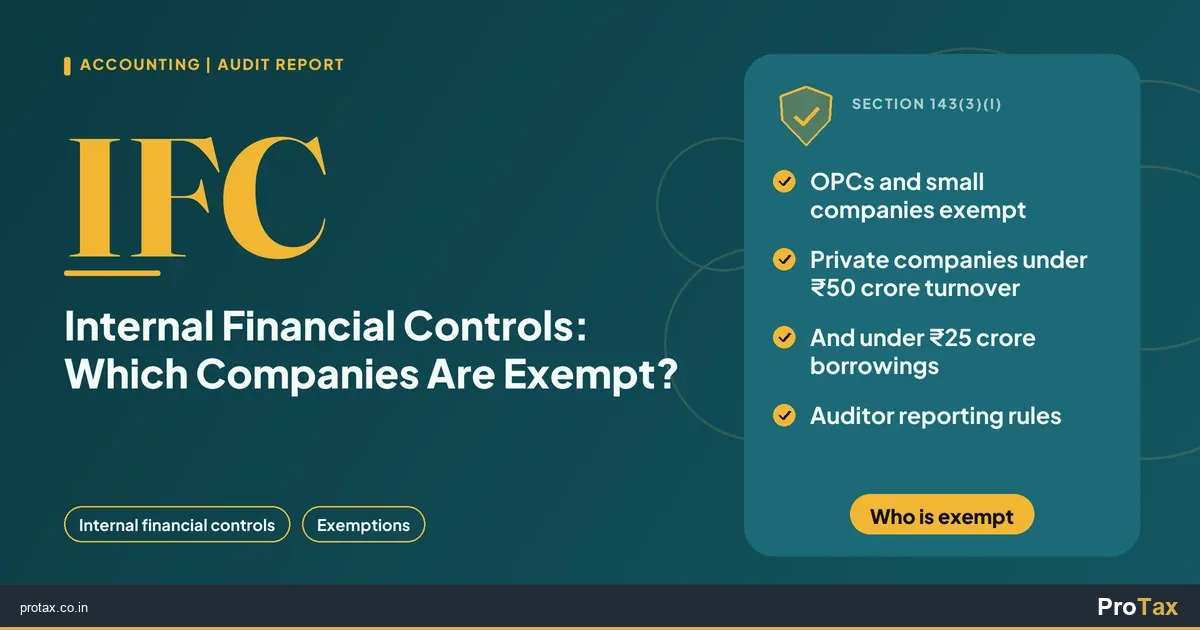
Auditors must report on internal financial controls (IFC) under Section 143(3)(i), except for private companies that are OPCs or small companies, or that have turnover below ₹50 crore and borrowings below ₹25 crore, with no filing default.
Every audit season, a familiar question lands on finance teams of growing private companies: does our auditor need to give an opinion on internal financial controls this year? The answer used to be yes for every company. Since 13 June 2017, MCA has exempted a band of smaller private companies, but the exemption has three moving parts, a corrigendum that changed "or" into "and", and a condition linked to the company's own filing record. Many companies discover they have lost the exemption only when the auditor asks for a risk and control matrix in March. This explainer sets out who must have IFC reporting, who is exempt and on what conditions, what the Board must still say about controls, and how to prepare when the exemption runs out.
- The rule: the auditor reports on the adequacy and operating effectiveness of internal financial controls over financial reporting, under Section 143(3)(i).
- Exempt private companies: one person companies (OPCs), small companies, and private companies with turnover below ₹50 crore and borrowings below ₹25 crore throughout the year.
- "And", not "or": S.O. 2218(E) of 13 July 2017 requires both conditions to be met.
- Filing condition: no exemption if AOC-4 or MGT-7 filing is in default.
- Board still reports: Rule 8(5)(viii) requires every Board's report to address IFC adequacy.
Scope: this explainer covers the auditor's IFC reporting requirement for companies under the Companies Act, 2013 and the 2017 private company exemption, with related Board and audit committee duties. Listed-company reporting under SEBI is noted briefly.
What Are Internal Financial Controls?
Internal financial controls, as described in the Explanation to Section 134(5)(e) of the Companies Act, 2013, are the policies and procedures a company adopts to ensure the orderly and efficient conduct of its business, including adherence to its policies, safeguarding of assets, prevention and detection of frauds and errors, accuracy and completeness of accounting records, and timely preparation of reliable financial information. The auditor's IFC opinion focuses on the subset that matters for financial reporting, often called internal control over financial reporting.
Think of it as a check on the machine rather than the output. The audit opinion on financial statements says whether the numbers are right. The IFC opinion says whether the system that produces the numbers is designed well and works, so that the numbers will keep being right next year too.
The auditor's duty sits in Section 143(3)(i) of the Companies Act, 2013. The private company exemption is in MCA notification G.S.R. 583(E) dated 13 June 2017, read with the corrigendum S.O. 2218(E) dated 13 July 2017. The Board's reporting duty sits in Rule 8(5)(viii) of the Companies (Accounts) Rules, 2014, and the listed-company directors' statement in Section 134(5)(e). Notifications are on the MCA portal, and the Act is on India Code.
Who Is Exempt From IFC Reporting?
The exemption applies only to private companies, and only in three cases:
| Private company | IFC reporting? | Condition |
|---|---|---|
| One person company | Exempt | No filing default under Sections 92 and 137 |
| Small company (capital up to ₹10 crore, turnover up to ₹100 crore, not a holding or subsidiary) | Exempt | No filing default |
| Turnover below ₹50 crore and borrowings below ₹25 crore throughout the year | Exempt | Both tests met, and no filing default |
| Turnover ₹50 crore or more, not small | Required | None |
| Borrowings reach ₹25 crore at any time in the year, not small | Required | None |
| Any private company with an overdue AOC-4 or MGT-7 | Required | Exemption lost |
All public companies, listed or unlisted, have IFC reporting. The practical group most affected by the thresholds is private subsidiaries of larger groups: because a subsidiary cannot be a small company, it depends on the ₹50 crore and ₹25 crore tests, and group borrowings routed through it can quickly cross ₹25 crore.
The ₹25 crore test looks at aggregate borrowings from banks, financial institutions and bodies corporate at any point during the year, not just at the year end. A company that drew ₹27 crore on a working capital line for two weeks in December, and repaid by March, has crossed the threshold for that year. Track peak borrowings monthly, not only the balance sheet figure.
Who Is Typically Caught? Four Profiles
| Company | Facts | IFC reporting? |
|---|---|---|
| Founder-owned private company | ₹8 crore capital, ₹90 crore turnover, no holding or subsidiary, filings current | No, small company |
| Private subsidiary of a foreign group | ₹30 crore turnover, no external borrowings, filings current | No, below both ₹50 crore and ₹25 crore |
| Private company with a large bank line | ₹40 crore turnover, peak borrowings ₹32 crore, not small because capital is ₹15 crore | Yes, borrowings crossed ₹25 crore |
| Small private company with old defaults | ₹5 crore turnover, MGT-7 for FY 2023-24 never filed | Yes, filing default removes the exemption |
The last row surprises most owners. A company small enough to be exempt three times over still needs IFC reporting if its annual filings are in default, which is a strong reason to clear old returns before the audit.
Getting Small Company Status Right
The small company route is the simplest exemption, but it depends on three facts that change over time. The company must be private; it must have paid-up capital up to ₹10 crore and turnover up to ₹100 crore, limits in force from 1 December 2025; and it must not be a holding or subsidiary company, a Section 8 company or a company under a special Act. A founder company that sets up its first subsidiary becomes a holding company and stops being small, even if its size has not changed. Recheck the status every year before the audit is planned, and our guide on financial statements for small companies covers the other reliefs that come with the status. For how the statutory audit differs from other audits a company may face, see our explainer on statutory audit vs tax audit.
The 2017 Corrigendum: Why "Or" Became "And"
The original notification of 13 June 2017 read, in effect, that the exemption covered a company with turnover below ₹50 crore "or" borrowings below ₹25 crore. On 13 July 2017, MCA issued S.O. 2218(E), directing that the word be read as "and". The difference is large. Under "or", a company with ₹200 crore turnover and no borrowings would have been exempt. Under "and", it is not. Only a private company below both lines, or one that is an OPC or small company, escapes IFC reporting.
The Filing Default Condition
The private company exemptions in G.S.R. 583(E), including the IFC exemption, apply only where the private company has not committed a default in filing its financial statements under Section 137 or its annual return under Section 92 with the Registrar. A private company that has missed its AOC-4 or MGT-7 for an earlier year therefore loses the exemption, however small it is. This is an easy point to miss, and it gives companies one more reason to keep their annual filings current. Our explainer on AOC-4 and MGT-7 filing covers the annual returns.
Financial audit: the law, the procedure and the consequences
An information guide to financial audit in India: what the law requires, who may act, the documents involved and what follows a default. No service is offered on the page; it carries a consultation request form only.
Read the financial audit guide
What the Board Must Still Say
The exemption is from the auditor's reporting only. Two Board-level duties continue:
- Board's report, all companies: Rule 8(5)(viii) of the Companies (Accounts) Rules, 2014 requires the Board's report to state the details in respect of the adequacy of internal financial controls with reference to the financial statements.
- Directors' responsibility statement, listed companies: Section 134(5)(e) requires directors of listed companies to state that they laid down adequate internal financial controls that operated effectively.
- Audit committee, where required: Section 177(4)(vii) makes evaluating internal financial controls and risk management part of the committee's terms of reference.
So even an exempt small company should be able to describe its controls in a few sentences of the Board's report, and support them if asked.
A Sample Board's Report Line
For a small private company outside IFC reporting, the Board's report disclosure under Rule 8(5)(viii) can be short, as long as it is true. A typical statement reads: "The Company has in place internal financial controls with reference to the financial statements, commensurate with its size and the nature of its operations, including documented procedures for purchases, sales, payroll and financial close, segregation of duties in payments, and monthly reconciliations reviewed by the directors. During the year, no material weakness in design or operation was observed." A company that cannot say that honestly has found its first control gap.
What Does an IFC Audit Involve?
When IFC reporting applies, the auditor tests design and operating effectiveness of controls over the main business cycles. Companies usually prepare:
| Document | Purpose |
|---|---|
| Entity-level controls | Code of conduct, delegation of authority, Board and committee oversight, whistle-blower mechanism |
| Process narratives or flowcharts | How revenue, purchases, payroll, inventory, fixed assets, treasury and financial close work |
| Risk and control matrix | Risks of misstatement in each process, the control addressing each, its owner, frequency and evidence |
| IT general controls | Access management, change management, backups and the accounting software audit trail |
| Test evidence | Samples showing each key control operated during the year |
The auditor's opinion appears as an annexure to the audit report, and any material weakness is described there. A clean opinion needs controls that operated through the year, so documentation started in March for a year ending that month is late.
IFC, Internal Audit and CARO: Three Different Things
| Point | IFC reporting | Internal audit | CARO 2020 |
|---|---|---|---|
| Who reports | Statutory auditor | Internal auditor appointed by the Board | Statutory auditor |
| Source | Section 143(3)(i) | Section 138 and Rule 13 | Section 143(11) and the 2020 Order |
| Subject | Controls over financial reporting | Functions and activities chosen by the Board | Specified matters such as fixed assets, inventory, loans, statutory dues |
| Private company exemption | OPC, small, or under ₹50 crore turnover and ₹25 crore borrowings | Applies only to prescribed classes by size | Separate exemption based on size and type |
Common Control Gaps in Mid-Sized Companies
When a growing private company first enters IFC reporting, the same gaps tend to appear:
- Payments: the same person creates vendors, approves invoices and releases payments.
- Revenue: credit notes and discounts issued without approval or review.
- Reconciliations: bank, GST and vendor reconciliations done irregularly or not reviewed.
- Access: shared logins to the accounting software, with no record of who changed what.
- Financial close: manual journal entries posted without a second check.
Each gap has a simple fix: separate duties, require approvals, schedule reviews and lock down access. Fixing them early in the year gives the controls time to operate and be tested. Most of these fixes cost little beyond a change in who does what, a second approval in the accounting software, and a monthly review meeting, which is why auditors expect them to be in place once a company crosses the thresholds.
Preparing When the Exemption Runs Out
- Step 1, test applicability early: check OPC or small company status, latest audited turnover, peak borrowings and filing status at the start of the year.
- Step 2, scope the processes: list the business cycles that drive the financial statements.
- Step 3, document: narratives and a risk and control matrix for each cycle, with control owners.
- Step 4, fix gaps: add missing controls, such as segregation of duties in payments or reconciliations signed off monthly.
- Step 5, test during the year: management testing in the third quarter, so problems can be fixed before year end.
- Step 6, share with the auditor: provide the documentation and test results before the year-end audit begins.
Worked Example
A Noida private company, a subsidiary of an Indian group, had FY 2024-25 turnover of ₹42 crore. In FY 2025-26, it drew ₹28 crore on a bank term loan in August 2025. Because it is a subsidiary, it is not a small company. Its turnover is below ₹50 crore, but its borrowings crossed ₹25 crore during FY 2025-26, so it fails the "and" test, and its FY 2025-26 audit includes IFC reporting. Had it stayed below ₹25 crore of borrowings all year, and kept its filings current, it would have been exempt.
Common Mistakes
- Reading "or": both the turnover and borrowing tests must be met after S.O. 2218(E).
- Year-end borrowings only: the borrowing test is any point in the year.
- Assuming subsidiaries are small: holding and subsidiary companies are never small companies.
- Ignoring filing defaults: an overdue AOC-4 or MGT-7 removes the exemption.
- Skipping the Board's report line: Rule 8(5)(viii) applies to all companies.
Related year-end topics include the CARO 2020 applicability rules and the audit trail requirement for accounting software, both of which the auditor reports on alongside IFC.
Harith - Compliance Expert notes that in our experience the borrowing test catches more companies than turnover, because a temporary peak in a working capital line is easy to forget by the time the audit starts. Our team checks peak monthly borrowings in the first quarter of each year for clients near the line, so that IFC documentation, if needed, can start with 9 months still left in the year.
Summary
Section 143(3)(i) of the Companies Act, 2013 requires the auditor to report on the adequacy and operating effectiveness of a company's internal financial controls over financial reporting. Under G.S.R. 583(E) of 13 June 2017, private companies are exempt if they are OPCs or small companies, or if they have turnover below ₹50 crore and borrowings below ₹25 crore throughout the year, both tests together after S.O. 2218(E), and in every case only if their AOC-4 and MGT-7 filings are not in default. Public companies always have IFC reporting. The Board's report must still address IFC adequacy for every company. Test applicability at the start of the year and document controls early.
Professional Accounting and Audit Support
ProTax provides accounting services, IFC documentation and audit preparation support for private and public companies, and assistance with the related ROC filings. Services are priced on the service pages; government fees are charged separately at actuals.
Frequently Asked Questions
What is internal financial controls reporting?
Under Section 143(3)(i) of the Companies Act, 2013, the statutory auditor's report states whether the company has an adequate internal financial controls system with reference to its financial statements, and whether those controls operated effectively. It is often called IFC or ICFR reporting, and appears as an annexure to the audit report.
Which companies are exempt from IFC reporting?
Under MCA notification G.S.R. 583(E) dated 13 June 2017, IFC reporting does not apply to a private company that is a one person company or a small company, or that has turnover below ₹50 crore as per the latest audited financial statements and aggregate borrowings below ₹25 crore at any time during the year.
Do both the turnover and borrowing conditions have to be met?
Yes. MCA's corrigendum S.O. 2218(E) dated 13 July 2017 clarified that the words should be read as "and", so a private company that is not an OPC or small company must have both turnover below ₹50 crore and borrowings below ₹25 crore throughout the year to be exempt.
Does a filing default remove the IFC exemption?
Yes. The 2017 exemptions for private companies apply only if the company has not defaulted in filing its financial statements under Section 137 or its annual return under Section 92. A private company with an overdue AOC-4 or MGT-7 loses the IFC exemption and the auditor must report.
Are public companies exempt from IFC reporting?
No. The exemption is only for private companies. Every public company, listed or unlisted and whatever its size, has IFC reporting in its auditor's report under Section 143(3)(i), unless another specific exemption applies to it, so public subsidiaries of private groups should plan for it.
Which borrowings count toward the ₹25 crore limit?
The notification counts aggregate borrowings from banks, financial institutions and any body corporate at any point of time during the financial year. Loans from individuals, including directors, are not in the list, though prudent practice is to track total borrowings.
Is the turnover test based on the current year?
No. Turnover is taken from the latest audited financial statements, which for a FY 2025-26 audit generally means FY 2024-25 figures, while the borrowing test looks at every point during the year being audited, including temporary peaks in working capital lines.
Does a small company need IFC reporting?
No. A private company that is a small company under Section 2(85), with paid-up capital up to ₹10 crore and turnover up to ₹100 crore and not a holding or subsidiary company, is exempt, provided it has no filing default under Sections 92 and 137.
Does the IFC exemption remove the Board's duty on internal controls?
No. The exemption covers only the auditor's reporting. The Board's report must still state the details of the adequacy of internal financial controls with reference to financial statements under Rule 8(5)(viii) of the Companies (Accounts) Rules, 2014, which applies to all companies.
What do directors of listed companies say about IFC?
Under Section 134(5)(e), the directors' responsibility statement of a listed company states that the directors laid down internal financial controls to be followed by the company, and that they were adequate and operating effectively. The explanation to the clause defines internal financial controls.
How does the Act define internal financial controls?
The Explanation to Section 134(5)(e) describes them as the policies and procedures adopted to ensure the orderly and efficient conduct of business, adherence to policies, safeguarding of assets, prevention and detection of frauds and errors, accuracy and completeness of records, and timely preparation of reliable financial information.
What role does the audit committee play in IFC?
Where a company has an audit committee, Section 177(4)(vii) requires it to evaluate internal financial controls and risk management systems. Independent directors also have a duty under Schedule IV to satisfy themselves on the integrity of financial information and the strength of controls.
What does the auditor need from the company for IFC reporting?
The auditor typically asks for a risk and control matrix, process narratives or flowcharts for key cycles such as revenue, purchases, payroll and financial close, evidence of control operation, entity-level controls such as policies and delegation of authority, and management's own testing results.
Is IFC reporting the same as an internal audit?
No. IFC reporting is the statutory auditor's opinion on controls over financial reporting under Section 143(3)(i). An internal audit under Section 138 is a separate review by an internal auditor appointed by the company, required only for prescribed classes, though it often supports IFC.
What happens if controls are found inadequate?
The auditor gives a qualified or adverse opinion on internal financial controls in an annexure to the audit report, describing the material weakness. That opinion is public through AOC-4 and is read by lenders, investors and acquirers, so weaknesses should be fixed before the year end where possible.
Does a company that loses the exemption need IFC from that year?
Yes. A private company whose borrowings cross ₹25 crore at any point in a year, or whose latest audited turnover reaches ₹50 crore, and which is not an OPC or small company, needs IFC reporting for that year's audit, so documentation should start as soon as the threshold is crossed.
Does the audit trail rule relate to IFC?
Yes, indirectly. The requirement for accounting software with an audit trail under the proviso to Rule 3(1) of the Accounts Rules applies to all companies and is reported on by the auditor, and an audit trail is itself a key control over the integrity of financial records.
Is IFC required for LLPs?
No. Section 143(3)(i) applies to company audits. LLP audits under the LLP Act, 2008 do not include an IFC opinion, although well-run LLPs keep similar controls for their lenders and investors, and banks often ask about them during credit reviews.
How long does it take to build IFC documentation?
For a mid-sized private company with standard processes, building a first risk and control matrix, narratives and test evidence usually takes 6 to 10 weeks, depending on the number of business cycles, locations and systems involved, plus time for management testing.
Where can a company get help with IFC documentation?
ProTax provides internal financial control documentation support through its accounting and advisory team, including risk and control matrices, process narratives and test files for audit, alongside related compliance reviews. Services are priced on the service page; any statutory fees are separate.
Frequently Asked Questions
What is internal financial controls reporting?
Under Section 143(3)(i) of the Companies Act, 2013, the statutory auditor's report states whether the company has an adequate internal financial controls system with reference to its financial statements, and whether those controls operated effectively. It is often called IFC or ICFR reporting, and appears as an annexure to the audit report.
Which companies are exempt from IFC reporting?
Under MCA notification G.S.R. 583(E) dated 13 June 2017, IFC reporting does not apply to a private company that is a one person company or a small company, or that has turnover below ₹50 crore as per the latest audited financial statements and aggregate borrowings below ₹25 crore at any time during the year.
Do both the turnover and borrowing conditions have to be met?
Yes. MCA's corrigendum S.O. 2218(E) dated 13 July 2017 clarified that the words should be read as "and", so a private company that is not an OPC or small company must have both turnover below ₹50 crore and borrowings below ₹25 crore throughout the year to be exempt.
Does a filing default remove the IFC exemption?
Yes. The 2017 exemptions for private companies apply only if the company has not defaulted in filing its financial statements under Section 137 or its annual return under Section 92. A private company with an overdue AOC-4 or MGT-7 loses the IFC exemption and the auditor must report.
Are public companies exempt from IFC reporting?
No. The exemption is only for private companies. Every public company, listed or unlisted and whatever its size, has IFC reporting in its auditor's report under Section 143(3)(i), unless another specific exemption applies to it, so public subsidiaries of private groups should plan for it.
Which borrowings count toward the ₹25 crore limit?
The notification counts aggregate borrowings from banks, financial institutions and any body corporate at any point of time during the financial year. Loans from individuals, including directors, are not in the list, though prudent practice is to track total borrowings.
Is the turnover test based on the current year?
No. Turnover is taken from the latest audited financial statements, which for a FY 2025-26 audit generally means FY 2024-25 figures, while the borrowing test looks at every point during the year being audited, including temporary peaks in working capital lines.
Does a small company need IFC reporting?
No. A private company that is a small company under Section 2(85), with paid-up capital up to ₹10 crore and turnover up to ₹100 crore and not a holding or subsidiary company, is exempt, provided it has no filing default under Sections 92 and 137.
Does the IFC exemption remove the Board's duty on internal controls?
No. The exemption covers only the auditor's reporting. The Board's report must still state the details of the adequacy of internal financial controls with reference to financial statements under Rule 8(5)(viii) of the Companies (Accounts) Rules, 2014, which applies to all companies.
What do directors of listed companies say about IFC?
Under Section 134(5)(e), the directors' responsibility statement of a listed company states that the directors laid down internal financial controls to be followed by the company, and that they were adequate and operating effectively. The explanation to the clause defines internal financial controls.
How does the Act define internal financial controls?
The Explanation to Section 134(5)(e) describes them as the policies and procedures adopted to ensure the orderly and efficient conduct of business, adherence to policies, safeguarding of assets, prevention and detection of frauds and errors, accuracy and completeness of records, and timely preparation of reliable financial information.
What role does the audit committee play in IFC?
Where a company has an audit committee, Section 177(4)(vii) requires it to evaluate internal financial controls and risk management systems. Independent directors also have a duty under Schedule IV to satisfy themselves on the integrity of financial information and the strength of controls.
What does the auditor need from the company for IFC reporting?
The auditor typically asks for a risk and control matrix, process narratives or flowcharts for key cycles such as revenue, purchases, payroll and financial close, evidence of control operation, entity-level controls such as policies and delegation of authority, and management's own testing results.
Is IFC reporting the same as an internal audit?
No. IFC reporting is the statutory auditor's opinion on controls over financial reporting under Section 143(3)(i). An internal audit under Section 138 is a separate review by an internal auditor appointed by the company, required only for prescribed classes, though it often supports IFC.
What happens if controls are found inadequate?
The auditor gives a qualified or adverse opinion on internal financial controls in an annexure to the audit report, describing the material weakness. That opinion is public through AOC-4 and is read by lenders, investors and acquirers, so weaknesses should be fixed before the year end where possible.
Does a company that loses the exemption need IFC from that year?
Yes. A private company whose borrowings cross ₹25 crore at any point in a year, or whose latest audited turnover reaches ₹50 crore, and which is not an OPC or small company, needs IFC reporting for that year's audit, so documentation should start as soon as the threshold is crossed.
Does the audit trail rule relate to IFC?
Yes, indirectly. The requirement for accounting software with an audit trail under the proviso to Rule 3(1) of the Accounts Rules applies to all companies and is reported on by the auditor, and an audit trail is itself a key control over the integrity of financial records.
Is IFC required for LLPs?
No. Section 143(3)(i) applies to company audits. LLP audits under the LLP Act, 2008 do not include an IFC opinion, although well-run LLPs keep similar controls for their lenders and investors, and banks often ask about them during credit reviews.
How long does it take to build IFC documentation?
For a mid-sized private company with standard processes, building a first risk and control matrix, narratives and test evidence usually takes 6 to 10 weeks, depending on the number of business cycles, locations and systems involved, plus time for management testing.
Where can a company get help with IFC documentation?
ProTax provides internal financial control documentation support through its accounting and advisory team, including risk and control matrices, process narratives and test files for audit, alongside related compliance reviews. Services are priced on the service page; any statutory fees are separate.














