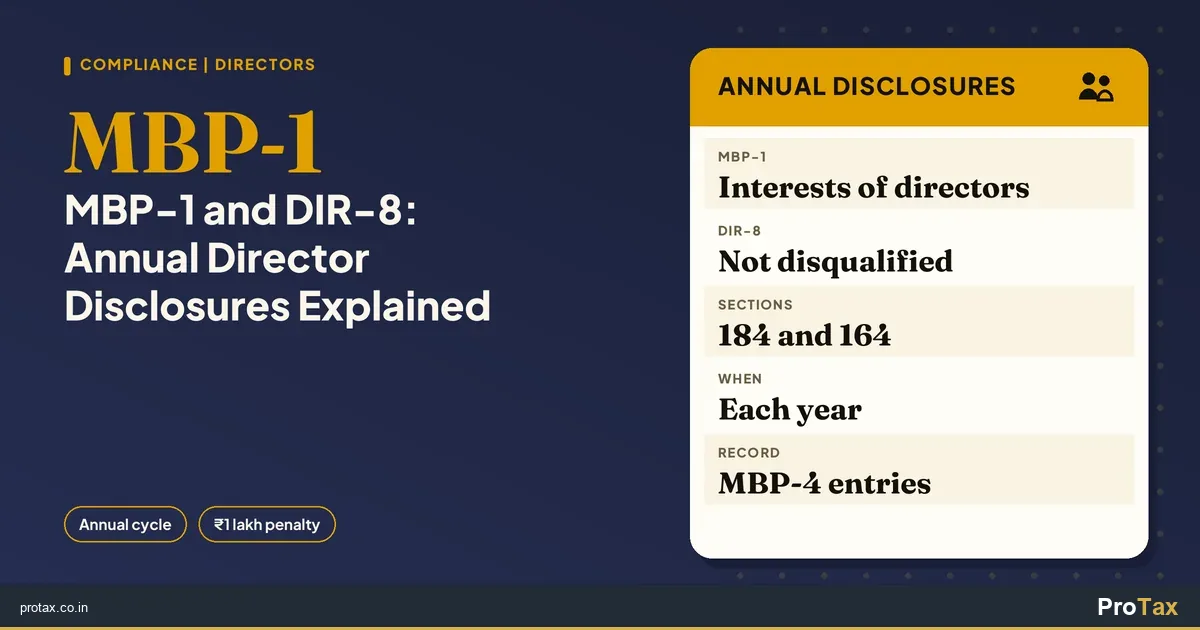
Every year, at the first board meeting of the financial year, each director of a company gives 2 documents to the board. Form MBP-1, under Section 184(1) of the Companies Act, 2013, discloses the director's interests in other companies, bodies corporate, firms and associations, including shareholdings. Form DIR-8, under Section 164(2) and Rule 14 of the director rules, confirms that the director is not disqualified because of defaults by another company. Neither form is filed with the ROC, but both matter: missing MBP-1 disclosures carry a ₹1 lakh penalty for the director under Section 184(4) and can lead to vacation of office under Section 167, while DIR-8 is the written representation the statutory auditor relies on to report on director disqualification. This guide explains what each form contains, when it is due, how the board records it, how it feeds the MBP-4 register, and what goes wrong when it is skipped.
- MBP-1: director's interests, given at the first board meeting as director, the first meeting of each financial year, and after any change.
- DIR-8: non-disqualification under Section 164(2), required before appointment or reappointment and collected annually in practice.
- Not filed with ROC: both are kept by the company; MBP-1 notices are preserved for 8 years.
- Section 184(2): disclose interest when a related contract is discussed; private company directors may then participate.
- Consequences: ₹1 lakh penalty under Section 184(4), voidable contracts and possible vacation of office.
This explainer is for directors, compliance professionals, finance teams and founders of private companies preparing for the first board meeting of FY 2026-27 or onboarding a new director mid-year.
MBP-1 and DIR-8 at a Glance
| Point | MBP-1 | DIR-8 |
|---|---|---|
| Full name | Notice of interest by director | Intimation by director of non-disqualification |
| Section | Section 184(1) | Section 164(2) |
| Rules | Rule 9, Companies (Meetings of Board and its Powers) Rules, 2014 | Rule 14(1), Companies (Appointment and Qualification of Directors) Rules, 2014 |
| What it says | Interests in other companies, bodies corporate, firms and associations, including shareholdings | Director is not disqualified under Section 164(2) |
| When | First board meeting as director; first meeting of each financial year; after any change | Before appointment or reappointment; annually in practice |
| Given to | The board | The company |
| Filed with ROC | No | No |
| Retention | 8 years from end of the relevant financial year | With board records |
| Consequence of failure | ₹1 lakh penalty on the director; voidable contracts; possible vacation of office | Auditor cannot rely on a representation; risk of an undisclosed disqualification |
Section 184 (disclosure of interest), Section 189 (register of contracts), Section 164 (disqualifications), Section 167 (vacation of office) and Section 143(3)(g) (auditor's report on disqualification) of the Companies Act, 2013; Rule 9 of the Companies (Meetings of Board and its Powers) Rules, 2014; Rule 14 of the Companies (Appointment and Qualification of Directors) Rules, 2014; private company exemptions in notification G.S.R. 464(E) dated 5 June 2015. Text is on the MCA portal.
MBP-1: What Directors Disclose Under Section 184(1)
Section 184(1) requires every director to disclose his or her concern or interest in any company or companies, bodies corporate, firms or other associations of individuals, including shareholding, in the manner prescribed. Form MBP-1 is that manner.
What Goes Into MBP-1
- Name of each company, body corporate, firm or association in which the director is interested.
- Nature of interest or concern, such as director, partner, member, proprietor or shareholder.
- Shareholding, with number and percentage of shares held, where applicable.
- Date on which the interest or concern arose or changed.
- The director's signature, place and date.
The 3 Trigger Points
- First board meeting as director: a newly appointed director gives MBP-1 at the first meeting he or she attends.
- First board meeting of every financial year: every director renews the disclosure, usually at the April, May or June meeting.
- Any change: if a director joins another board, buys shares in another company or becomes a partner in a firm, he or she gives a fresh MBP-1 at the first board meeting after the change.
Interests That Are Often Missed
- Shareholdings in other private companies, including small holdings in friends' startups.
- Partnerships in firms and LLPs, including family firms.
- Directorships in Section 8 companies, trusts or associations.
- Proprietorship businesses that trade with the company.
- Holdings through a spouse or HUF that give the director a concern in the entity.
How MBP-1 Feeds the Financial Statements
The interests listed in MBP-1 are the starting point for the company's related party disclosures under AS 18 or Ind AS 24, the particulars of related party contracts in Form AOC-2 attached to the board's report, and the entries in the MBP-4 register. If a director's firm supplies the company and the firm is missing from MBP-1, the accounts can understate related party transactions, which auditors treat seriously. A complete MBP-1 makes the year-end related party schedule a matter of matching ledgers against a known list.
These interests matter because they identify the company's related parties. Our article on related party transaction compliance explains how MBP-1 feeds the Section 188 process and the accounting disclosures.
Section 184(2): Disclosure When a Contract Is Discussed
Section 184(2) adds a transaction-level duty. A director who is directly or indirectly concerned or interested in a contract or arrangement, entered into or proposed to be entered into, with:
- a body corporate in which the director, alone or with other directors, holds more than 2% of shareholding, or is a promoter, manager or chief executive officer; or
- a firm or other entity in which the director is a partner, owner or member,
must disclose the nature of that interest at the board meeting where the contract or arrangement is discussed. If the director was not interested when the contract was made, he or she discloses at the first board meeting after becoming interested.
Can the Interested Director Vote?
| Company Type | Participation After Disclosure |
|---|---|
| Public company | Must not participate in the discussion or vote on that item |
| Private company | May participate after disclosing the interest, under the 5 June 2015 exemption |
Contracts entered into without the disclosure required by Section 184(2), or with participation by an interested director where that is barred, are voidable at the option of the company under Section 184(3).
Handling It at the Meeting
When an agenda item involves a contract with an entity in which a director is interested, the chair should invite the director to state the interest before discussion begins. The minutes should record the disclosure, whether the director participated, and how the decision was taken. In a public company, the minutes should show that the interested director left the discussion and did not vote; in a private company, they should show the disclosure was made before the director took part. This single paragraph in the minutes is the company's best evidence if the contract is ever questioned.
Get Your First Board Meeting of the Year Right
ProTax private limited company compliance packages from ₹2,999 include annual MBP-1 and DIR-8 collection, minutes of the first board meeting and updates to statutory registers, so disclosures are complete and on record.
MBP-4: The Register of Contracts
Disclosures under Section 184 flow into the register of contracts or arrangements in which directors are interested, maintained in Form MBP-4 under Section 189.
- What goes in: particulars of contracts or arrangements with bodies corporate and firms covered by Section 184(2), and related party contracts under Section 188.
- Who signs: entries are signed by a director or by the key managerial person the board authorises.
- When: entries are made as the contracts are entered into, and the register is placed before the next board meeting.
- Directors and KMP: under Section 189(2), every director and key managerial personnel discloses the particulars in Section 184(1) within 30 days of appointment or relinquishment of office.
- Inspection: the register is kept at the registered office, open to member inspection, and produced at the AGM.
Contracts for sale, purchase or supply of goods or services not exceeding ₹5 lakh in a financial year, and transactions between a banking company and its customers in the ordinary course, are among those Section 189 excludes from the register.
MBP-2, MBP-3 and MBP-4 Compared
The MBP series includes 3 registers that are easy to confuse. MBP-2 is the register of loans, guarantees, security and acquisitions under Section 186. MBP-3 is the register of investments not held in the company's own name under Section 187. MBP-4 is the register of contracts with related parties and entities in which directors are interested under Section 189. Each is kept at the registered office and updated as transactions occur. MBP-1 is different in kind: it is a notice from a director, not a register, but its contents decide which transactions must be entered in MBP-4, so the 2 should be reviewed side by side at each first board meeting of the year.
DIR-8: The Non-Disqualification Declaration
Rule 14(1) of the director rules requires every director to inform the company about any disqualification under Section 164(2), in Form DIR-8, before he or she is appointed or reappointed. Companies collect DIR-8 every year as well, for 2 reasons: directors retiring by rotation in public companies are reappointed regularly, and the statutory auditor reports on Section 164(2) disqualification as on 31 March based on written representations from directors.
What DIR-8 Confirms
The director confirms that he or she is not, and has not been in the preceding 5 years, a director of a company that:
- has not filed financial statements or annual returns for any continuous period of 3 financial years; or
- has failed to repay deposits, pay interest on them, redeem debentures on the due date, pay interest due, or pay a declared dividend, where the failure has continued for 1 year or more.
Consequences of a Section 164(2) Disqualification
A disqualified person cannot be reappointed as director of the defaulting company, or appointed to any other company, for 5 years from the date of the default. Under the proviso to Section 167(1)(a), the director vacates office in all other companies, but stays on the board of the defaulting company so that the defaults can be fixed. Directors of companies that stopped filing after closing operations are the group most often caught, as our article on disqualification risks in inactive companies explains.
Checking a Director's Status on the MCA Portal
Before appointing a director, and once a year for existing directors, check the director's DIN on the MCA portal's director master data. It shows the DIN status, such as active, deactivated for missing KYC, or disqualified, and lists the companies and LLPs with which the director is associated. Compare that list with the director's MBP-1: an association on the portal that is missing from MBP-1 is a gap to resolve, and a company on the list that has stopped filing is an early warning for Section 164(2).
If a Director Turns Out to Be Disqualified
- Confirm the facts: which company defaulted, for which years, and from what date the disqualification runs.
- Recognise that the director has vacated office in every company other than the defaulting one, under the proviso to Section 167(1)(a).
- File DIR-12 in each affected company to record the vacation of office within 30 days.
- Ensure the company still meets the minimum number of directors and the resident director rule, appointing replacements if needed.
- In the defaulting company, file the overdue financial statements and annual returns so the underlying default is cured, and take advice on any further remedy available to the director.
Section 164(1): The Personal Disqualifications
| Clause | Disqualification |
|---|---|
| 164(1)(a) | Of unsound mind, as declared by a competent court |
| 164(1)(b) | Undischarged insolvent |
| 164(1)(c) | Applied to be adjudicated an insolvent and the application is pending |
| 164(1)(d) | Convicted of an offence and sentenced to imprisonment of 6 months or more (7 years or more: permanent) |
| 164(1)(e) | Disqualified by a court or tribunal order |
| 164(1)(f) | Has not paid calls on shares for 6 months |
| 164(1)(g) | Convicted of a related party offence under Section 188 in the preceding 5 years |
| 164(1)(h) | Has not obtained a DIN |
| 164(1)(i) | Holds directorships beyond the Section 165 limits |
DIR-8 formally addresses Section 164(2), but most companies use a combined annual declaration that also covers Section 164(1), so the board has a complete picture. Our article on director disqualification rules covers recent changes.
How the Board Handles MBP-1 and DIR-8
- Before the meeting: send blank or pre-filled MBP-1 and DIR-8 forms to each director with the notice of the first board meeting of the year.
- At the meeting: directors table signed forms. The board notes the disclosures, and the minutes record each director's MBP-1 and DIR-8.
- After the meeting: update the related party list, the register of directors and KMP, and the MBP-4 register.
- Through the year: collect a fresh MBP-1 whenever a director's interests change, and a Section 184(2) disclosure at each meeting where an interested contract is discussed.
- At year end: give the statutory auditor copies of DIR-8 and the board minute taking them on record, for the Section 143(3)(g) report.
A Simple Annual Calendar
| When | Action |
|---|---|
| March | Send MBP-1 and DIR-8 formats to directors; check DIN status on the MCA portal |
| First board meeting of the financial year | Table signed MBP-1 and DIR-8; minute them; update related party list |
| Every board meeting | Standing item on changes in directors' interests; Section 184(2) disclosures on interested contracts |
| Within 30 days of any director change | Section 189(2) disclosure; DIR-12; MBP-4 update |
| Year end | Provide DIR-8 and the board minute to the statutory auditor |
Sample Minute
"The Board noted the disclosures of interest received from all the directors in Form MBP-1 pursuant to Section 184(1) of the Companies Act, 2013, and the intimations in Form DIR-8 pursuant to Section 164(2) read with Rule 14(1) of the Companies (Appointment and Qualification of Directors) Rules, 2014, confirming that none of the directors is disqualified. The same were taken on record."
Our guide on board meeting compliance covers notice, quorum and minutes, and our article on the first board meeting after incorporation covers the first-ever disclosures for a new company.
Worked Example: A Founder's MBP-1
Ms. R is a director of ABC Private Limited. For the first board meeting of FY 2026-27, her MBP-1 lists:
| Entity | Nature of Interest | Shareholding | Date Interest Arose |
|---|---|---|---|
| ABC Private Limited | Director and shareholder | 45% | 12 June 2021 |
| XYZ Technologies Private Limited | Director | Nil | 3 March 2024 |
| PQR Foods Private Limited | Shareholder | 3% | 18 September 2025 |
| R and Sons (partnership firm) | Partner | Profit share 50% | 1 April 2015 |
| LMN Foundation (Section 8 company) | Director | Nil | 5 January 2026 |
Three consequences follow. First, XYZ, PQR, the firm and the foundation all become entities to check for transactions with ABC, because Ms. R is a director or member of each. Second, any contract between ABC and PQR triggers a Section 184(2) disclosure because she holds more than 2% of PQR. Third, any contract with R and Sons triggers Section 184(2) because she is a partner. If Ms. R buys shares in another startup in November 2026, she gives a fresh MBP-1 at the next board meeting, not in April 2027.
Special Situations
Director Appointed Mid-Year
A director appointed in, say, August gives DIR-2 consent and a declaration before appointment, and MBP-1 at the first board meeting he or she attends. The director then gives MBP-1 again at the first board meeting of the next financial year, so the cycle aligns with the other directors.
Investor Nominee Directors
A nominee director appointed by a fund typically sits on other portfolio company boards and may be a director of the fund's management company. All of those interests go into MBP-1. If the company contracts with another portfolio company, the nominee's Section 184(2) disclosure must be considered at that meeting.
Directors of Companies That Have Stopped Filing
The highest DIR-8 risk is a director who also sits on the board of a company that closed operations without formally winding up and stopped filing AOC-4 and MGT-7. After 3 years of non-filing, the director is disqualified for 5 years and vacates office everywhere else. Our article on annual filing for inactive companies explains how to avoid that outcome.
One Person Companies
An OPC with a single director still needs MBP-1 and DIR-8 on record, even though the "board" is one person. Under Section 122(4), where an OPC has only one director, business required to be transacted at a board meeting is treated as done when the resolution is entered in the minute book and signed and dated by that director, so the disclosures are recorded the same way.
Director Resigning
A director who resigns should give notice to the company, and may file DIR-11 with the ROC. Under Section 189(2), the director discloses relinquishment-related particulars within 30 days, and the company updates the MBP-4 register and related party list. The company files DIR-12 within 30 days.
Penalties and Consequences
| Default | Consequence |
|---|---|
| Failure to disclose under Section 184(1) or 184(2) | Penalty of ₹1 lakh on the director under Section 184(4), as amended by the Companies (Amendment) Act, 2020 |
| Contract made without required disclosure or with barred participation | Voidable at the option of the company under Section 184(3) |
| Acting in contravention of Section 184 on interested contracts | Vacation of office under Section 167(1)(c) |
| Continuing as director while disqualified under Section 164 | Vacation of office under Section 167(1)(a); liability under Section 167(2) for continuing to act |
| Register of contracts not maintained | Liability under Section 189(6) for the company and every officer in default |
An incomplete MBP-1 rarely surfaces on its own. It surfaces when a related party contract is challenged, an investor runs due diligence, or the ROC examines a Section 188 transaction and finds no disclosure on record. By then, the ₹1 lakh penalty is the smaller problem; the contract itself may be voidable and the director's office at risk.
Our review of ROC penalty orders in 2026 shows how ROCs examine board records during adjudication.
Common Mistakes
- Copying last year's MBP-1 without checking for new directorships, shareholdings or partnerships.
- Collecting MBP-1 but not minuting it, so there is no board record that the disclosure was made.
- Leaving out small shareholdings, which still create a concern or interest and may cross the 2% line for Section 184(2).
- Treating DIR-8 as a one-time form, so the auditor has no current representation as on 31 March.
- Not updating MBP-4 after a director's interest changes, leaving the register out of step with the disclosures.
- Ignoring interests held through family, such as a spouse's firm, that give the director a concern in the entity.
Each of these is a 10-minute fix at the time and a painful reconstruction later, usually under the pressure of an audit, a funding round or a related party dispute. Keep a running file for each director with the latest MBP-1, DIR-8, DIR-2 and KYC status, and review it before every board meeting so nothing is missed.
Links to Other Annual Director Compliance
| Requirement | When | Filed With ROC? |
|---|---|---|
| MBP-1 | First board meeting of the year; on change | No |
| DIR-8 | Before appointment or reappointment; annually in practice | No |
| DIR-3 KYC | Once every 3 financial years, by 30 June | Yes |
| DIR-12 | Within 30 days of appointment, resignation or change | Yes |
| Resident director check (Section 149(3)) | Each financial year | No |
| Directors' responsibility statement in board's report | Annually with accounts | Yes, with AOC-4 |
Our articles on the DIR-3 KYC triennial rule, the resident director requirement and the board's report under Section 134 cover these in detail, and our guide to MCA form codes decodes the MBP and DIR series.
Based on our experience preparing board records, the most common gap is not a missing MBP-1 but an outdated one: a director joins another board or invests in a startup in October and nobody asks for a fresh disclosure until next April. Harith - Compliance Expert recommends adding a standing agenda item, "changes in directors' interests", to every board meeting, so updates are captured as they happen and the related party list stays current.
Summary
MBP-1 and DIR-8 are the 2 annual disclosures every director gives the company. MBP-1, under Section 184(1), lists the director's interests and shareholdings, at the first board meeting as director, the first meeting of each financial year and after any change; Section 184(2) adds disclosure when an interested contract is discussed. DIR-8, under Section 164(2) and Rule 14(1), confirms the director is not disqualified because of another company's filing or repayment defaults. Neither is filed with the ROC, but both are minuted, retained and relied upon by auditors, investors and regulators. Failure costs the director a ₹1 lakh penalty, can make contracts voidable and can end the directorship. Collect both forms with the notice of the first meeting each year, update them through the year, and keep the MBP-4 register in step. For new directors, ProTax also assists with director appointments and DIR-12 filing.
Keep Director Disclosures and Registers Up to Date
ProTax compliance packages from ₹2,999 handle annual director disclosures, board minutes, statutory registers and event-based filings for private companies. MCA fees for any filings are paid separately at actuals.
Frequently Asked Questions
What is Form MBP-1?
Form MBP-1 is the notice in which a director discloses his or her concern or interest in other companies, bodies corporate, firms and associations, including shareholdings, under Section 184(1) of the Companies Act, 2013 and Rule 9 of the Companies (Meetings of Board and its Powers) Rules, 2014.
When must a director give MBP-1?
A director gives MBP-1 at the first board meeting in which he or she participates as a director, then at the first board meeting of every financial year, and whenever the disclosures change, at the first board meeting held after the change.
What is Form DIR-8?
Form DIR-8 is a director's intimation to the company that he or she is not disqualified under Section 164(2), which disqualifies directors of companies that failed to file financial statements or annual returns for 3 years, or defaulted on deposits, debentures or dividends for a year.
When is DIR-8 given?
Rule 14(1) of the Appointment and Qualification of Directors Rules requires DIR-8 before appointment or reappointment. In practice, companies collect it every financial year, because the statutory auditor must report on director disqualification as on 31 March based on written representations from directors.
Are MBP-1 and DIR-8 filed with the ROC?
MBP-1 and DIR-8 are not filed with the ROC. They are given to the company, placed before the board, and kept in the company's records. The board minutes record that they were received, and the information feeds into the registers, related party disclosures and the auditor's report.
What is the penalty for not giving MBP-1?
Under Section 184(4), as amended in 2020, a director who fails to make the disclosures under Section 184(1) or 184(2) is liable to a penalty of ₹1 lakh. A contract entered without the required disclosure is also voidable at the company's option.
Can a director lose office for not disclosing interest?
Under Section 167(1)(c), a director vacates office if he or she acts in contravention of Section 184 relating to entering into contracts or arrangements in which he or she is directly or indirectly interested. The non-disclosure can therefore cost the directorship itself.
What does a director disclose in MBP-1?
MBP-1 lists every company, body corporate, firm or association in which the director is interested, with the nature of interest, such as director, partner, member or shareholder, the shareholding where applicable, and the date the interest arose or changed. Each entry is signed and dated.
What is Section 184(2) disclosure?
Section 184(2) requires a director to disclose his or her interest at the board meeting where a contract or arrangement is discussed with a body corporate in which the director holds more than 2% or is a promoter, manager or chief executive, or with a firm or entity where the director is a partner, owner or member.
Can an interested director vote in a private company?
In a public company, an interested director must not participate in the discussion or vote on the contract under Section 184(2). Under the MCA exemption of 5 June 2015, a director of a private company may participate after disclosing the interest.
What is Form MBP-4?
Form MBP-4 is the register of contracts or arrangements in which directors are interested, maintained under Section 189. Entries are made for contracts with bodies corporate and firms covered by Section 184(2) and for related party contracts under Section 188, and each entry is signed by a director or the officer authorised by the board.
How long must MBP-1 be kept?
Rule 9(4) of the Meetings of Board Rules requires the company to keep the notices received under the rule in its custody for 8 years from the end of the financial year to which they relate. Keep them with the board minutes and registers at the registered office.
What are the Section 164(2) disqualifications?
A person is disqualified for 5 years if he or she is or was a director of a company that has not filed financial statements or annual returns for 3 continuous financial years, or has failed for 1 year or more to repay deposits, redeem debentures, pay interest or pay declared dividends.
What are the Section 164(1) disqualifications?
Section 164(1) disqualifies persons of unsound mind, undischarged insolvents, those convicted with imprisonment of 6 months or more, those disqualified by court or tribunal order, those with unpaid calls for 6 months, those convicted under Section 188 within 5 years, and those without a valid DIN.
Does the auditor check director disqualification?
Under Section 143(3)(g), the statutory auditor reports whether any director is disqualified from being appointed under Section 164(2), based on written representations received from the directors as on 31 March and taken on record by the board. DIR-8 provides that representation.
What is the difference between DIR-2 and DIR-8?
DIR-2 is the consent to act as director, given before appointment and attached to DIR-12. DIR-8 is the declaration of non-disqualification under Section 164(2). A new director gives both; continuing directors usually give DIR-8 each year with MBP-1 at the first board meeting.
Do key managerial personnel give MBP-1?
MBP-1 under Section 184 is for directors. However, under Section 189(2), every director and key managerial personnel must disclose the particulars in Section 184(1) within 30 days of appointment or relinquishment, for entries in the register of contracts maintained in Form MBP-4.
Is MBP-1 needed in a company with only 2 founder directors?
Every company with directors needs MBP-1, including small private companies with 2 founders. Founders often hold interests in other companies and firms, and those interests drive related party disclosures in the accounts, so the annual MBP-1 is not a formality even in a small company.
What happens if a director becomes disqualified under Section 164(2)?
The director cannot be reappointed to the defaulting company or appointed to any other company for 5 years. Under the proviso to Section 167(1)(a), the director vacates office in all other companies, while remaining on the board of the defaulting company to rectify the defaults.
How can ProTax help with annual director disclosures?
ProTax private limited company compliance packages from ₹2,999 include annual MBP-1 and DIR-8 collection, first board meeting minutes and register updates. Assistance with DIR-3 KYC and director appointments or resignations is available separately, with MCA fees paid at actuals and each director's disclosure file kept current.
Frequently Asked Questions
What is Form MBP-1?
Form MBP-1 is the notice in which a director discloses his or her concern or interest in other companies, bodies corporate, firms and associations, including shareholdings, under Section 184(1) of the Companies Act, 2013 and Rule 9 of the Companies (Meetings of Board and its Powers) Rules, 2014.
When must a director give MBP-1?
A director gives MBP-1 at the first board meeting in which he or she participates as a director, then at the first board meeting of every financial year, and whenever the disclosures change, at the first board meeting held after the change.
What is Form DIR-8?
Form DIR-8 is a director's intimation to the company that he or she is not disqualified under Section 164(2), which disqualifies directors of companies that failed to file financial statements or annual returns for 3 years, or defaulted on deposits, debentures or dividends for a year.
When is DIR-8 given?
Rule 14(1) of the Appointment and Qualification of Directors Rules requires DIR-8 before appointment or reappointment. In practice, companies collect it every financial year, because the statutory auditor must report on director disqualification as on 31 March based on written representations from directors.
Are MBP-1 and DIR-8 filed with the ROC?
MBP-1 and DIR-8 are not filed with the ROC. They are given to the company, placed before the board, and kept in the company's records. The board minutes record that they were received, and the information feeds into the registers, related party disclosures and the auditor's report.
What is the penalty for not giving MBP-1?
Under Section 184(4), as amended in 2020, a director who fails to make the disclosures under Section 184(1) or 184(2) is liable to a penalty of ₹1 lakh. A contract entered without the required disclosure is also voidable at the company's option.
Can a director lose office for not disclosing interest?
Under Section 167(1)(c), a director vacates office if he or she acts in contravention of Section 184 relating to entering into contracts or arrangements in which he or she is directly or indirectly interested. The non-disclosure can therefore cost the directorship itself.
What does a director disclose in MBP-1?
MBP-1 lists every company, body corporate, firm or association in which the director is interested, with the nature of interest, such as director, partner, member or shareholder, the shareholding where applicable, and the date the interest arose or changed. Each entry is signed and dated.
What is Section 184(2) disclosure?
Section 184(2) requires a director to disclose his or her interest at the board meeting where a contract or arrangement is discussed with a body corporate in which the director holds more than 2% or is a promoter, manager or chief executive, or with a firm or entity where the director is a partner, owner or member.
Can an interested director vote in a private company?
In a public company, an interested director must not participate in the discussion or vote on the contract under Section 184(2). Under the MCA exemption of 5 June 2015, a director of a private company may participate after disclosing the interest.
What is Form MBP-4?
Form MBP-4 is the register of contracts or arrangements in which directors are interested, maintained under Section 189. Entries are made for contracts with bodies corporate and firms covered by Section 184(2) and for related party contracts under Section 188, and each entry is signed by a director or the officer authorised by the board.
How long must MBP-1 be kept?
Rule 9(4) of the Meetings of Board Rules requires the company to keep the notices received under the rule in its custody for 8 years from the end of the financial year to which they relate. Keep them with the board minutes and registers at the registered office.
What are the Section 164(2) disqualifications?
A person is disqualified for 5 years if he or she is or was a director of a company that has not filed financial statements or annual returns for 3 continuous financial years, or has failed for 1 year or more to repay deposits, redeem debentures, pay interest or pay declared dividends.
What are the Section 164(1) disqualifications?
Section 164(1) disqualifies persons of unsound mind, undischarged insolvents, those convicted with imprisonment of 6 months or more, those disqualified by court or tribunal order, those with unpaid calls for 6 months, those convicted under Section 188 within 5 years, and those without a valid DIN.
Does the auditor check director disqualification?
Under Section 143(3)(g), the statutory auditor reports whether any director is disqualified from being appointed under Section 164(2), based on written representations received from the directors as on 31 March and taken on record by the board. DIR-8 provides that representation.
What is the difference between DIR-2 and DIR-8?
DIR-2 is the consent to act as director, given before appointment and attached to DIR-12. DIR-8 is the declaration of non-disqualification under Section 164(2). A new director gives both; continuing directors usually give DIR-8 each year with MBP-1 at the first board meeting.
Do key managerial personnel give MBP-1?
MBP-1 under Section 184 is for directors. However, under Section 189(2), every director and key managerial personnel must disclose the particulars in Section 184(1) within 30 days of appointment or relinquishment, for entries in the register of contracts maintained in Form MBP-4.
Is MBP-1 needed in a company with only 2 founder directors?
Every company with directors needs MBP-1, including small private companies with 2 founders. Founders often hold interests in other companies and firms, and those interests drive related party disclosures in the accounts, so the annual MBP-1 is not a formality even in a small company.
What happens if a director becomes disqualified under Section 164(2)?
The director cannot be reappointed to the defaulting company or appointed to any other company for 5 years. Under the proviso to Section 167(1)(a), the director vacates office in all other companies, while remaining on the board of the defaulting company to rectify the defaults.
How can ProTax help with annual director disclosures?
ProTax private limited company compliance packages from ₹2,999 include annual MBP-1 and DIR-8 collection, first board meeting minutes and register updates. Assistance with DIR-3 KYC and director appointments or resignations is available separately, with MCA fees paid at actuals and each director's disclosure file kept current.














