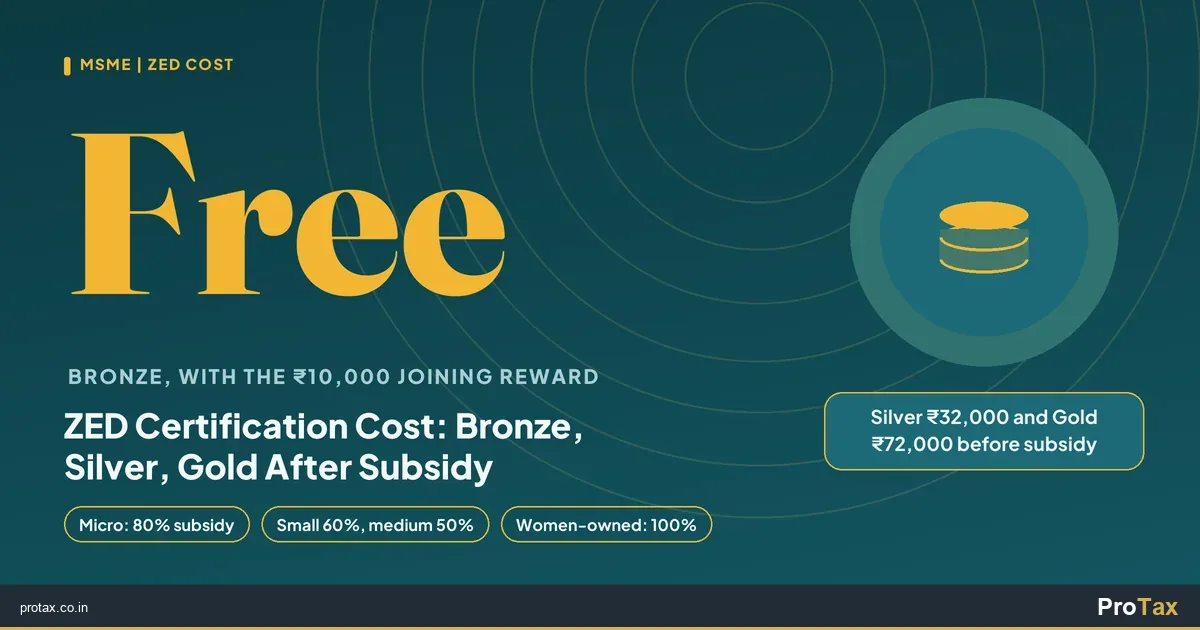
ZED certification costs ₹8,000 for Bronze, ₹32,000 for Silver and ₹72,000 for Gold in 2026, inclusive of taxes. After the Ministry of MSME's subsidy of 80%, 60% or 50%, a micro unit pays ₹1,600, ₹6,400 or ₹14,400, and the ₹10,000 joining reward makes Bronze free.
Those headline numbers hide a few rules that change the final bill: the order in which the joining reward and subsidy apply, the extra 10% and 5% categories, the full waiver for women-owned units, and the surveillance costs that fall due during the three-year validity. Many pages online still quote the pre-2024 costs of ₹10,000, ₹40,000 and ₹90,000. This article works through the current figures under Addendum-2 to the MSME Sustainable (ZED) Certification Scheme Guidelines, level by level and category by category, so you can see exactly what your unit would pay before you apply.
- Cost: ₹8,000 Bronze, ₹32,000 Silver, ₹72,000 Gold, from 18 September 2024.
- Subsidy: 80% micro, 60% small, 50% medium; plus 10% and 5% for listed categories.
- Women-owned MSMEs: 100% subsidy at every level.
- Joining reward: ₹10,000, deducted before the subsidy, usable once within a year.
- Surveillance: ₹2,000 for Bronze (fully subsidised); ₹10,000 or ₹20,000 per visit for Silver or Gold.
- Registration: always free.
New to the scheme itself? Start with our explainer on what ZED certification is, then come back for the numbers.
ZED Certification Cost at a Glance
The cost of ZED certification is the fixed amount set by the scheme guidelines for each certification level, covering verification, assessment, certification, monitoring and taxes. It is the base on which the joining reward and subsidy are calculated. Addendum-2, issued by the office of the Development Commissioner (MSME) and effective 18 September 2024, reduced each level by 20%:
| Level | Cost Under 2022 Guidelines | Cost From 18 Sep 2024 | Assessment Mode |
|---|---|---|---|
| Bronze | ₹10,000 | ₹8,000 | Verification of uploaded documents and photographs |
| Silver | ₹40,000 | ₹32,000 | Remote assessment by a QCI-accredited agency |
| Gold | ₹90,000 | ₹72,000 | On-site assessment at the unit |
The gap between levels reflects the work involved: Bronze is checked largely from evidence the MSME uploads, Silver needs an assessor's time on a remote session, and Gold needs a site visit.
MSME Sustainable (ZED) Certification Scheme Guidelines, 2022, clauses 3.4.4 to 3.4.8. Addendum-2, office of the Development Commissioner (MSME), effective 18 September 2024. Women-owned MSMEs addendum, effective 11 November 2023. Portal: zed.msme.gov.in.
How the ZED Subsidy Is Calculated
The calculation follows a fixed order set in the guidelines. Get the order wrong and the numbers will not match what the portal asks you to pay.
- Start with the cost of the level: ₹8,000, ₹32,000 or ₹72,000.
- Deduct the joining reward of ₹10,000, if the unit is using it on this level.
- Apply the subsidy rate to the balance: 80%, 60% or 50%, plus any additional category.
- The remainder is the MSME's contribution, paid online through the portal.
As a formula: MSME pays = (Cost minus joining reward used) multiplied by (100% minus total subsidy rate). The subsidy rate comes from the micro, small or medium classification in the unit's Udyam record, which is why keeping that record current matters. Our explainer on Udyam investment calculation shows how the classification is worked out.
What Micro, Small and Medium Units Pay
Without the Joining Reward
This is the usual position for a unit that has already used its reward, for example on Bronze, and is now upgrading.
| Level | Cost | Micro (80%) | Small (60%) | Medium (50%) |
|---|---|---|---|---|
| Bronze | ₹8,000 | ₹1,600 | ₹3,200 | ₹4,000 |
| Silver | ₹32,000 | ₹6,400 | ₹12,800 | ₹16,000 |
| Gold | ₹72,000 | ₹14,400 | ₹28,800 | ₹36,000 |
With the Joining Reward Used on That Level
| Level | Cost After Reward | Micro (80%) | Small (60%) | Medium (50%) |
|---|---|---|---|---|
| Bronze | Nil (₹2,000 reward balance left) | ₹0 | ₹0 | ₹0 |
| Silver | ₹22,000 | ₹4,400 | ₹8,800 | ₹11,000 |
| Gold | ₹62,000 | ₹12,400 | ₹24,800 | ₹31,000 |
These figures are for units with no additional subsidy category. The next two sections cover the categories that reduce them further.
Additional Subsidy: SC/ST, Location and Clusters
The guidelines add two extra layers on top of the base rate, and they can apply together:
- An extra 10% for MSMEs owned by SC or ST entrepreneurs, or located in the North Eastern Region, Himalayan states, LWE-affected areas, island territories or aspirational districts.
- A further 5% for MSMEs that are part of SFURTI or the Micro and Small Enterprises Cluster Development Programme (MSE-CDP).
| Category | Micro | Small | Medium |
|---|---|---|---|
| Base rate | 80% | 60% | 50% |
| With 10% category | 90% | 70% | 60% |
| With 10% and 5% categories | 95% | 75% | 65% |
Worked Examples
- Micro unit in a Himalayan state, Gold, reward already used: ₹72,000 at 90% subsidy, so the unit pays ₹7,200.
- SC-owned small unit, Silver, reward already used: ₹32,000 at 70%, so it pays ₹9,600.
- Same SC-owned small unit, reward used on Silver: ₹22,000 at 70%, so it pays ₹6,600.
- Micro unit in an aspirational district and an MSE-CDP cluster, Silver, no reward: ₹32,000 at 95%, so it pays ₹1,600.
Women-Owned MSMEs: Free at Every Level
From 11 November 2023, an addendum issued by the Development Commissioner (MSME) gives women-owned MSMEs a 100% subsidy on the cost of certification, for the validity of the scheme. The effect is simple: Bronze, Silver and Gold certification cost a woman-owned unit nothing. Because the subsidy is already complete, the addendum makes the extra 10% and 5% categories inapplicable to these units.
Two practical points follow. First, the women ownership must be reflected in the unit's Udyam registration, since that is where the portal reads it from. Second, because the certification itself is free, a woman-owned unit has every reason to aim directly at Silver or Gold if its processes are ready, rather than stopping at Bronze. The parameters, documents and assessment remain exactly the same as for any other applicant.
Bronze First or Straight to Silver? The Joining Reward Decision
The ZED joining reward is a limited-purpose credit of ₹10,000 that an MSME earns by taking the free ZED Pledge. It can be used once, on any one level, within one year of the pledge. Where you spend it changes the total cost of reaching Silver.
| Route to Silver | Micro Pays | Small Pays | Medium Pays |
|---|---|---|---|
| Path A: Bronze with reward, then upgrade to Silver | ₹0 + ₹6,400 = ₹6,400 | ₹0 + ₹12,800 = ₹12,800 | ₹0 + ₹16,000 = ₹16,000 |
| Path B: Straight to Silver with reward | ₹4,400 | ₹8,800 | ₹11,000 |
| Saving on Path B | ₹2,000 | ₹4,000 | ₹5,000 |
Path B is cheaper because the full ₹10,000 reward is used against a larger cost, whereas on Bronze ₹2,000 of it sits unused until the surveillance. But Path A has real advantages: a certificate within weeks, a first look at how the assessment works, and eligibility for handholding support, which needs at least Bronze, to prepare for Silver. A unit with documented processes and confidence in a remote assessment should consider Path B; a unit still organising its records is usually better off with Path A.
Surveillance Costs During the Three-Year Validity
A ZED certificate is valid for three years, and Addendum-2 sets these surveillance assessments within that period:
| Level | Surveillances | Cost per Surveillance | Micro Pays (Total) | Small Pays (Total) | Medium Pays (Total) |
|---|---|---|---|---|---|
| Bronze | One, at 18 months | ₹2,000 | ₹0 | ₹0 | ₹0 |
| Silver | Two, at 12 to 18 and 24 to 30 months | ₹10,000 | ₹4,000 | ₹8,000 | ₹10,000 |
| Gold | Two, at 12 to 18 and 24 to 30 months | ₹20,000 | ₹8,000 | ₹16,000 | ₹20,000 |
For Bronze units certified before Addendum-2, the surveillance is done at no extra cost. For new Bronze applicants, the ₹2,000 left over from the joining reward stays available until the surveillance is completed, which is why using the reward on Bronze leaves nothing to pay later.
Total Three-Year Cost of Ownership
Adding certification without the reward to both surveillances gives the realistic budget for each level over a full certificate cycle:
- Silver: micro ₹10,400, small ₹20,800, medium ₹26,000.
- Gold: micro ₹22,400, small ₹44,800, medium ₹56,000.
- Bronze: ₹0 with the reward; ₹1,600 to ₹4,000 without it, with the surveillance fully subsidised either way.
If the reward is used on Silver or Gold, subtract ₹2,000 for a micro unit, ₹4,000 for a small unit or ₹5,000 for a medium unit.
Other Costs Linked to ZED
| Item | Scheme Provision | What the MSME Bears |
|---|---|---|
| Handholding and consultancy | Up to ₹2 lakh inclusive of taxes, once per ZED cycle | 20%, 40% or 50% share, paid at application |
| Technology upgradation for zero effect | Up to ₹3 lakh | 20%, 40% or 50% share, subject to approval |
| Testing, system or product certification | 75% of the cost, capped at ₹50,000 | The rest, after paying the certification body or lab |
| Readiness spending | Not covered | Safety equipment, signage, housekeeping, records |
| Private consultants | Not covered | Their professional fees, if engaged |
Readiness spending is often the largest hidden cost: fire extinguishers, first-aid kits, safety signage, storage racks and a basic system for recording quality checks and deliveries. For most micro units this is modest, and much of it is required by other laws anyway. Our explainer on ZED certification benefits covers the testing and handholding support in more depth.
Five Real-World Cost Scenarios
The tables above are easier to use when tied to real situations. Each scenario below uses the current costs and assumes the subsidy terms on the portal are unchanged.
1. A Micro Engineering Workshop Starting Out
A micro workshop with eight workers takes the ZED Pledge in January and applies for Bronze in March, using its joining reward. Bronze costs ₹8,000, the reward covers it, and the ₹2,000 balance is held for the Bronze surveillance at 18 months. Total scheme cost over three years: ₹0. The real spend is on readiness, such as a fire extinguisher, safety signage and a simple delivery register.
2. A Small Auto Component Supplier Asked for Silver
A small supplier's buyer asks for ZED Silver. The unit has not used its reward, so it applies straight for Silver: ₹32,000 minus ₹10,000 leaves ₹22,000, and at 60% subsidy the unit pays ₹8,800. Two surveillances at ₹10,000 each cost it ₹4,000 apiece. Three-year total: ₹16,800.
3. A Woman-Owned Food Processing Unit Going for Gold
A woman-owned medium unit with export ambitions applies for Gold. Under the 100% subsidy, the ₹72,000 certification costs it nothing. The unit should still budget for readiness work and confirm on the portal how its surveillance is charged, since the women-owned addendum speaks of the cost of certification.
4. A Medium Textile Unit in an Aspirational District
A medium unit in an aspirational district qualifies for 50% plus 10%, a 60% subsidy. Having used its reward on Bronze two years ago, it upgrades to Silver: ₹32,000 at 60% subsidy means it pays ₹12,800, instead of the ₹16,000 a medium unit elsewhere would pay.
5. A Small Firm With Two Factories
A small enterprise has two units under one Udyam registration. Each unit applies separately, and the joining reward can be used only once. If both go for Bronze, the first is free with the reward and the second costs ₹3,200 at 60% subsidy. Total: ₹3,200 for two certificates.
How to Check Your Exact Amount on the Portal
The portal works out the payable amount for you, but it is worth checking it against your own calculation before you pay:
- Log in to zed.msme.gov.in with your Udyam-linked credentials and confirm the enterprise classification shown.
- Check that ownership details, such as women, SC or ST ownership, match your Udyam record.
- Note the date of your ZED Pledge and whether the joining reward is still unused and within its one-year window.
- Select the level and the unit, then review the cost breakdown the portal shows before payment.
- If the subsidy rate looks wrong, correct the Udyam record first; a payment made at the wrong rate is hard to reverse.
Our page on Udyam registration assistance covers updating an existing record when the classification or ownership details have changed.
Renewal Cost After Three Years
When the three-year validity ends, a unit can renew its level to keep the associated benefits. The guidelines treat renewal as a fresh certification at that level, so the cost and subsidy are the same as in the tables above, without the joining reward, which can be used only once. A micro unit renewing Silver therefore pays ₹6,400 again, plus surveillance during the new cycle. Upgrading at renewal time, for example from Silver to Gold, costs the same as a fresh Gold application. Before renewing, check whether your state's incentives or your bank's concession depend on a current certificate, since that is usually what makes renewal worth the cost.
What You Should Never Pay For
- Registration on the ZED portal: free and paperless.
- The ZED Pledge and e-learning modules: free.
- Cash payments to an assessor: scheme payments are made only online through the portal.
- A "guaranteed certificate" fee: certification depends on the assessment, and no one can sell it.
The ZED portal states that no agency, institution, assessor or consultant is authorised to charge any fee for registration. Complaints can be sent to the scheme's official email address listed on the portal.
Is the Subsidy Still Available in 2026?
The 2022 guidelines state that the financial support, incentives and benefits under the scheme are valid until 31 March 2026. As of October 2026, no extension order appears among the scheme documents, the newest of which is still Addendum-2. At the same time, the scheme has kept certifying: the Press Information Bureau's release of 4 August 2026 reported about 9.49 lakh registrations and about 6.67 lakh Bronze, 6,700 Silver and 4,800 Gold certifications as of 7 July 2026, with about ₹913 crore in support extended. For a free Bronze certificate the risk is small, but for Silver or Gold, confirm on the portal or with QCI that the subsidy share is still being paid before budgeting on the figures above.
Based on our experience with MSME certification work, the most common budgeting mistake is spending the joining reward on Bronze by default and then finding Silver costs more than expected. Harith - Compliance Expert suggests deciding the target level before taking the ZED Pledge, because the one-year reward clock starts on the day of the pledge, and a unit that is ready for Silver saves between ₹2,000 and ₹5,000 by applying straight for it.
Summary
After Addendum-2, ZED certification costs ₹8,000 for Bronze, ₹32,000 for Silver and ₹72,000 for Gold, inclusive of taxes. The ₹10,000 joining reward is deducted first, then the subsidy of 80%, 60% or 50% applies, with extra 10% and 5% layers for listed categories and a full waiver for women-owned units. A micro unit pays nothing for Bronze with the reward, ₹6,400 for Silver and ₹14,400 for Gold without it, plus subsidised surveillance during the three-year validity. Registration is free, payments are online only, and the subsidy terms should be confirmed on the portal before applying for the higher levels. For help choosing a level and preparing the evidence, see our page on ZED certification assistance, and for the wider context, our explainer on what ZED certification is.
Professional Assistance for ZED Certification
ProTax provides assistance for ZED certification, including level selection, joining reward planning, document preparation and assessment readiness. Professional charges start at ₹4,999; government fees are separate and paid at actuals.
Frequently Asked Questions
What is the cost of ZED certification in 2026?
The cost of ZED certification is ₹8,000 for Bronze, ₹32,000 for Silver and ₹72,000 for Gold, inclusive of taxes, under Addendum-2 to the scheme guidelines effective 18 September 2024. The cost covers verification, assessment, certification and monitoring. What an MSME pays is lower after the subsidy and the joining reward.
What was the old ZED certification fee?
Before 18 September 2024, the 2022 guidelines fixed the cost at ₹10,000 for Bronze, ₹40,000 for Silver and ₹90,000 for Gold. Addendum-2 cut every level by 20%. Articles that still quote the old figures overstate what an MSME pays today, so always check the cost shown on the ZED portal.
How much does a micro enterprise pay for ZED Bronze?
A micro enterprise pays nothing for Bronze if it uses the ₹10,000 joining reward, because the reward exceeds the ₹8,000 cost. Without the reward, the 80% subsidy leaves the micro unit paying ₹1,600. The leftover ₹2,000 of the reward goes towards the Bronze surveillance at 18 months.
How much does ZED Silver cost after subsidy?
Silver costs ₹32,000. Without the joining reward, a micro unit pays ₹6,400, a small unit ₹12,800 and a medium unit ₹16,000. If the reward is used on Silver, ₹10,000 comes off first and the subsidy applies to ₹22,000, so the payments fall to ₹4,400, ₹8,800 and ₹11,000.
How much does ZED Gold cost after subsidy?
Gold costs ₹72,000. Without the joining reward, a micro unit pays ₹14,400, a small unit ₹28,800 and a medium unit ₹36,000. Using the reward on Gold brings the base down to ₹62,000, so the payments fall to ₹12,400, ₹24,800 and ₹31,000 respectively, before any additional subsidy categories.
What is the subsidy rate under the ZED scheme?
The Ministry of MSME pays 80% of the certification cost for micro, 60% for small and 50% for medium enterprises. The rate follows the classification in the unit's Udyam registration, so an outdated Udyam record can lead to the wrong subsidy. Women-owned MSMEs receive 100% instead of these rates.
Is ZED certification free for women-owned MSMEs?
Yes. Under the Development Commissioner (MSME) addendum in force since 11 November 2023, women-owned MSMEs receive a 100% subsidy on the cost of certification at every level. Bronze, Silver and Gold are therefore free for them, and the extra 10% and 5% categories do not apply on top.
Who gets the additional 10% ZED subsidy?
An extra 10% applies to MSMEs owned by SC or ST entrepreneurs and to units located in the North Eastern Region, Himalayan states, LWE-affected areas, island territories and aspirational districts. A micro unit in one of these categories therefore gets 90%, a small unit 70% and a medium unit 60%.
Who gets the additional 5% ZED subsidy?
A further 5% applies to MSMEs that are part of SFURTI or the Micro and Small Enterprises Cluster Development Programme (MSE-CDP) of the Ministry of MSME. The guidelines add it on top of the base rate and any 10% category, so a qualifying micro unit can reach 95%.
How is the ZED joining reward adjusted against the cost?
The guidelines say the joining reward is deducted first from the cost of certification, and the subsidy then applies to the balance. On Bronze, the reward exceeds the cost, so the effective cost becomes zero. On Silver or Gold, the reward reduces the base before the micro, small or medium subsidy rate applies.
Is it better to use the joining reward on Bronze or Silver?
Using the reward directly on Silver saves more money: a micro unit pays ₹4,400 instead of ₹6,400 for Silver, with no Bronze step. Using it on Bronze gives a free certificate quickly and covers the Bronze surveillance. The right choice depends on whether the unit is ready for a remote Silver assessment today.
How long is the ZED joining reward valid?
The joining reward is valid for one year from the date of the ZED Pledge and can be used only once, on any one certification level. If the MSME does not apply within that year, the reward lapses. For new Bronze applicants, Addendum-2 keeps the ₹2,000 balance available until the Bronze surveillance is done.
What is the cost of ZED surveillance?
Under Addendum-2, Bronze has one surveillance at 18 months costing ₹2,000, fully subsidised. Silver has two surveillances at ₹10,000 each, and Gold two at ₹20,000 each, in the 12 to 18 month and 24 to 30 month windows, subsidised at 80% for micro, 60% for small and 50% for medium units.
What is the total three-year cost of ZED Silver for a micro unit?
Without the joining reward, a micro unit pays ₹6,400 for Silver certification and ₹2,000 for each of the two surveillances, a total of ₹10,400 over the three-year validity. If the reward was used on Silver itself, the certification share drops to ₹4,400 and the three-year total to ₹8,400.
Does upgrading from Bronze to Silver cost extra?
An upgrade is charged at the same cost and subsidy as a fresh application for the higher level. A micro unit upgrading from Bronze to Silver pays ₹6,400 if its joining reward was already used on Bronze. The upgrade can be made at any time before the existing certificate expires.
Is there a fee for ZED registration?
No. Registration and the ZED Pledge are free and paperless. The ZED portal warns that no agency, institution, assessor or consultant is authorised to charge a fee for registration. Scheme payments are only the MSME's share of certification, surveillance or handholding, paid online through the portal.
How is the ZED certification fee paid?
The MSME pays its contribution online through the ZED portal after choosing the level and uploading its documents. The portal calculates the payable amount after the joining reward and the applicable subsidy. The guidelines direct that payments, where due, are made only online, and never in cash to an individual.
What does ZED handholding support cost?
Handholding support has an upper limit of ₹2 lakh inclusive of taxes, subsidised at 80% for micro, 60% for small and 50% for medium enterprises. The MSME pays its contribution while applying, and the support is available once per ZED cycle to units holding at least a Bronze certificate.
Can ZED certification cost be reimbursed by the state?
It depends on the state. The Press Information Bureau reported that 22 States and Union Territories had integrated ZED into their policies as of July 2026, and incentives under those policies include reimbursement of the MSME's share. The terms vary by state, so check your state's current MSME or industrial policy.
Does each unit pay separately for ZED certification?
Yes. Any number of units under one Udyam registration can apply, but each unit applies and pays for certification separately to claim its own subsidy and benefits. An MSME with two factories therefore pays two certification costs, each reduced by its own subsidy, while the joining reward is limited to one use.
Is the ZED subsidy still available after March 2026?
The 2022 guidelines stated that financial support is valid until 31 March 2026, and no extension order had been published on the portal by October 2026. The portal still accepts registrations and certifications continue, so confirm with QCI that the subsidy share still applies before budgeting for Silver or Gold.
Do consultants charge extra for ZED certification?
The scheme fixes only the certification, surveillance and handholding costs. Private consultants who help with documents and readiness charge their own professional fees, which are outside the scheme and not subsidised. Registration itself must never carry a fee, so ask any adviser to separate professional charges from scheme payments.














