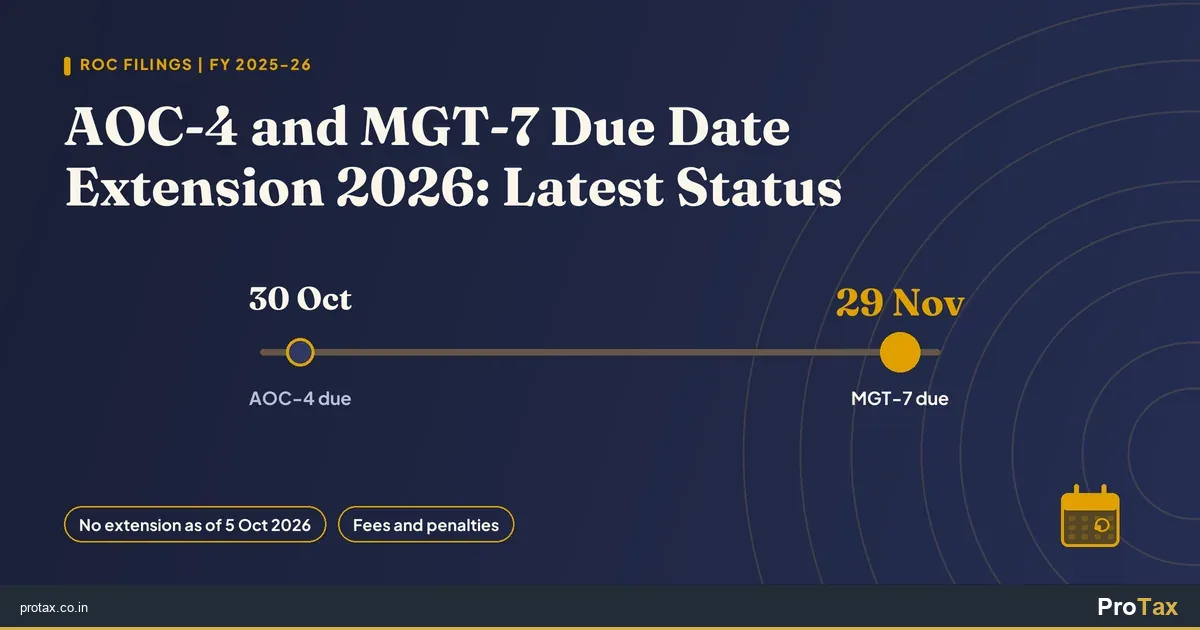
There is no AOC-4 and MGT-7 due date extension for FY 2025-26 yet. As of 5 October 2026, the Ministry of Corporate Affairs (MCA) has issued four general circulars this year, numbered 01/2026 to 04/2026, and none of them extends this year's annual filing dates. So the statutory clock is running. A company that held its AGM on 30 September 2026 must file Form AOC-4 by 30 October 2026 and Form MGT-7 or MGT-7A by 29 November 2026, while a One Person Company's AOC-4 was due on 27 September 2026. Each late form collects an additional fee of ₹100 a day, with no ceiling. And General Circular 08/2025, the last annual filing extension MCA issued? It is genuine, but it covered FY 2024-25 filings, extending them to 31 January 2026. Here is the full status, the extension track record and a filing plan.
- Status on 5 October 2026: no extension for FY 2025-26 AOC-4, MGT-7 or MGT-7A. MCA's 2026 circulars cover only CCFS-2026 and DPT-3.
- General Circular 08/2025 (30 December 2025) extended FY 2024-25 filings to 31 January 2026. It has no effect on this year's forms.
- Due dates for a 30 September 2026 AGM: AOC-4 by 30 October 2026 and MGT-7 or MGT-7A by 29 November 2026. The OPC AOC-4 was due on 27 September 2026.
- Cost of delay: ₹100 per day per form with no cap, plus penalties of up to ₹2 lakh for the company under Sections 137(3) and 92(5).
- Track record: the first extension circulars for FY 2017-18, FY 2018-19, FY 2020-21 and FY 2024-25 all arrived between 17 and 29 October, while MCA's 2023 and 2024 circulars gave FY 2022-23 and FY 2023-24 none. Plan for the statutory dates.
This explainer covers companies with a 31 March year end filing FY 2025-26 financial statements and annual returns under the Companies Act, 2013. LLP Forms 8 and 11 and GST deadlines are outside its scope; the income-tax side appears only where it gets confused with ROC filing.
Has MCA Extended the AOC-4 and MGT-7 Due Dates for FY 2025-26?
Not as of 5 October 2026. Relief on annual filings comes as a numbered general circular, and the 2026 series currently ends at 04/2026. One of those four circulars launched the Companies Compliance Facilitation Scheme, 2026 (CCFS-2026), two extended it, and one relaxed the DPT-3 return of deposits after a fire at MCA's data centre on 5 June 2026. None of them extends the FY 2025-26 due dates for AOC-4, MGT-7 or MGT-7A, which means the timelines in the Companies Act, 2013 apply in full.
| General Circular | Date | Subject | Effect on FY 2025-26 AOC-4 and MGT-7 |
|---|---|---|---|
| 01/2026 | 24 February 2026 | Launch of CCFS-2026 for pending filings, dormant status and closure | None |
| 02/2026 | 19 June 2026 | DPT-3 for FY 2025-26 allowed without additional fee up to 31 July 2026, after the data centre fire | None |
| 03/2026 | 8 July 2026 | CCFS-2026 extended from 15 July to 31 August 2026 | None |
| 04/2026 | 31 August 2026 | CCFS-2026 extended to 15 September 2026 | None, since the scheme closed before any FY 2025-26 annual form fell due |
That last row matters if your company also has older years pending. CCFS-2026 closed on 15 September 2026, so arrears now attract the regular additional fee, and so will any FY 2025-26 form filed late. Our explainer on what happens now that CCFS-2026 has closed covers the options for older arrears.
So why ask about an extension at all? Because MCA did extend these dates for FY 2024-25, twice, and the second of those circulars is easy to mistake for this year's relief.
What General Circular 08/2025 Actually Extended
A general circular is an administrative instruction from the Ministry of Corporate Affairs that clarifies or relaxes compliance under the Companies Act, 2013. For annual filings, it is the tool MCA uses to waive additional fees for a fixed window without amending the Act itself.
The FY 2024-25 relief came in two steps. General Circular 06/2025, dated 17 October 2025, noted that revised e-forms MGT-7, MGT-7A, AOC-4, AOC-4 CFS, AOC-4 NBFC (Ind AS), AOC-4 CFS NBFC (Ind AS) and AOC-4 (XBRL) had just been deployed on the MCA21 Version 3 portal. Because companies needed time to learn the new forms, MCA allowed FY 2024-25 annual filings up to 31 December 2025 without additional fees. On 30 December 2025, citing representations from stakeholders, General Circular 08/2025 pushed that window to 31 January 2026 and left every other condition of the October circular unchanged. Both circulars carry the same file number, Policy-17/111/2022-CL-V-MCA, and both speak only of FY 2024-25. Nothing in either text reaches FY 2025-26, so General Circular 08/2025 cannot be read as this year's extension, however recently it was forwarded.
Two clauses in General Circular 06/2025 carried over to the extension, and both shape how any future relief would work:
- Paragraph 3: the circular "shall not be construed as conferring any extension of statutory time for holding of AGMs", and companies that missed AGM timelines remained liable to legal action.
- Paragraph 4: filings made after the window attract all fees, including additional fees, "from the date when such filings were actually due under the Act".
Paragraph 4 has a sting in its tail. A company with a 30 September 2025 AGM that filed AOC-4 on 1 February 2026 paid ₹100 a day counted from 31 October 2025, not from 1 February. For late filers, the extension simply vanished.
FY 2025-26 Statutory Due Dates for AOC-4, MGT-7 and MGT-7A
Form AOC-4 is the e-form for filing a company's adopted financial statements, with the board's report and auditor's report, with the Registrar of Companies under Section 137 of the Companies Act, 2013. Form MGT-7 is the annual return under Section 92 that reports shareholding, directors, meetings and other governance details for the year.
Both clocks start at the AGM. Section 96(1) requires the AGM within six months of the year end, so by 30 September 2026 for a 31 March 2026 close. Section 137(1) then allows 30 days for AOC-4, and Section 92(4) allows 60 days for the annual return. The table maps each situation a company is likely to be in this month:
| Situation | AGM deadline | AOC-4 due | MGT-7 or MGT-7A due | Provision |
|---|---|---|---|---|
| AGM held on 30 September 2026 | 30 September 2026 | 30 October 2026 | 29 November 2026 | Sections 96(1), 137(1) and 92(4) |
| AGM held earlier, on 15 September 2026 | Met | 15 October 2026 | 14 November 2026 | Periods run from the actual AGM |
| One Person Company | No AGM required | 27 September 2026 (180 days from year end) | 29 November 2026 (MGT-7A) | Section 137(1) proviso and Section 92(4) |
| AGM not held by 30 September 2026 | Missed | 30 October 2026, with a statement of reasons | 29 November 2026, with reasons | Sections 137(2) and 92(4) |
| ROC extended the AGM on a Form GNL-1 application | Up to 31 December 2026 | 30 days from the actual AGM | 60 days from the actual AGM | Section 96(1) proviso |
| First AGM, first financial year ended 31 March 2026 | 31 December 2026 | 30 January 2027 for an AGM on 31 December | 1 March 2027 | Section 96(1) |
AGM: Section 96(1) of the Companies Act, 2013. Financial statements: Section 137, filed in AOC-4. Annual return: Section 92(4) read with Rule 11 of the Companies (Management and Administration) Rules, 2014, filed in MGT-7 or MGT-7A. Late fees: Section 403 and the Companies (Registration Offices and Fees) Rules, 2014. Penalties: Sections 92(5), 137(3), 446B and 454. All forms are filed on the MCA21 V3 portal of the Ministry of Corporate Affairs.
For the forms themselves, see our explainer on MCA form codes such as AOC, MGT and ADT, and for portal rejections, our guide to MCA V3 filing errors in AOC-4 and MGT-7A. This article stays on the dates and the extension question.
29 October or 30 October? How the 30 Days Are Counted
Compare a handful of published compliance calendars and you will find two sets of dates: 29 October and 28 November, or 30 October and 29 November. The gap comes from whether the AGM day counts as day one. Section 9 of the General Clauses Act, 1897 excludes the first day when a period is counted "from" an event, and Section 92(4) uses exactly that word for the annual return. Applying the same logic to the 30 days in Section 137(1) puts the AOC-4 deadline on 30 October 2026, and the 60-day count for MGT-7 lands on 29 November 2026. Still, why argue over a single day when every day of delay costs ₹100 per form? Treat 29 October as your internal deadline, keep 30 October as the statutory backstop, and the counting question never comes up at all.
OPCs and Small Companies: Different Forms, Firm Dates
Form MGT-7A is the abridged annual return that One Person Companies and small companies file instead of MGT-7, under Rule 11 of the Companies (Management and Administration) Rules, 2014. A small company today means a private company with paid-up capital up to ₹10 crore and turnover up to ₹100 crore, the limits notified by G.S.R. 880(E) on 1 December 2025.
The OPC calendar is the one that catches people out. Because an OPC need not hold an AGM, its AOC-4 runs on a fixed 180 days from the year end, which for FY 2025-26 was 27 September 2026. As of 5 October 2026, an OPC that has not filed has already built up ₹800 in additional fees, and the meter adds ₹100 every day. The OPC's MGT-7A follows the general rule, falling 60 days after the date its AGM would have been due, so 29 November 2026. Our guide to filling MGT-7A field by field covers the form itself, and the OPC annual compliance page lists the full yearly set.
The FY 2025-26 AOC-4 for a One Person Company was due on 27 September 2026, and no circular waives the delay. Every day adds ₹100 to the additional fee, so a full year's delay would cost ₹36,500 for this one form. Filing now caps the cost; waiting for a circular that may never come only adds to it.
Estimate Your MCA Filing Fee Before You File
The free ROC fee calculator shows the normal MCA fee for AOC-4 or MGT-7 from your company type and authorised capital, along with sample late-fee totals at 30 and 90 days of delay, so you can see the full cost before you file.
AOC-4 and MGT-7 Extension History Since FY 2017-18
Each relief in recent years traces to a numbered general circular. The table lists those we could match to the circular text, plus the two recent years for which MCA's published circular lists show no annual filing relief at all.
| Financial year | General Circular | Issued on | Relief granted (no additional fee up to) |
|---|---|---|---|
| FY 2017-18 | 10/2018 | 29 October 2018 | 31 December 2018 for AOC-4, AOC-4 CFS, AOC-4 XBRL and MGT-7 |
| FY 2018-19 | 13/2019 | 29 October 2019 | 30 November 2019 for AOC-4 forms; 31 December 2019 for MGT-7 |
| FY 2019-20 | 04/2021 | 28 January 2021 | 15 February 2021 for AOC-4 forms |
| FY 2020-21 | 17/2021 | 29 October 2021 | 31 December 2021 for AOC-4 forms and MGT-7 or MGT-7A |
| FY 2020-21 | 22/2021 | 29 December 2021 | 15 February 2022 for AOC-4 forms; 28 February 2022 for MGT-7 or MGT-7A |
| FY 2020-21 | 01/2022 | 14 February 2022 | 15 March 2022 for AOC-4 forms; 31 March 2022 for MGT-7 or MGT-7A |
| FY 2022-23 | None | Not applicable | No annual filing relaxation among MCA's 2023 circulars |
| FY 2023-24 | None | Not applicable | No annual filing relaxation among MCA's 2024 circulars |
| V3 migration window, any year | 01/2025 | 16 June 2025 | 15 August 2025 for AOC-4 and MGT-7 forms falling due between 18 June and 31 July 2025 |
| FY 2024-25 | 06/2025 | 17 October 2025 | 31 December 2025 for all seven annual filing forms |
| FY 2024-25 | 08/2025 | 30 December 2025 | 31 January 2026 for the same forms |
| FY 2025-26 | None so far | Checked on 5 October 2026 | Statutory dates apply |
Read the table as a pattern rather than a promise. The first circulars for FY 2017-18, FY 2018-19 and FY 2020-21 each came on 29 October, a day before the usual AOC-4 deadline, and the year-wide FY 2024-25 relief came on 17 October. Each had a visible cause: stakeholder requests in 2018 and 2019, the pandemic years that followed, and the redeployment of the annual e-forms on MCA21 V3 for FY 2024-25. In years without such a trigger, as in FY 2022-23 and FY 2023-24, MCA issued no year-wide relief, and companies that waited simply paid ₹100 a day per form. FY 2025-26 has had its own disruption in the 5 June 2026 data centre fire, but MCA's relief this year has been targeted: DPT-3 and two CCFS-2026 extensions. Whether that sympathy reaches annual filings cannot be known today. The safer reading is that an extension is a bonus you collect if it arrives, not a plan to build your calendar around.
How an MCA Extension Works and What It Never Covers
An MCA due date extension is a time-bound waiver of the additional fee for named e-forms of a named financial year, issued as a general circular. It does not amend Section 137 or Section 92, which is why MCA titles these circulars as a relaxation of additional fees and extension of time rather than as a new due date.
Think of it as switching off a parking meter for one street and one afternoon. Park on the next street, or stay past the hour, and the meter runs as usual. In practice, that means four limits:
- It covers only the forms named. General Circular 08/2025 listed seven AOC-4 and MGT-7 variants. ADT-1, MGT-14 and DPT-3 were not part of it.
- It covers only the year named. The FY 2024-25 relief did nothing for a company still carrying FY 2023-24 arrears.
- It does not move the AGM. General Circular 06/2025 said so in terms, General Circular 08/2025 kept that condition, and Section 96 defaults stayed actionable.
- It ends abruptly. File a day after the window closes and the additional fee is counted from the original due date.
If your company did not hold its FY 2025-26 AGM by 30 September 2026 and had no ROC approval to extend it, a filing extension would not cure that default. File AOC-4 under Section 137(2) and MGT-7 under Section 92(4) with the statement of reasons, and see our explainer on filing AOC-4 and MGT-7 when the AGM is not held for the steps.
What Happens If No Extension Comes?
Then the Act and the fee rules apply without relief, and they work on two separate tracks: a fee that the MCA21 system charges automatically when you file late, and a penalty that the ROC imposes through adjudication. You can pay the first without ever facing the second, but only if you file before the ROC acts or soon after its notice.
Additional Fee: ₹100 a Day, Per Form, With No Cap
An additional fee is the late-filing charge levied under Section 403 of the Companies Act, 2013 read with the Companies (Registration Offices and Fees) Rules, 2014. For annual returns and financial statements whose filing period expired after 30 June 2018, the rules fix it at ₹100 for each day of delay, separately for each form and with no maximum. A holding company late on AOC-4, AOC-4 CFS and MGT-7 therefore accrues ₹300 a day. The normal fee is charged on top, by nominal share capital:
| Nominal share capital | Normal fee per form |
|---|---|
| Less than ₹1 lakh | ₹200 |
| ₹1 lakh to less than ₹5 lakh | ₹300 |
| ₹5 lakh to less than ₹25 lakh | ₹400 |
| ₹25 lakh to less than ₹1 crore | ₹500 |
| ₹1 crore or more | ₹600 |
| Company without share capital | ₹200 |
The ROC fee calculator shows the normal fee for AOC-4, MGT-7 and other MCA forms from your company type and authorised capital, and our review of ROC penalty orders from 2026 shows how adjudication plays out in practice.
Penalties Under Sections 137(3) and 92(5)
The penalty track starts only when the ROC, acting as adjudicating officer under Section 454, issues a notice. These are the amounts it can impose on the company and its officers in default:
| Provision | Default | Company | Officers in default |
|---|---|---|---|
| Section 137(3) | AOC-4 not filed in time | ₹10,000 plus ₹100 per day, up to ₹2 lakh | Managing director and CFO, or the responsible director: ₹10,000 plus ₹100 per day, up to ₹50,000 |
| Section 92(5) | MGT-7 or MGT-7A not filed in time | ₹10,000 plus ₹100 per day, up to ₹2 lakh | Every officer in default: ₹10,000 plus ₹100 per day, up to ₹50,000 |
| Section 446B | Same defaults by an OPC, small company, start-up or producer company | Not more than one-half, so up to ₹1 lakh | Not more than one-half, so up to ₹25,000 |
Persistent non-filing escalates further. Under Section 164(2)(a), every director of a company that has not filed financial statements or annual returns for any continuous period of three financial years is disqualified for five years, which is why a skipped AOC-4 rarely stays a small problem.
The Section 454(3) Proviso: Your 30-Day Safety Valve
The Companies (Amendment) Act, 2020 added a proviso to Section 454(3) that matters more than any extension. Where the default is under Section 92(4) or Section 137(1) or (2), and the company files either before the adjudicating officer's notice or within 30 days of it, no penalty is imposed and all proceedings for that default are deemed concluded. In other words, the law already gives every late filer a second chance, provided the forms actually reach the registry in time. Two limits apply. The proviso does not waive the ₹100 a day additional fee, and it does nothing for a missed AGM. If an adjudication order still follows and you disagree with it, you can appeal to the Regional Director in Form ADJ within 60 days, as our Form ADJ appeal guide explains.
Late Filing Cost: 5 Scenarios Worked Out for FY 2025-26
Numbers make the trade-off clear. Take a private company with ₹10 lakh nominal capital, so its normal fee is ₹400 per form, and an AGM on 30 September 2026. Here is what each filing pattern costs in additional fees alone, before any penalty:
| Scenario | AOC-4 filed | MGT-7 filed | Days late (AOC-4 / MGT-7) | Additional fee |
|---|---|---|---|---|
| 1. On time | 30 October 2026 | 29 November 2026 | 0 / 0 | Nil (normal fees of ₹800 only) |
| 2. AOC-4 slips two weeks | 13 November 2026 | 29 November 2026 | 14 / 0 | ₹1,400 |
| 3. Both filed at calendar year end | 31 December 2026 | 31 December 2026 | 62 / 32 | ₹9,400 |
| 4. Both filed at financial year end | 31 March 2027 | 31 March 2027 | 152 / 122 | ₹27,400 |
| 5. OPC with AOC-4 due 27 September | 31 October 2026 | 29 November 2026 (MGT-7A) | 34 / 0 | ₹3,400 |
Scenario 4 is where waiting for a circular usually ends: ₹27,400 in fees that no later extension refunds, plus exposure to the penalty track if the ROC sends a notice first. Filing on time is the only zero-cost option. Holding companies should add ₹100 a day for AOC-4 CFS, and companies covered by the XBRL rules follow the same arithmetic for AOC-4 XBRL filing.
Get Expert Help with AOC-4 and MGT-7 Filing
ProTax provides assistance for preparing and filing AOC-4, AOC-4 CFS and MGT-7 or MGT-7A with the ROC on MCA V3, from ₹2,499 in professional charges. Government fees and any additional fees are charged separately at actuals.
Get ROC Annual Filing Assistance
Why the Tax Audit Extension Does Not Move ROC Dates
On 28 September 2026, the CBDT issued Circular No. 07/2026, moving the tax audit report for AY 2026-27 from 30 September to 21 October 2026 and the ITR due date for audit cases from 31 October to 21 November 2026. That circular works under the Income-tax Act, 1961. AOC-4 and MGT-7 deadlines come from the Companies Act, 2013 and key off the AGM, so the CBDT's relief leaves them exactly where they were.
| Filing | Law | Original date | Position on 5 October 2026 |
|---|---|---|---|
| Tax audit report (AY 2026-27) | Income-tax Act, 1961 | 30 September 2026 | 21 October 2026 under CBDT Circular No. 07/2026 |
| ITR for audit cases | Income-tax Act, 1961 | 31 October 2026 | 21 November 2026 |
| AOC-4 for a 30 September AGM | Companies Act, 2013 | 30 October 2026 | 30 October 2026, unchanged |
| MGT-7 or MGT-7A | Companies Act, 2013 | 29 November 2026 | 29 November 2026, unchanged |
| DPT-3 for FY 2025-26 | Companies Act, 2013 | 30 June 2026 | Fee waived to 31 July 2026 by General Circular 02/2026; window closed |
The mix-up has a practical cause. The statutory audit under the Companies Act must be complete before the AGM can adopt the accounts, while the tax audit can follow later. Companies that hold back the AGM or AOC-4 to line up with the tax audit gain nothing on the MCA side and start paying ₹100 a day from 31 October. The thresholds behind the tax audit are compared in our guide to statutory audit versus tax audit, and the report itself is uploaded on the income tax e-filing portal.
How to Spot a Genuine MCA Extension Circular
A forwarded screenshot is not a circular. Since genuine year-wide relief has historically landed in the second half of October, run any claim through these checks before you change your filing plan:
- Find it on MCA's website. The relaxations in the history table were all issued as numbered general circulars, and new ones appear on the MCA general circulars page.
- Check the number and date. The 2026 series stood at 04/2026 on 5 October 2026, so a new annual filing circular would carry a later number and a 2026 date.
- Read the financial year. A circular that says FY 2024-25 is last year's relief, however recently it was shared.
- Read the form list. Relief for DPT-3 or CCFS-2026 says nothing about AOC-4 or MGT-7.
- Cross-check the announcement. MCA's official X account, @MCA21India, posted the General Circular 08/2025 notice and is a useful second source.
Timing matters too. Waiting past 25 October in the hope of a circular leaves almost no margin to file if none arrives, and the ₹100 a day starts on 31 October whatever the rumours say.
What Should Companies Do Now? A Filing Action Plan for October and November 2026
Whatever MCA decides later this month, this sequence keeps you on the right side of every date:
- Step 1: This week. Confirm the AGM date and that the adopted financial statements, board's report and auditor's report are final and signed. If the AGM did not take place, record the facts and reasons now.
- Step 2: Within 15 days of the AGM. File ADT-1 if the AGM appointed or reappointed the statutory auditor.
- Step 3: By 21 October 2026. Upload the tax audit report if Section 44AB applies. It runs on its own track.
- Step 4: By 29 October 2026. File AOC-4, AOC-4 CFS or AOC-4 XBRL, keeping 30 October as the statutory backstop.
- Step 5: Immediately, for OPCs. File the overdue AOC-4 to stop the ₹100 a day.
- Step 6: By 29 November 2026. File MGT-7 or MGT-7A.
- Step 7: If an ROC notice arrives for any year. File within 30 days to use the Section 454(3) proviso.
Two situations need extra care. If the company had no business in FY 2025-26, it still files both forms, as our article on annual filing for a company with no business explains. If the AGM itself slipped, the filings change shape under Section 137(2), as set out in the warning above, and the statement of facts and reasons must travel with both forms.
Common Mistakes While Waiting for an Extension
- Treating GC 08/2025 as current relief. It covered FY 2024-25 and expired on 31 January 2026.
- Delaying the AGM for the tax audit. CBDT Circular No. 07/2026 changed income-tax dates only.
- Asking the ROC to extend the filing date. The Act lets the ROC extend an AGM by up to three months under Section 96(1), not the AOC-4 or MGT-7 periods; late filing simply carries the Section 403 fee.
- Forgetting the extra forms. AOC-4 CFS for holding companies and AOC-4 XBRL for companies covered by the 2015 XBRL rules, such as listed companies and those with ₹5 crore paid-up capital or ₹100 crore turnover, each carry their own ₹100 a day.
- Counting the Corporate Laws (Amendment) Bill, 2026 as law. The Bill, introduced on 23 March 2026, was still pending when the Monsoon Session ended on 13 August 2026, so none of its proposals affects FY 2025-26 filings.
- Ignoring older years. With CCFS-2026 closed, arrears cost the full additional fee, and three missed years trigger director disqualification.
In our experience, the companies that pay the most are not the ones that file a week late; they are the ones that pause everything for a rumoured extension and then lose a month when it never comes. Harith - Compliance Expert recommends a simple rule: keep the AOC-4 pack ready by 25 October, file by 29 October, and treat any circular that arrives later as a refund of stress rather than a change of plan. Our team also reviews OPC filings first each October, because their 27 September deadline comes a month before the 30 October date that applies after a 30 September AGM.
Summary
There is no AOC-4 and MGT-7 due date extension for FY 2025-26 as of 5 October 2026, and General Circular 08/2025 belongs to last year. For a 30 September 2026 AGM, file AOC-4 by 30 October 2026, ideally a day earlier, and MGT-7 or MGT-7A by 29 November 2026; OPCs are already past their 27 September AOC-4 date. Each late form costs ₹100 a day with no cap, and penalties of up to ₹2 lakh sit behind that, although filing within 30 days of an ROC notice avoids them. If MCA does issue relief, expect a numbered general circular on its website, and remember that filing on time costs you nothing either way. For help with the filings themselves, see the private limited company compliance page.
Professional Assistance for FY 2025-26 Annual Filing
ProTax helps companies prepare AOC-4 and MGT-7 or MGT-7A and file them with the ROC before the deadline, with private limited company compliance starting at ₹2,999 in professional charges. Government fees and any additional fees are payable separately at actuals.
Frequently Asked Questions
Has MCA extended the AOC-4 and MGT-7 due date for FY 2025-26?
As of 5 October 2026, MCA has not extended the FY 2025-26 due dates. Its 2026 general circulars, numbered 01/2026 to 04/2026, cover only CCFS-2026 and DPT-3. Companies with a 30 September 2026 AGM must file AOC-4 by 30 October 2026 and MGT-7 or MGT-7A by 29 November 2026.
What is the AOC-4 due date for FY 2025-26?
Under Section 137(1) of the Companies Act, 2013, AOC-4 is due within 30 days of the AGM. For an AGM held on 30 September 2026, the last date is 30 October 2026. An earlier AGM brings the date forward, so a 15 September AGM means AOC-4 is due on 15 October 2026.
What is the MGT-7 due date for FY 2025-26?
Section 92(4) requires the annual return within 60 days from the date of the AGM. With an AGM on 30 September 2026, MGT-7 or MGT-7A is due by 29 November 2026. Where no AGM was held, the 60 days run from the date the AGM should have been held, with reasons attached.
What is the AOC-4 due date for an OPC for FY 2025-26?
A One Person Company files AOC-4 within 180 days from the close of the financial year under a proviso to Section 137(1). For FY 2025-26, that date was 27 September 2026, so an OPC filing now pays an additional fee of ₹100 for each day of delay since then, with no upper limit.
What is the MGT-7A due date for FY 2025-26?
MGT-7A is the abridged annual return filed by OPCs and small companies under Rule 11 of the Companies (Management and Administration) Rules, 2014. A small company files it within 60 days of its AGM, so by 29 November 2026 for a 30 September AGM. OPCs work to the same date, counted from when their AGM would have been due.
What was MCA General Circular 08/2025 about?
General Circular 08/2025, dated 30 December 2025, allowed companies to file FY 2024-25 annual forms, including AOC-4, AOC-4 CFS, AOC-4 XBRL, MGT-7 and MGT-7A, up to 31 January 2026 without additional fees. It continued General Circular 06/2025 and does not apply to any FY 2025-26 filing.
Does an MCA filing extension also extend the AGM deadline?
An MCA filing extension does not move the AGM date. General Circular 06/2025 stated that it conferred no extension of statutory time for holding AGMs and that defaulting companies remained liable to action. Only the ROC can extend an AGM other than the first, by up to three months under Section 96(1), on an application in Form GNL-1.
What is the late fee for filing AOC-4 and MGT-7 after the due date?
For financial statements and annual returns due after 30 June 2018, the Companies (Registration Offices and Fees) Rules, 2014 charge an additional fee of ₹100 per day for each form, with no upper limit. This comes on top of the normal fee of ₹200 to ₹600, which depends on the company's nominal share capital.
What is the penalty under Section 137(3) for not filing AOC-4 on time?
Section 137(3) imposes a penalty of ₹10,000 on the company plus ₹100 for each day the failure continues, up to ₹2 lakh. The managing director and CFO, or the responsible director, face ₹10,000 plus ₹100 a day, up to ₹50,000. Section 446B caps these at one-half for OPCs, small companies and start-ups.
What is the penalty under Section 92(5) for not filing MGT-7?
Under Section 92(5), a company that misses the annual return deadline faces a penalty of ₹10,000 plus ₹100 for each day the failure continues, up to ₹2 lakh. Every officer in default faces the same daily amount, up to ₹50,000. These penalties sit on top of the ₹100 per day additional fee.
Can a company avoid an ROC penalty if it files after receiving a notice?
The proviso to Section 454(3) says no penalty is imposed for a default under Section 92(4) or Section 137(1) or (2) if the company files before, or within 30 days of, the adjudicating officer's notice. The proceedings are then deemed concluded. The additional fee of ₹100 a day per form still has to be paid.
Is the AOC-4 due date 29 October or 30 October 2026?
Counting 30 days from a 30 September AGM and excluding the AGM day, as Section 9 of the General Clauses Act, 1897 directs for periods counted from an event, gives 30 October 2026. Calendars showing 29 October count the AGM day itself. Filing by 29 October removes any argument about the additional fee.
When did MCA last extend the AOC-4 and MGT-7 due dates?
The last extension covered FY 2024-25. General Circular 06/2025 of 17 October 2025 waived additional fees up to 31 December 2025, and General Circular 08/2025 of 30 December 2025 stretched the window to 31 January 2026. MCA's circulars for 2023 and 2024 gave no such relief for FY 2022-23 or FY 2023-24.
Does the tax audit extension to 21 October 2026 extend AOC-4?
CBDT Circular No. 07/2026, dated 28 September 2026, moved the tax audit report to 21 October 2026 and audited ITRs to 21 November 2026 under the Income-tax Act, 1961. It does not touch the Companies Act, 2013, so AOC-4 and MGT-7 deadlines stay tied to the AGM date.
Where can I check if MCA has extended the AOC-4 due date?
Check the General Circulars page under Acts and Rules on mca.gov.in, where MCA publishes every numbered circular, including the FY 2024-25 relaxations. MCA's official X account, @MCA21India, also posts these announcements. A genuine notice names the circular number, date, financial year and the e-forms it covers.
What happens if a company does not file AOC-4 and MGT-7 for three years?
Under Section 164(2)(a), every director of a company that has not filed financial statements or annual returns for any continuous period of three financial years is disqualified for five years from being appointed in any company. Prolonged non-filing also exposes the company to strike-off proceedings under Section 248.
Can the ROC extend the due date for filing AOC-4 on request?
The Companies Act, 2013 gives the ROC power to extend an AGM, not the AOC-4 or MGT-7 filing periods. Under Section 96(1), the ROC can extend an AGM other than the first by up to three months, and the 30-day and 60-day filing periods then run from the actual AGM date.
What if our AGM was not held by 30 September 2026?
File AOC-4 under Section 137(2) within 30 days of the last date for the AGM, which is 30 October 2026, along with a statement of facts and reasons. File MGT-7 within 60 days, by 29 November 2026, with reasons. The missed AGM remains a separate default under Section 96.
What are the due dates for a company holding its first AGM?
A company whose first financial year ended on 31 March 2026 can hold its first AGM up to 31 December 2026, nine months after the year end, under Section 96(1). With the AGM on that date, AOC-4 falls due on 30 January 2027 and MGT-7 on 1 March 2027.
How much does professional help with AOC-4 and MGT-7 filing cost?
Charges depend on the volume of work and any pending years. ProTax provides assistance for ROC annual filing of AOC-4 and MGT-7 from ₹2,499 in professional charges. Government filing fees of ₹200 to ₹600 per form, and any additional fees for delay, are charged separately at actuals.
Frequently Asked Questions
Has MCA extended the AOC-4 and MGT-7 due date for FY 2025-26?
As of 5 October 2026, MCA has not extended the FY 2025-26 due dates. Its 2026 general circulars, numbered 01/2026 to 04/2026, cover only CCFS-2026 and DPT-3. Companies with a 30 September 2026 AGM must file AOC-4 by 30 October 2026 and MGT-7 or MGT-7A by 29 November 2026.
What is the AOC-4 due date for FY 2025-26?
Under Section 137(1) of the Companies Act, 2013, AOC-4 is due within 30 days of the AGM. For an AGM held on 30 September 2026, the last date is 30 October 2026. An earlier AGM brings the date forward, so a 15 September AGM means AOC-4 is due on 15 October 2026.
What is the MGT-7 due date for FY 2025-26?
Section 92(4) requires the annual return within 60 days from the date of the AGM. With an AGM on 30 September 2026, MGT-7 or MGT-7A is due by 29 November 2026. Where no AGM was held, the 60 days run from the date the AGM should have been held, with reasons attached.
What is the AOC-4 due date for an OPC for FY 2025-26?
A One Person Company files AOC-4 within 180 days from the close of the financial year under a proviso to Section 137(1). For FY 2025-26, that date was 27 September 2026, so an OPC filing now pays an additional fee of ₹100 for each day of delay since then, with no upper limit.
What is the MGT-7A due date for FY 2025-26?
MGT-7A is the abridged annual return filed by OPCs and small companies under Rule 11 of the Companies (Management and Administration) Rules, 2014. A small company files it within 60 days of its AGM, so by 29 November 2026 for a 30 September AGM. OPCs work to the same date, counted from when their AGM would have been due.
What was MCA General Circular 08/2025 about?
General Circular 08/2025, dated 30 December 2025, allowed companies to file FY 2024-25 annual forms, including AOC-4, AOC-4 CFS, AOC-4 XBRL, MGT-7 and MGT-7A, up to 31 January 2026 without additional fees. It continued General Circular 06/2025 and does not apply to any FY 2025-26 filing.
Does an MCA filing extension also extend the AGM deadline?
An MCA filing extension does not move the AGM date. General Circular 06/2025 stated that it conferred no extension of statutory time for holding AGMs and that defaulting companies remained liable to action. Only the ROC can extend an AGM other than the first, by up to three months under Section 96(1), on an application in Form GNL-1.
What is the late fee for filing AOC-4 and MGT-7 after the due date?
For financial statements and annual returns due after 30 June 2018, the Companies (Registration Offices and Fees) Rules, 2014 charge an additional fee of ₹100 per day for each form, with no upper limit. This comes on top of the normal fee of ₹200 to ₹600, which depends on the company's nominal share capital.
What is the penalty under Section 137(3) for not filing AOC-4 on time?
Section 137(3) imposes a penalty of ₹10,000 on the company plus ₹100 for each day the failure continues, up to ₹2 lakh. The managing director and CFO, or the responsible director, face ₹10,000 plus ₹100 a day, up to ₹50,000. Section 446B caps these at one-half for OPCs, small companies and start-ups.
What is the penalty under Section 92(5) for not filing MGT-7?
Under Section 92(5), a company that misses the annual return deadline faces a penalty of ₹10,000 plus ₹100 for each day the failure continues, up to ₹2 lakh. Every officer in default faces the same daily amount, up to ₹50,000. These penalties sit on top of the ₹100 per day additional fee.
Can a company avoid an ROC penalty if it files after receiving a notice?
The proviso to Section 454(3) says no penalty is imposed for a default under Section 92(4) or Section 137(1) or (2) if the company files before, or within 30 days of, the adjudicating officer's notice. The proceedings are then deemed concluded. The additional fee of ₹100 a day per form still has to be paid.
Is the AOC-4 due date 29 October or 30 October 2026?
Counting 30 days from a 30 September AGM and excluding the AGM day, as Section 9 of the General Clauses Act, 1897 directs for periods counted from an event, gives 30 October 2026. Calendars showing 29 October count the AGM day itself. Filing by 29 October removes any argument about the additional fee.
When did MCA last extend the AOC-4 and MGT-7 due dates?
The last extension covered FY 2024-25. General Circular 06/2025 of 17 October 2025 waived additional fees up to 31 December 2025, and General Circular 08/2025 of 30 December 2025 stretched the window to 31 January 2026. MCA's circulars for 2023 and 2024 gave no such relief for FY 2022-23 or FY 2023-24.
Does the tax audit extension to 21 October 2026 extend AOC-4?
CBDT Circular No. 07/2026, dated 28 September 2026, moved the tax audit report to 21 October 2026 and audited ITRs to 21 November 2026 under the Income-tax Act, 1961. It does not touch the Companies Act, 2013, so AOC-4 and MGT-7 deadlines stay tied to the AGM date.
Where can I check if MCA has extended the AOC-4 due date?
Check the General Circulars page under Acts and Rules on mca.gov.in, where MCA publishes every numbered circular, including the FY 2024-25 relaxations. MCA's official X account, @MCA21India, also posts these announcements. A genuine notice names the circular number, date, financial year and the e-forms it covers.
What happens if a company does not file AOC-4 and MGT-7 for three years?
Under Section 164(2)(a), every director of a company that has not filed financial statements or annual returns for any continuous period of three financial years is disqualified for five years from being appointed in any company. Prolonged non-filing also exposes the company to strike-off proceedings under Section 248.
Can the ROC extend the due date for filing AOC-4 on request?
The Companies Act, 2013 gives the ROC power to extend an AGM, not the AOC-4 or MGT-7 filing periods. Under Section 96(1), the ROC can extend an AGM other than the first by up to three months, and the 30-day and 60-day filing periods then run from the actual AGM date.
What if our AGM was not held by 30 September 2026?
File AOC-4 under Section 137(2) within 30 days of the last date for the AGM, which is 30 October 2026, along with a statement of facts and reasons. File MGT-7 within 60 days, by 29 November 2026, with reasons. The missed AGM remains a separate default under Section 96.
What are the due dates for a company holding its first AGM?
A company whose first financial year ended on 31 March 2026 can hold its first AGM up to 31 December 2026, nine months after the year end, under Section 96(1). With the AGM on that date, AOC-4 falls due on 30 January 2027 and MGT-7 on 1 March 2027.
How much does professional help with AOC-4 and MGT-7 filing cost?
Charges depend on the volume of work and any pending years. ProTax provides assistance for ROC annual filing of AOC-4 and MGT-7 from ₹2,499 in professional charges. Government filing fees of ₹200 to ₹600 per form, and any additional fees for delay, are charged separately at actuals.














