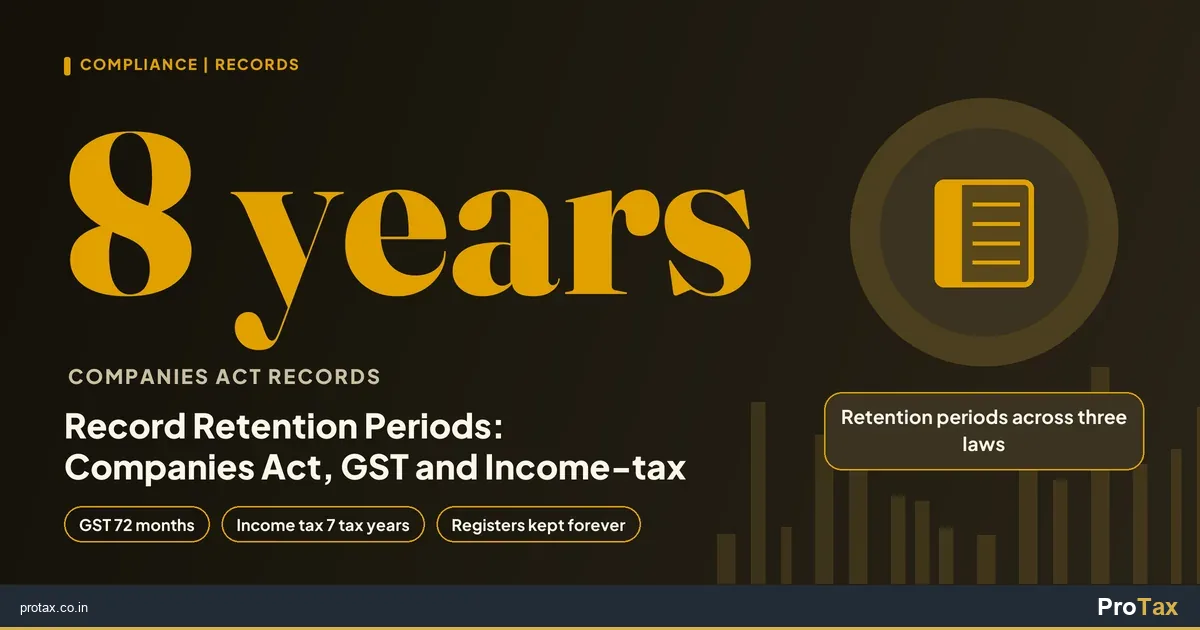
In India, a company must keep its books of account for 8 financial years under Section 128(5) of the Companies Act, 2013, its GST records for 72 months from the due date of the annual return under Section 36 of the CGST Act, and its income tax records for 7 tax years from the end of the tax year under Rule 46 of the Income-tax Rules for tax year 2026-27 onwards. Minutes and the register of members are preserved permanently, and labour registers are kept for 5 years after the last entry under the Code on Wages Central rules. Each period runs on a different clock, and any pending assessment, appeal or dispute extends it. The practical rule is simple: keep each record for the longest period that any law applies to it, then destroy it under a documented policy. This guide sets out every major retention period in one place, shows how to calculate the actual end dates, and explains how to build a retention schedule that survives software changes, staff turnover and inspections.
- Companies Act: books of account, vouchers and audit trail for 8 financial years; minutes and member registers permanently.
- GST: 72 months from the annual return due date; longer if proceedings are pending.
- Income tax: 7 tax years from tax year 2026-27 under the Income-tax Act, 2025; transfer pricing documents 8 years.
- Labour: core registers 5 years after the last entry under the Code on Wages Central rules.
- Electronic records: allowed, with daily backup on servers in India.
This guide is for finance heads, accountants, HR teams and founders of companies, LLPs and other businesses deciding what to keep, for how long and in what form. It reflects the law as of October 2026.
Retention Periods at a Glance
| Record | Law | Retention Period |
|---|---|---|
| Books of account and vouchers | Section 128(5), Companies Act, 2013 | 8 financial years preceding the current year |
| Audit trail (edit log) | Rule 3(1), Companies (Accounts) Rules, with Section 128(5) | 8 financial years |
| Minutes of board, committee and general meetings | Section 118 and related rules | Permanently |
| Register of members and other Section 88 registers | Rule 5, Management and Administration Rules | Permanently (debenture holder registers: 8 years after redemption) |
| Copies of annual returns with attachments | Rule 15, Management and Administration Rules | 8 years from filing |
| Register of charges (CHG-7) | Charges Rules | Permanently; charge instruments 8 years after satisfaction |
| Register of contracts (MBP-4) and register of loans and investments (MBP-2) | Meetings of Board Rules | Permanently |
| Directors' MBP-1 notices | Rule 9(4), Meetings of Board Rules | 8 years from end of the financial year |
| Register of deposits | Acceptance of Deposits Rules | 8 years from the financial year of the latest entry |
| GST accounts and records, e-invoices, e-way bills | Section 36, CGST Act | 72 months from annual return due date; or 1 year after disposal of pending proceedings |
| Income tax books and documents (tax year 2026-27 onwards) | Rule 46, Income-tax Rules under the 2025 Act | 7 tax years from end of the tax year |
| Income tax books (up to FY 2025-26) | Rule 6F, Income-tax Rules, 1962 | 6 years from end of the assessment year |
| Transfer pricing documentation | Rule 10D, Income-tax Rules | 8 years from end of the assessment year |
| Employee, wage and attendance registers | Code on Wages (Central) Rules, 2026 | 5 years after the last entry |
| LLP books of account | LLP Act, 2008 and LLP Rules, 2009 | 8 years from close of the financial year |
Section 128 of the Companies Act, 2013 and Rule 3 of the Companies (Accounts) Rules, 2014; the Companies (Management and Administration) Rules, 2014; Section 36 of the CGST Act, 2017 with Rules 56 to 58 of the CGST Rules; Section 62 of the Income-tax Act, 2025 with Rule 46 (Notification 22/2026); Rule 6F and Rule 10D of the Income-tax Rules, 1962; the Code on Wages, 2019 and its Central rules; the LLP Act, 2008. Company law text is on the MCA portal.
Companies Act: Books, Registers and Minutes
Books of Account: 8 Financial Years
Section 128(5) requires every company to preserve its books of account, together with relevant vouchers, for at least 8 financial years immediately preceding a financial year. For a company incorporated less than 8 years ago, that means every year since incorporation. If an investigation has been ordered under the Act, the Central Government can direct that books be kept for a longer period. "Books of account" covers the cash book, journal, ledgers, sales and purchase records, assets and liabilities records, and for manufacturers, cost records where applicable. Our article on books of account under the Income-tax Act, 2025 covers the tax side of the same records.
The Audit Trail
Since FY 2023-24, accounting software must record an audit trail of every change, which cannot be disabled. The trail is part of the books, so it carries the same 8-year retention, and it must survive software migrations. Before switching systems, export and archive the old system's data and trail. Our article on audit trail rules explains the requirement and the auditor's Rule 11(g) report.
Minutes and Statutory Registers
Minutes of board meetings, committee meetings and general meetings are kept permanently, as are the register of members and the other registers under Section 88, the register of charges, and the registers of loans and investments (MBP-2) and contracts with related parties (MBP-4). These records establish who owns the company, who approved what, and which assets are encumbered. They are needed for due diligence, share transfers and disputes long after the accounts of a given year have lost their relevance.
Where Company Records Must Be Kept
Books of account are kept at the registered office, unless the board decides to keep all or any of them at another place in India, in which case the company files Form AOC-5 with the ROC within 7 days of the board decision. Branch offices may keep their own books, with summarised returns sent to the registered office at least quarterly. Statutory registers and minutes are normally kept at the registered office, and the register of members can be kept at another place in India where more than one-tenth of members reside, with a special resolution.
Shorter Periods for Specific Records
- Annual return copies: 8 years from the date of filing.
- MBP-1 notices from directors: 8 years from the end of the financial year, as covered in our article on MBP-1 and DIR-8.
- Charge instruments: 8 years from the date the charge is satisfied, as our article on charge forms explains.
- Register of deposits: 8 years from the financial year in which the latest entry is made.
- Debenture holder registers: 8 years from the date of redemption.
Electronic Records and the India Backup Rule
Books of account may be kept in electronic form under Rule 3 of the Companies (Accounts) Rules, 2014, subject to conditions:
- The records must remain accessible in India at all times, so they can be used for later reference.
- A backup of the books and other relevant records kept in electronic form, including at a place outside India, must be kept in servers physically located in India on a daily basis.
- The company must inform the ROC, at the time of filing its financial statements, of the name and address of any service provider, the location of servers, and the address where the books are maintained if a cloud provider is used.
- Information must be retained completely in the format in which it was originally generated, sent or received, or in a format that accurately represents it.
From tax year 2026-27, Rule 46 under the Income-tax Act, 2025 adds a similar requirement that electronic books stay accessible in India with daily backup on servers in India. A cloud accounting system hosted abroad, with no India backup, fails both rules. Ask your software provider in writing where backups are stored, how often, and how you can export full data and audit trails if you leave.
Keep Every Record Compliant and Retrievable
ProTax accounting services from ₹4,999 a month maintain books in audit-trail-enabled software with India backups, and organise vouchers so each year's records are ready for the full retention period.
GST: 72 Months From the Annual Return Due Date
Section 36 of the CGST Act requires every registered person to keep accounts and records for 72 months from the due date of furnishing the annual return for the year to which they relate. Note the starting point: it is the annual return due date, not the end of the financial year, so GST retention runs longer than it first appears.
| Financial Year | Annual Return (GSTR-9) Due Date | Keep GST Records Until |
|---|---|---|
| FY 2024-25 | 31 December 2025 | 31 December 2031 |
| FY 2025-26 | 31 December 2026 | 31 December 2032 |
| FY 2026-27 | 31 December 2027 | 31 December 2033 |
Where the due date is extended by notification, the 72 months run from the extended date. The table assumes the standard 31 December due date.
Pending Proceedings Extend Retention
If the registered person is a party to an appeal, revision or other proceeding before any authority, tribunal or court, or is under investigation for an offence or fraud, records relating to the matter must be kept for 1 year after final disposal of the proceeding, or 72 months, whichever is later. Never destroy records for a year with an open notice or appeal.
Where GST Records Must Be Kept
GST records are kept at the principal place of business declared in the registration, and records relating to each additional place of business are kept at that place. Records can be kept electronically, with proper backup, and must be produced on demand. A business that moves its accounting to a central office should still ensure each registered place can access its records when an officer visits.
What GST Records Include
Records cover production or manufacture, inward and outward supplies, stock, input tax credit, output tax, e-invoices, e-way bills, and the electronic audit trail required by Rule 56(15) for records kept electronically. Our article on bookkeeping errors that trigger GST and income tax notices explains why complete records matter when a notice arrives years later.
Income Tax: 7 Tax Years Under the New Rules
Tax Year 2026-27 Onwards
From 1 April 2026, Section 62 of the Income-tax Act, 2025 and Rule 46, notified by Notification 22/2026 dated 20 March 2026, govern books of account for specified persons. Rule 46(9) requires books and documents to be kept for 7 tax years from the end of the relevant tax year. Records for tax year 2026-27, which ends on 31 March 2027, must therefore be kept until 31 March 2034.
Years Up to FY 2025-26
For earlier years, Rule 6F of the Income-tax Rules, 1962 required specified professionals to keep books for 6 years from the end of the relevant assessment year. FY 2025-26 corresponds to AY 2026-27, ending 31 March 2027, so those records run to at least 31 March 2033.
Reassessment Windows
Retention periods are minimums. Under the reassessment provisions applicable to earlier years, notices can generally be issued up to 3 years and 3 months after the end of the assessment year, and up to 5 years and 3 months where the income that escaped assessment is ₹50 lakh or more. Records supporting large transactions, capital assets and carried-forward losses should be kept until those windows close for every year they affect. A loss carried forward from 2020 needs its supporting records for as long as the loss is being set off.
Transfer Pricing Documentation
Companies with international transactions or specified domestic transactions must keep the documentation required by Rule 10D for 8 years from the end of the relevant assessment year.
Labour and Payroll Records
The 4 labour codes came into force on 21 November 2025, and the Code on Wages (Central) Rules were notified on 8 May 2026. Under the Central rules, employers maintain the employee register, the register of wages, overtime, advances, fines and deductions, and the attendance register-cum-muster roll, electronically or physically, and preserve them for 5 years after the last entry. Wage slips must be issued on or before payment of wages.
- State rules: establishments in the State sphere follow their State's rules, which can prescribe different periods. Check the rules for each State where you employ people.
- PF and ESI: keep contribution records, challans and returns for at least the labour code period, and longer while any inspection or assessment of dues is open.
- Payroll tax records: salary TDS workings, Form 16 and investment proofs follow the income tax retention period, which is longer.
- Bonus records: keep the bonus computation and payment records with the wage registers. Our article on statutory bonus under the Code on Wages covers the current rules.
ProTax HR and payroll management services from ₹2,999 a month maintain the registers and payroll records in electronic form.
Calculating the Actual Destruction Date
Because each law uses a different starting point, calculate the end date for each law and take the latest. Here is FY 2025-26 for a typical private company registered under GST.
| Law | Rule | Earliest Destruction Date for FY 2025-26 Records |
|---|---|---|
| Companies Act | 8 financial years preceding the current year | After 31 March 2034 |
| GST | 72 months from 31 December 2026 | After 31 December 2032 |
| Income tax (Rule 6F basis) | 6 years from end of AY 2026-27 | After 31 March 2033 |
| Labour (wage registers) | 5 years after last entry (31 March 2026) | After 31 March 2031 |
| Binding date | After 31 March 2034, if no proceeding is pending |
For most companies, the Companies Act period is the binding one for accounting records. GST can become binding when a notice or appeal is pending, and income tax when reassessment or carried-forward losses are involved. Run this calculation once a year, at the time the oldest year falls due for destruction, and record the decision so the next finance team knows which years have been cleared and why.
If a company cannot produce records for a year under scrutiny, the tax officer can estimate income, deny input tax credit or disallow expenses, and the burden of proof sits with the business. Under company law, failure to maintain books exposes the managing director, the chief financial officer and other responsible persons to prosecution under Section 128(6). Keeping records a little longer is almost always cheaper than losing them.
Situations That Need Records for Longer
- Carried-forward losses: losses and unabsorbed depreciation can be set off in later years, so the records proving the loss must be kept until the last year of set-off has passed its own reassessment window.
- Fixed assets: the tax written down value of a block depends on purchases going back to when each asset was acquired. Keep purchase invoices for assets still in use, plus the period after sale.
- Shares and investments: cost of acquisition records for shares, securities and property are needed when they are sold, which may be decades later.
- Share capital history: allotment records, valuation reports and FC-GPR filings support the cap table and are needed in every future funding round or sale. Keep them permanently with the register of members.
- Long contracts: leases, loan agreements and supply contracts should be kept for their full term plus the limitation period.
- Disputes and notices: any year connected to an open dispute, notice, inspection or investigation is frozen until the matter closes.
Due diligence teams in a funding round or acquisition ask for multiple years of financial records, and for title and capital records going back to incorporation. Companies planning a raise or a sale should treat their records as an asset to be maintained, not just a legal burden.
Common Mistakes
- Counting GST from the end of the financial year instead of the annual return due date, which shortens retention by about 9 months.
- Discarding records after 6 years under the old income tax rule, when the Companies Act needs 8 and the new income tax rule needs 7.
- Switching off old accounting software without exporting the data and audit trail.
- Keeping electronic books only on servers abroad, with no daily India backup.
- Destroying records for a year with an open notice, assuming the normal period has expired.
- No record of destruction, so the company cannot show records were destroyed lawfully under its policy.
LLPs, Firms and Proprietors
An LLP must preserve its books for 8 years from the close of the financial year, under the LLP Act and Rules, in addition to GST and income tax periods. Partnership firms and proprietors are not covered by company or LLP law, so their binding periods come from income tax (7 tax years from tax year 2026-27, where they are specified persons or required to keep books) and GST (72 months from the annual return due date). Our article on the LLP audit limit covers related LLP obligations.
Building a Document Retention Policy
- List record categories: accounting, tax, GST, payroll, corporate records, contracts, property and IT system logs.
- Assign the legal period to each, using the longest applicable law.
- Decide the format: physical, electronic or both, with India backup for electronic books.
- Name an owner for each category, such as the finance head for accounts and the HR head for payroll.
- Add a litigation hold: any record linked to a notice, appeal, dispute or investigation is frozen until the matter closes.
- Plan migrations: archive data and audit trails before changing software or service providers.
- Destroy securely: shred paper and wipe electronic media, and record what was destroyed, when and by whom, with board or authorised approval.
- Review annually: update the policy for law changes, such as the 2026 income tax rules and labour code rules.
A Sample Retention Schedule
| Category | Retention | Format | Owner |
|---|---|---|---|
| Ledgers, vouchers, bank statements, audit trail | 8 financial years, or longer if a proceeding is pending | Electronic with daily India backup | Finance head |
| GST returns, e-invoices, e-way bills, ITC workings | 72 months from annual return due date | Electronic | Tax manager |
| Income tax returns, computations, TDS records | 7 tax years from end of tax year | Electronic | Tax manager |
| Minutes, registers, share capital records | Permanent | Physical minute books plus scanned copies | Compliance officer or director |
| Wage, attendance and employee registers | 5 years after last entry | Electronic | HR head |
| Contracts and leases | Term plus limitation period | Physical originals plus scans | Legal or admin head |
A one-page schedule like this, approved by the board and reviewed each year, gives every team a clear answer to the question "can we delete this yet?" and gives auditors and inspectors evidence that the company manages its records deliberately rather than by accident.
Personal Data and the DPDP Act
The Digital Personal Data Protection Act, 2023 requires personal data to be erased once its purpose is served, unless retention is necessary to comply with law. Payroll records, KYC documents and customer data held for tax or company law purposes can be kept for the statutory period, but the retention policy should provide for deletion of personal data once that period ends.
Contracts and Property Documents
Contracts should be kept for at least the limitation period for claims under them, typically 3 years from the breach for most contract claims under the Limitation Act, 1963, and in practice for the life of the contract plus that period. Title deeds and documents relating to immovable property should be kept permanently while the property is owned, and for a reasonable period after sale.
Based on our experience handling tax notices and due diligence requests, records are rarely lost through deliberate destruction. They are lost when an accountant leaves, a laptop is replaced, or an old accounting system is switched off without exporting the data. Harith - Compliance Expert recommends a year-end archive routine: export each closed year's books, audit trail, GST returns and payroll registers to a read-only archive in India, indexed by year, with a second copy stored separately.
Summary
Indian businesses must keep books of account and audit trails for 8 financial years under the Companies Act, GST records for 72 months from the annual return due date, income tax records for 7 tax years from tax year 2026-27 under Rule 46, transfer pricing documents for 8 years, and labour registers for 5 years after the last entry under the Code on Wages Central rules. Minutes, the register of members and the register of charges are kept permanently. Any pending assessment, appeal or investigation extends the period. In practice, accounting records for FY 2025-26 should be kept until at least 31 March 2034. Build a written retention schedule that applies the longest period to each record, keep electronic books with daily India backups, archive data before every software change, and destroy records only under a documented process. Clean monthly bookkeeping and accounting make this far easier, and our guide to turnover thresholds shows when extra records, such as cost records and tax audit reports, become mandatory.
Records That Stand Up to Any Inspection
ProTax provides bookkeeping services from ₹1,999 a month, accounting services from ₹4,999 a month and HR and payroll management from ₹2,999 a month, with records maintained for the full statutory retention period.
Frequently Asked Questions
How long must a company keep books of account in India?
Under Section 128(5) of the Companies Act, 2013, a company must preserve its books of account and relevant vouchers for at least 8 financial years immediately preceding the current financial year. If an investigation is ordered, the Central Government can direct a longer period.
How long must GST records be kept?
Under Section 36 of the CGST Act, 2017, records must be kept for 72 months from the due date of the annual return for the year. If an appeal, revision or other proceeding is pending, they must be kept for 1 year after its final disposal, or 72 months, whichever is later.
How long must income tax records be kept?
For tax year 2026-27 onwards, Rule 46 under the Income-tax Act, 2025 requires books and documents to be kept for 7 tax years from the end of the relevant tax year. For years up to FY 2025-26, Rule 6F of the 1961 rules required 6 years from the end of the assessment year.
How long must board and general meeting minutes be kept?
Minutes of board meetings, committee meetings and general meetings are preserved permanently. They are the company's legal record of decisions on appointments, allotments, borrowings and approvals, and can be needed decades later, for example in a title dispute or a shareholder claim.
How long must the register of members be kept?
The register of members and the other registers maintained under Section 88 are preserved permanently. Registers of debenture holders and other security holders are preserved for 8 years from the date of redemption of the securities. Both are kept at the registered office.
How long must annual returns be kept?
Copies of annual returns filed under Section 92, with the certificates and documents attached, must be preserved for 8 years from the date of filing with the Registrar, under Rule 15 of the Companies (Management and Administration) Rules, 2014, with the filing SRNs.
How long must the audit trail be kept?
The audit trail recorded by accounting software under Rule 3(1) of the Companies (Accounts) Rules, 2014 is part of the books of account, so it must be preserved for at least 8 financial years under Section 128(5), including after any software migration.
Can books of account be kept only in electronic form?
Companies can keep books in electronic form if they remain accessible in India at all times, and a daily backup is kept on servers physically located in India, under Rule 3 of the Companies (Accounts) Rules. Income tax rules from 2026 contain a similar India backup requirement.
How long must transfer pricing documents be kept?
Transfer pricing documentation under Rule 10D of the Income-tax Rules must be kept for 8 years from the end of the relevant assessment year. It covers the information on international and specified domestic transactions and the analysis supporting the arm's length price.
How long must labour and payroll records be kept?
The Code on Wages (Central) Rules notified in May 2026 require the employee register, wage register and attendance register to be preserved for 5 years after the last entry. State rules can differ, and records linked to tax deductions should follow the income tax retention period.
How long must an LLP keep its books of account?
An LLP must preserve its books of account for 8 years from the close of the financial year to which they relate, under the LLP Act and LLP Rules. GST and income tax retention periods also apply to the LLP, so keep records for whichever period is longest.
How long must the register of charges be kept?
Entries in the register of charges in Form CHG-7 are preserved permanently. The instruments creating a charge, or modifying it, are preserved for 8 years from the date of satisfaction of the charge, under the Companies (Registration of Charges) Rules, 2014.
When can a company destroy old accounting records?
Only when every applicable period has expired: 8 financial years under the Companies Act, 72 months from the annual return due date for GST, the income tax period, and any pending assessment, appeal or litigation. Record the destruction with a board-approved list of what was destroyed and when.
What if a tax assessment or appeal is pending?
Records for any year under assessment, reassessment, appeal or litigation must be kept until the proceeding ends, even if the normal retention period has expired. GST law expressly extends retention to 1 year after final disposal of pending proceedings, whichever date is later.
How long must GST e-invoices and e-way bills be kept?
E-invoices and e-way bills are part of the GST records and follow the 72-month rule under Section 36. Although they are generated on government portals, the business should keep its own copies, since portal access to old documents is not guaranteed for the full period.
Does the DPDP Act conflict with record retention rules?
The Digital Personal Data Protection Act, 2023 requires personal data to be erased once its purpose is served, unless retention is required by law. Statutory retention under company, tax and labour laws therefore continues; after it ends, personal data in those records should be deleted.
How long should MBP-1 and director declarations be kept?
Notices of interest received from directors in Form MBP-1 must be kept for 8 years from the end of the financial year to which they relate, under Rule 9(4) of the Companies (Meetings of Board and its Powers) Rules, 2014.
How long must a company keep records after closing down?
A company that is struck off or wound up should keep its records until the income tax and GST reopening windows for its last years have closed, and longer if any dispute is pending. Directors can be questioned about a closed company's affairs, so records protect them too.
What is a document retention policy?
A document retention policy is a board-approved schedule listing each category of record, the legal retention period, the format, the person responsible, and the method of secure destruction. It turns scattered legal rules into one practical calendar for the finance and HR teams.
How can ProTax help with record keeping?
ProTax accounting services from ₹4,999 a month maintain books in compliant software with audit trail and India backups, and bookkeeping services from ₹1,999 a month keep vouchers organised, so every record is ready and retrievable for the full retention period.
Frequently Asked Questions
How long must a company keep books of account in India?
Under Section 128(5) of the Companies Act, 2013, a company must preserve its books of account and relevant vouchers for at least 8 financial years immediately preceding the current financial year. If an investigation is ordered, the Central Government can direct a longer period.
How long must GST records be kept?
Under Section 36 of the CGST Act, 2017, records must be kept for 72 months from the due date of the annual return for the year. If an appeal, revision or other proceeding is pending, they must be kept for 1 year after its final disposal, or 72 months, whichever is later.
How long must income tax records be kept?
For tax year 2026-27 onwards, Rule 46 under the Income-tax Act, 2025 requires books and documents to be kept for 7 tax years from the end of the relevant tax year. For years up to FY 2025-26, Rule 6F of the 1961 rules required 6 years from the end of the assessment year.
How long must board and general meeting minutes be kept?
Minutes of board meetings, committee meetings and general meetings are preserved permanently. They are the company's legal record of decisions on appointments, allotments, borrowings and approvals, and can be needed decades later, for example in a title dispute or a shareholder claim.
How long must the register of members be kept?
The register of members and the other registers maintained under Section 88 are preserved permanently. Registers of debenture holders and other security holders are preserved for 8 years from the date of redemption of the securities. Both are kept at the registered office.
How long must annual returns be kept?
Copies of annual returns filed under Section 92, with the certificates and documents attached, must be preserved for 8 years from the date of filing with the Registrar, under Rule 15 of the Companies (Management and Administration) Rules, 2014, with the filing SRNs.
How long must the audit trail be kept?
The audit trail recorded by accounting software under Rule 3(1) of the Companies (Accounts) Rules, 2014 is part of the books of account, so it must be preserved for at least 8 financial years under Section 128(5), including after any software migration.
Can books of account be kept only in electronic form?
Companies can keep books in electronic form if they remain accessible in India at all times, and a daily backup is kept on servers physically located in India, under Rule 3 of the Companies (Accounts) Rules. Income tax rules from 2026 contain a similar India backup requirement.
How long must transfer pricing documents be kept?
Transfer pricing documentation under Rule 10D of the Income-tax Rules must be kept for 8 years from the end of the relevant assessment year. It covers the information on international and specified domestic transactions and the analysis supporting the arm's length price.
How long must labour and payroll records be kept?
The Code on Wages (Central) Rules notified in May 2026 require the employee register, wage register and attendance register to be preserved for 5 years after the last entry. State rules can differ, and records linked to tax deductions should follow the income tax retention period.
How long must an LLP keep its books of account?
An LLP must preserve its books of account for 8 years from the close of the financial year to which they relate, under the LLP Act and LLP Rules. GST and income tax retention periods also apply to the LLP, so keep records for whichever period is longest.
How long must the register of charges be kept?
Entries in the register of charges in Form CHG-7 are preserved permanently. The instruments creating a charge, or modifying it, are preserved for 8 years from the date of satisfaction of the charge, under the Companies (Registration of Charges) Rules, 2014.
When can a company destroy old accounting records?
Only when every applicable period has expired: 8 financial years under the Companies Act, 72 months from the annual return due date for GST, the income tax period, and any pending assessment, appeal or litigation. Record the destruction with a board-approved list of what was destroyed and when.
What if a tax assessment or appeal is pending?
Records for any year under assessment, reassessment, appeal or litigation must be kept until the proceeding ends, even if the normal retention period has expired. GST law expressly extends retention to 1 year after final disposal of pending proceedings, whichever date is later.
How long must GST e-invoices and e-way bills be kept?
E-invoices and e-way bills are part of the GST records and follow the 72-month rule under Section 36. Although they are generated on government portals, the business should keep its own copies, since portal access to old documents is not guaranteed for the full period.
Does the DPDP Act conflict with record retention rules?
The Digital Personal Data Protection Act, 2023 requires personal data to be erased once its purpose is served, unless retention is required by law. Statutory retention under company, tax and labour laws therefore continues; after it ends, personal data in those records should be deleted.
How long should MBP-1 and director declarations be kept?
Notices of interest received from directors in Form MBP-1 must be kept for 8 years from the end of the financial year to which they relate, under Rule 9(4) of the Companies (Meetings of Board and its Powers) Rules, 2014.
How long must a company keep records after closing down?
A company that is struck off or wound up should keep its records until the income tax and GST reopening windows for its last years have closed, and longer if any dispute is pending. Directors can be questioned about a closed company's affairs, so records protect them too.
What is a document retention policy?
A document retention policy is a board-approved schedule listing each category of record, the legal retention period, the format, the person responsible, and the method of secure destruction. It turns scattered legal rules into one practical calendar for the finance and HR teams.
How can ProTax help with record keeping?
ProTax accounting services from ₹4,999 a month maintain books in compliant software with audit trail and India backups, and bookkeeping services from ₹1,999 a month keep vouchers organised, so every record is ready and retrievable for the full retention period.














